It is not uncommon for a European woman to fall in love with an Asian man, marry him and make his country her own. But for such a woman to be on the brink of becoming prime minister of a nation which was then the world’s second most populous, only to refuse the exalted post, is almost unheard of. That in essence is the remarkable narrative of Italian-born Sonia Maino, now better known as Sonia Gandhi, whose love for her husband Rajiv Gandhi catapulted her to faraway India, where she lived through the assassinations of her mother-in-law and her husband, before assuming the presidency of their political party, the Indian National Congress, herself. Ashis Ray has been reading Sonia’s story. Belonging: A Journey of Love by Sonia Gandhi is published in the UK by William Collins, in the US by Alfred A. Knopf and in India by HarperCollins.
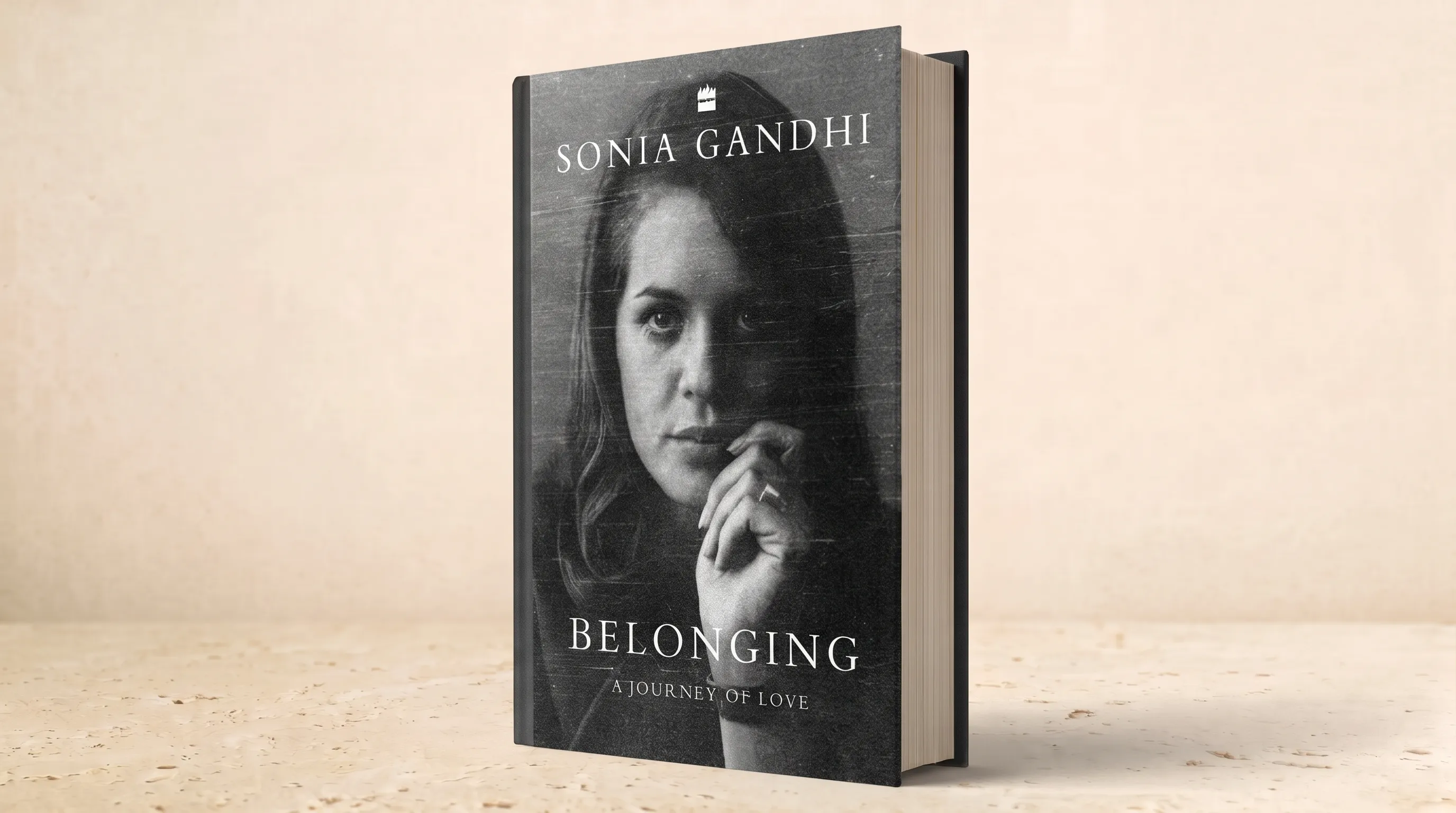
Sonia Gandhi recounts her personal journey from Italy to the centre of Indian politics in her memoir, Belonging: A Journey of Love.
A private person despite being a public figure, Sonia Gandhi tells her story publicly for the first time in her just-published memoir, Belonging. Not everyone agrees with everything she says – her political opponents certainly don’t – and her publishers could have done a better job of editing and fact-checking the manuscript. But the imperfections are minor compared to the rich material she has presented.
‘My parents, Stefano and Paolina Maino; my two sisters; and I were an ordinary middle-class family known only in Orbassano, a small town in the Torino province in the northern part of Italy,’ she writes. Her first twenty-one years, spent in Italy, have been the least known part of her life to anyone outside her family and close friends. This part of her tale therefore provides a better understanding of her. Besides, it is quite engrossing.
 Sonia Gandhi, photographed by her husband, Rajiv Gandhi.
Her father, a Second World War veteran, known to his comrades as ‘Maino il Leone – Maino the Lion’ – returned home from the Soviet front without a livelihood. From odd jobs to start with, he made his way up in the construction industry to establish his own business. But he was a disciplinarian who took time to reconcile himself to his second of three daughters’ relationship with Rajiv.
After meeting Rajiv while studying at a language school in Cambridge, Sonia disarmingly admits it was love at first sight. ‘My heart was pounding hard, so hard I was sure it could be heard. My face was on fire, my hand trembling as I extended it forward to him. Luminous, dark eyes, in a face of striking openness, met mine for the first time. “How do you do?” I replied. I knew, that very instant – it was un colpo di fulmine, a bolt of lightning.’
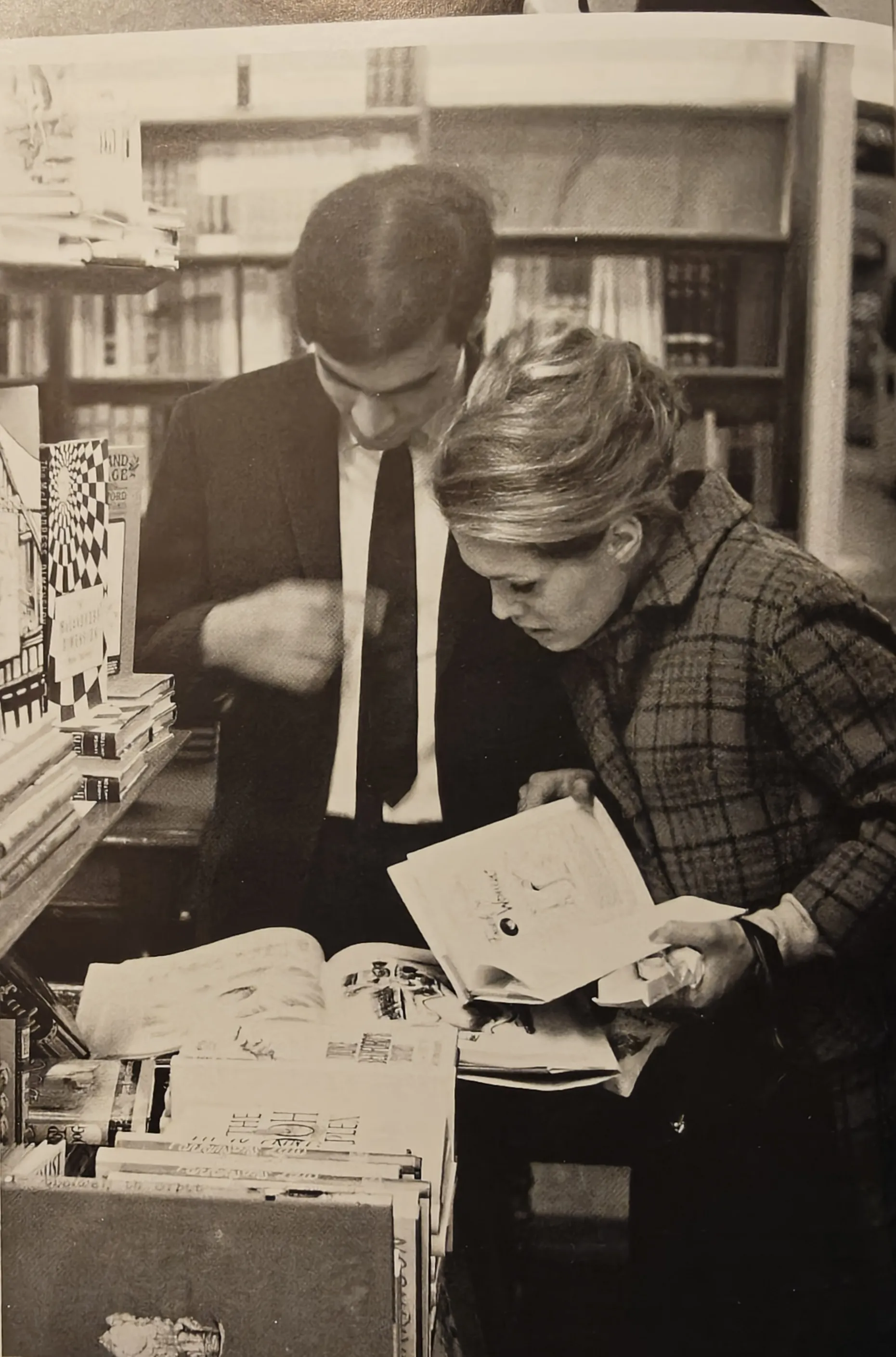 Rajiv Gandhi and Sonia Maino during their student days, shopping at the Harrods book department in London. Photo: Dilsher Virk, reproduced from Rajiv Gandhi: Son of a Dynasty by Nicholas Nugent
In India, she entered a joint family household headed by a formidable mother-in-law who was also prime minister of India. She was nearby at their shared home when Indira Gandhi was shot dead in 1984 by her Sikh security guards not long after the Indian Army had stormed the Golden Temple in Amritsar, Sikhdom’s holiest shrine, to evict militants demanding a separate Sikh homeland carved out of India.
To her credit, the chronicling of Indira’s controversial imposition of a state of emergency in India in 1975 is factual and fairly unbiased. Sonia accompanied Indira and Rajiv on numerous official tours of Asian countries. One such was to Kabul. She writes: ‘People were strikingly handsome; most of the women sported Western clothes and hairstyles, some wore waist-length chadors, and many were engaged in important occupations in universities, hospitals, and government departments.’ What a sea change has occurred since!
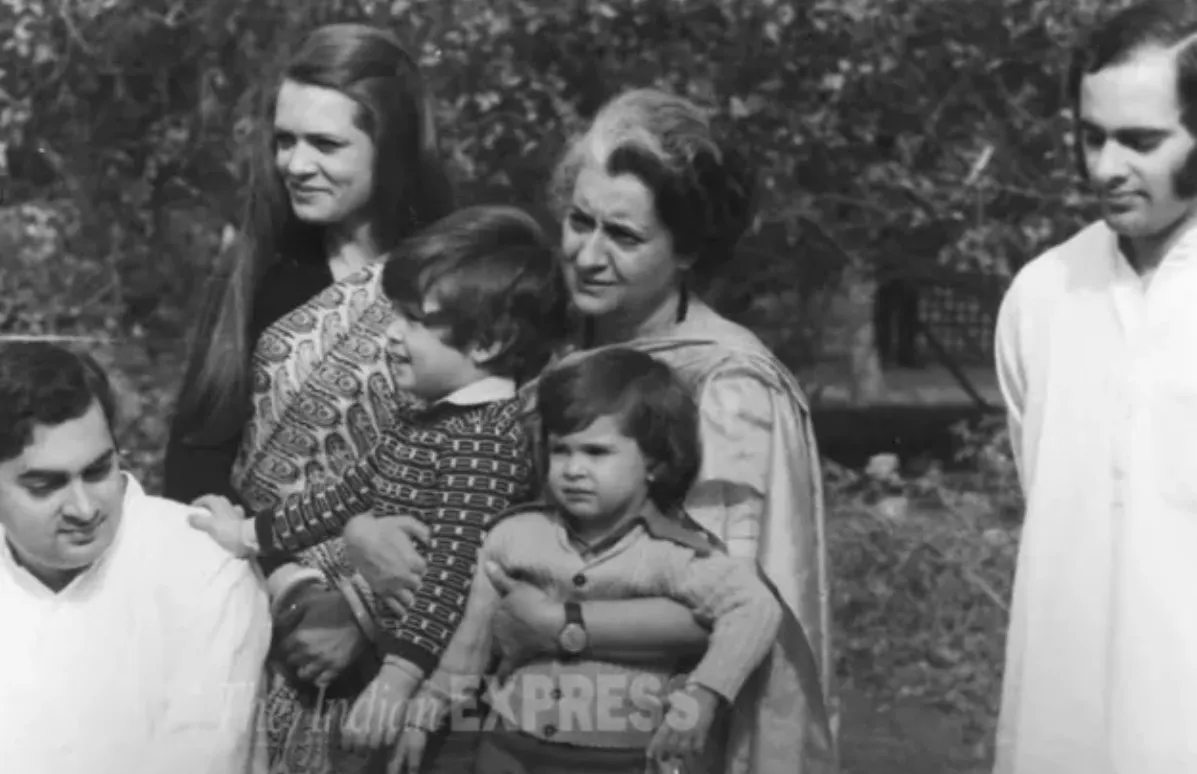 Indira Gandhi with her son Rajiv, daughter-in-law Sonia and grandchildren Rahul and Priyanka, alongside her younger son Sanjay. Photo: Express Archive
She went to China with Rajiv in 1988. ‘The high point of the visit was his meeting with President Deng Xiaoping. As both leaders reached the meeting spot, Deng held Rajiv’s hand for three minutes – a historic handshake, taken note of by the world. He welcomed Rajiv warmly, saying that the past (the state of freeze in relations between the two countries since the Sino-Indian war in 1962) ought to be forgotten…’
In 1989 the destination was Pakistan, where she and Rajiv met Benazir Bhutto and her husband. ‘The atmosphere was informal, as we were young and found much in common. I remember that, after a few friendly exchanges, whenever the discussion veered towards political matters, our host would increase the volume of the music playing in the background, thereby warning us that people were listening in to our conversation. Clearly there was an absence of trust between the newly elected leader and the military administration that had always run things in Pakistan.’
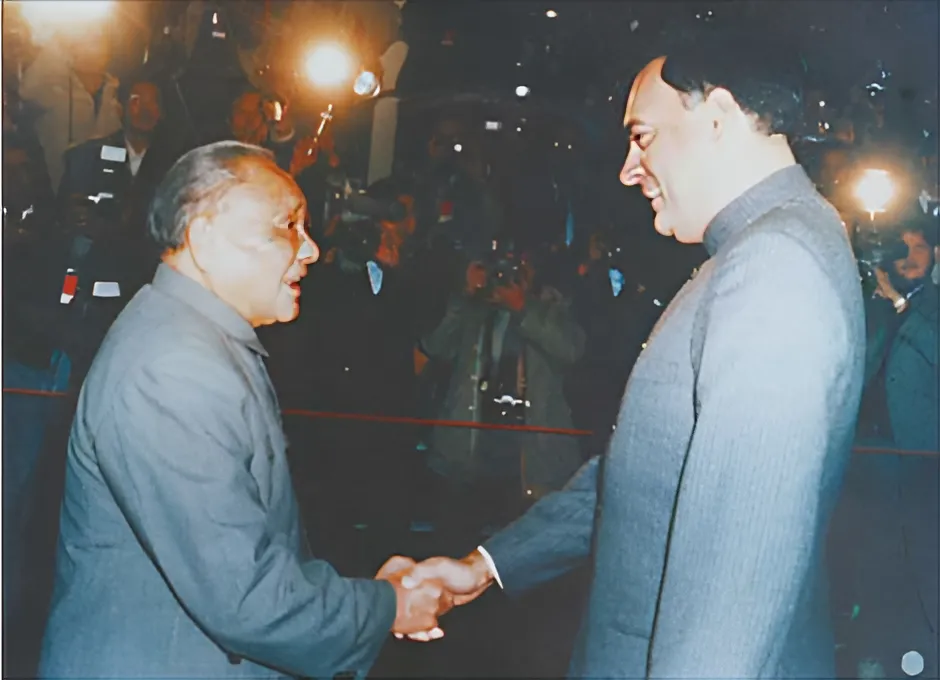 Chinese leader Deng Xiaoping receives Indian Prime Minister Rajiv Gandhi at the Great Hall of the People in Beijing on 21 December 1988. Photo: Chinese Ministry of Foreign Affairs
News of her beloved Rajiv’s death in 1991 was broken by her daughter Priyanka. ‘She stood in front of me in the half-lit room. “Papa is dead,” she said. I looked into her eyes, desperately hoping this was a nightmare from which I would awake. She looked back at me, her gaze piercing mine, mirroring my horror. I crumpled in my daughter’s arms.’
In 2004, an opposition alliance led by the Congress party, of which she was now president, surprisingly defeated the ruling coalition led by the Hindu nationalist Bharatiya Janata Party. She describes a meeting of the Congress parliamentary party: ‘I enter the hall to thunderous applause. The members of Parliament stand up in their places, thumping their palms on the wooden ledges in front of them… One of them reads out a speech imploring me once again to accept the post… I begin to read out my speech: “Throughout these past six years that I have been in politics, one thing has been clear to me. And that is, as I have often stated, that the post of prime minister is not my aim. I was always certain that if ever I found myself in the position that I am in today, I would follow my own inner voice. Today that voice tells me I must humbly decline this post.”’
Sonia ends the book with an epilogue reflecting on her life today. ‘I am now a member of Parliament on the Rajya Sabha, the Upper House of Parliament. Rahul [her son] is a four-term member of Parliament and leader of the opposition... Priyanka has been elected as the representative of Wayanad in Kerala... Both my son, now fifty-five years old, and my daughter, fifty-three, have been this year, together with their party colleagues and our allies, at the centre of a fight for the very essence of our democracy... In these eight decades of my life I have travelled through many worlds, experienced life in all its facets. I have felt overwhelming joy and lacerating sorrow, I have encountered honesty and deceit, I've experienced kindness and cruelty. Yet through the traumas and difficulties I faced along the way, I have been sustained by love...’