Throughout Asia, Myanmar is the country whose government controls the least of its terrain, probably barely more than 60 per cent. Yet neighbouring governments of India, China and Thailand, tired of waiting for peace to break out, are negotiating with the newly civilianised government to establish crucial trade routes across Myanmar’s territory. Nyein Chan Aye questions whether this approach can succeed.
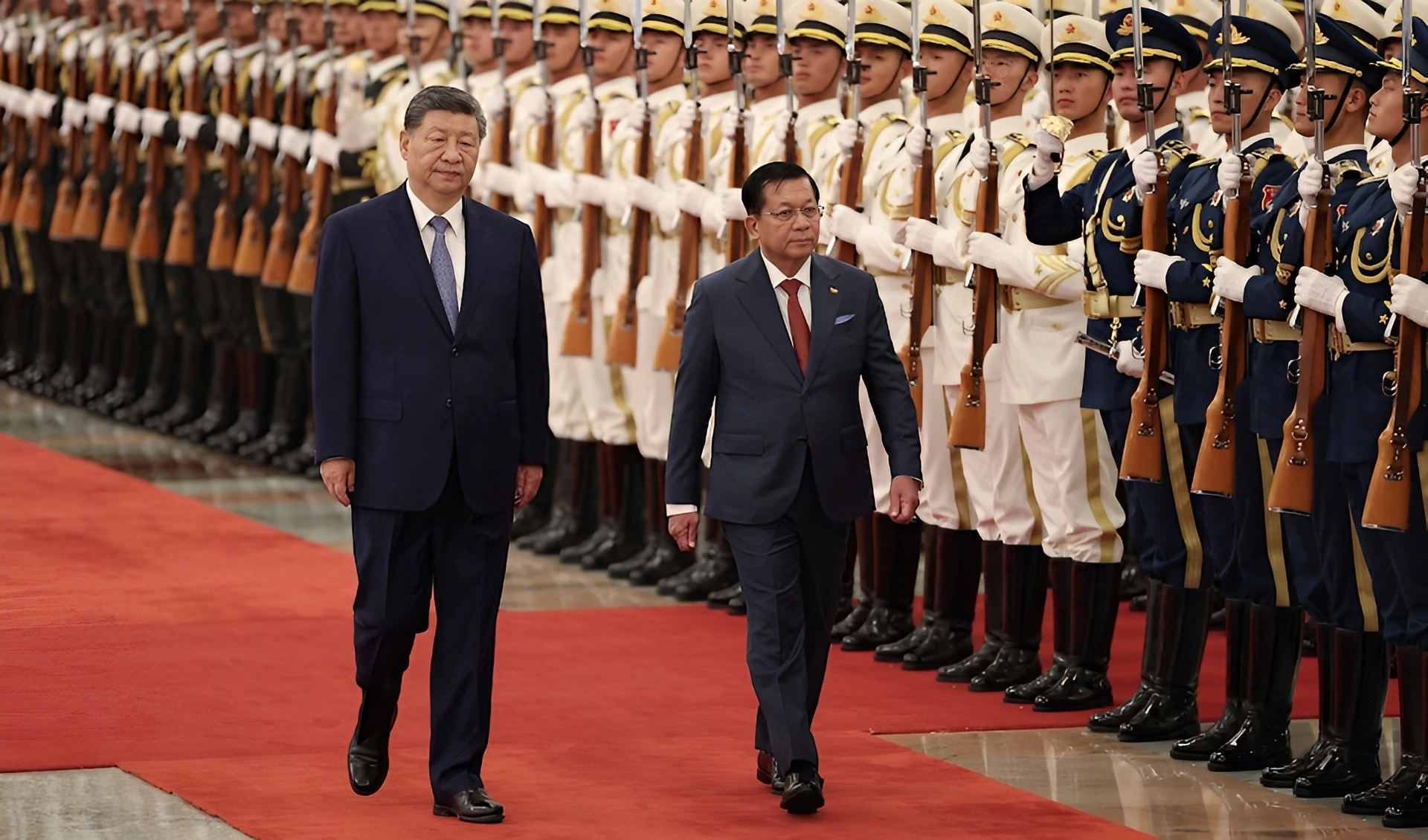
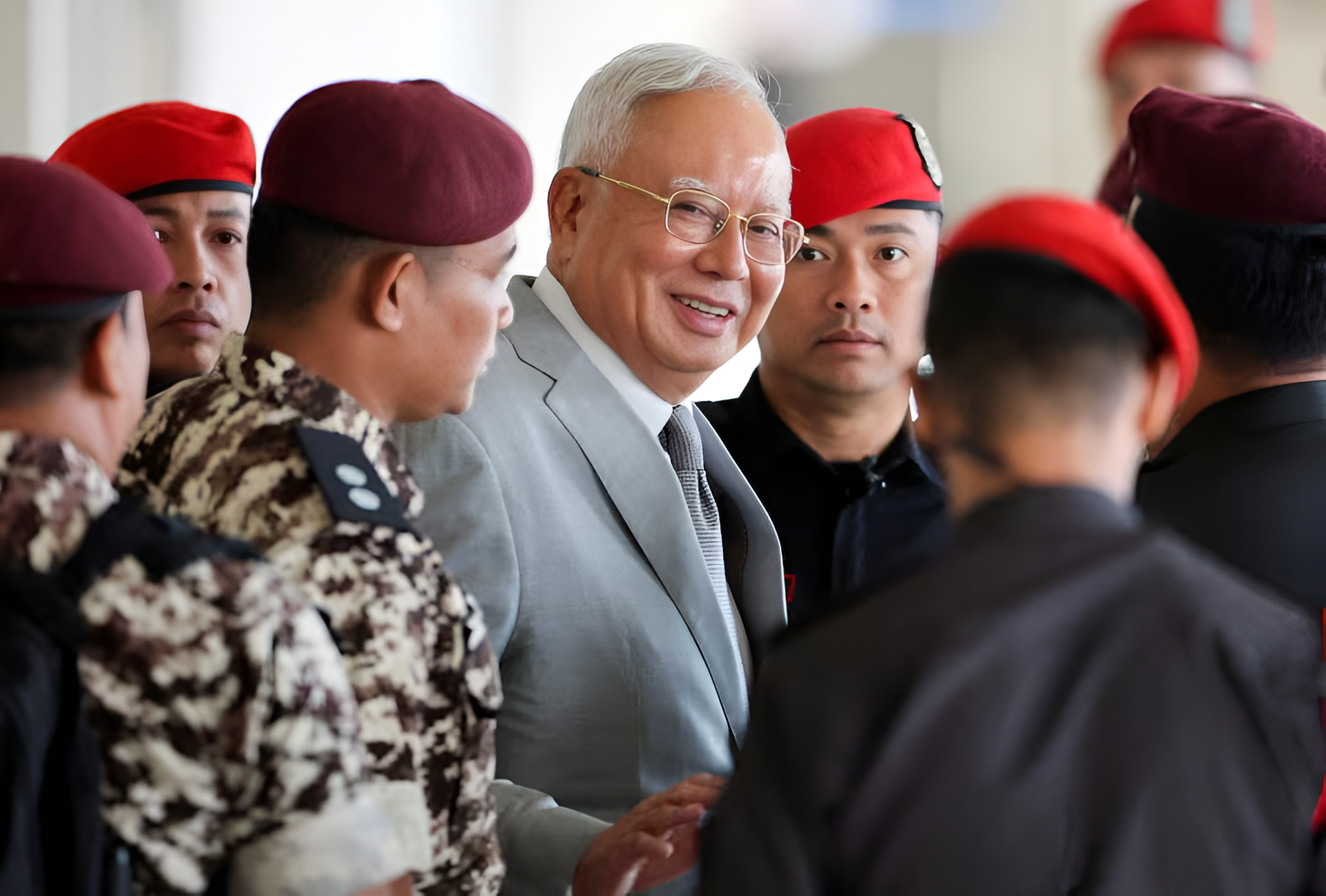
President Xi Jinping welcomes Myanmar's President Min Aung Hlaing in Beijing, reflecting regional efforts to secure strategic interests despite Myanmar's ongoing conflict. Photo: Lintao Zhang/Reuters
Regional powers are restoring ties with Myanmar’s military-backed government to secure strategic corridors. Yet many of those routes run through territory controlled or contested by ethnic armed groups and resistance forces. Five years after the coup, Myanmar's war has killed more than 100,000 people, according to a conflict monitor, ACLED, while the general whose takeover triggered it has swapped his uniform for a civilian jacket. The neighbours have responded in kind.
India hosted the coup leader Min Aung Hlaing in May on his first foreign trip since becoming president, and China accorded him a five-day state visit in June. In early July, he received a state welcome in Laos on his first presidential visit to an ASEAN member state. Later that month, ASEAN foreign ministers met their Myanmar counterpart before the bloc’s envoy held talks in Thailand with ethnic armed groups and a military-backed negotiation committee.
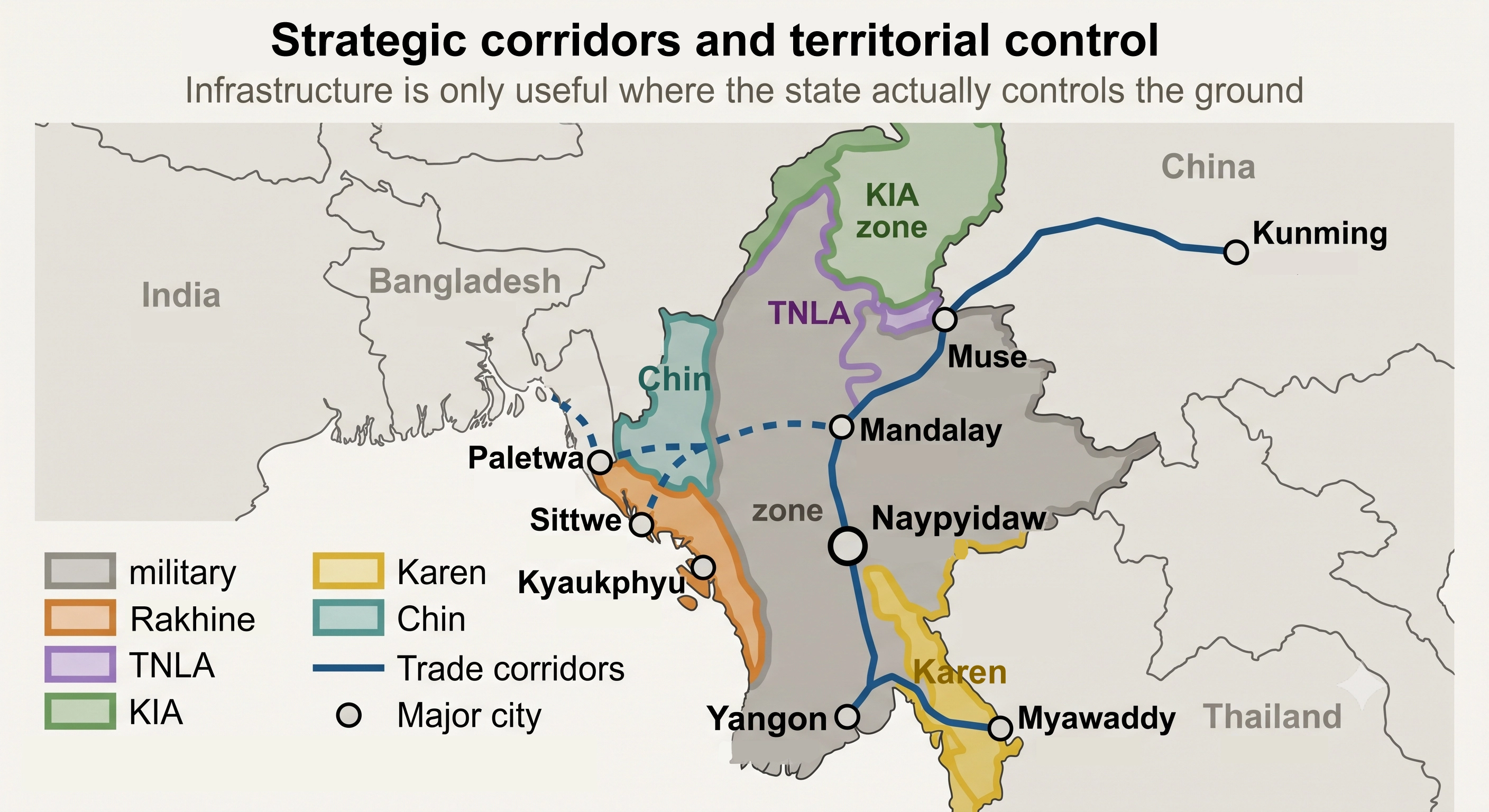 Strategic transport corridors through Myanmar and the shifting territorial control that complicates regional connectivity projects. Map illustration created by Democracy Asia
Read quickly, this looks like a state returning to regional business. Read closely, it is something stranger: regional powers are negotiating with the regime over roads, pipelines and border gates that it increasingly cannot secure on its own. The contradiction was on display in July, when Min Aung Hlaing pledged to complete India’s Kaladan corridor, the India–Myanmar–Thailand trilateral highway, and to advance the China–Myanmar Economic Corridor. Kaladan is intended to connect India’s landlocked northeast to the Bay of Bengal. The trilateral highway would link India to Thailand through Myanmar, while the China–Myanmar economic corridor would connect Yunnan to the Indian Ocean. Construction, he told his ministers, should begin once security is established along the routes. Security is not a footnote to these projects; it is the whole question.
The limits of formal authority
‘Control is often difficult to assess in Myanmar,’ said Thomas Kean, senior consultant at the International Crisis Group. The military still controls many cities and important highways, but trade follows a different map. ‘Most of the country’s borderlands—the areas adjacent to Bangladesh, India, China, Laos and Thailand – are under the control of ethnic armed groups,’ Kean said, adding that they ‘often have a firm grip over many of the key trade routes and border gates.'
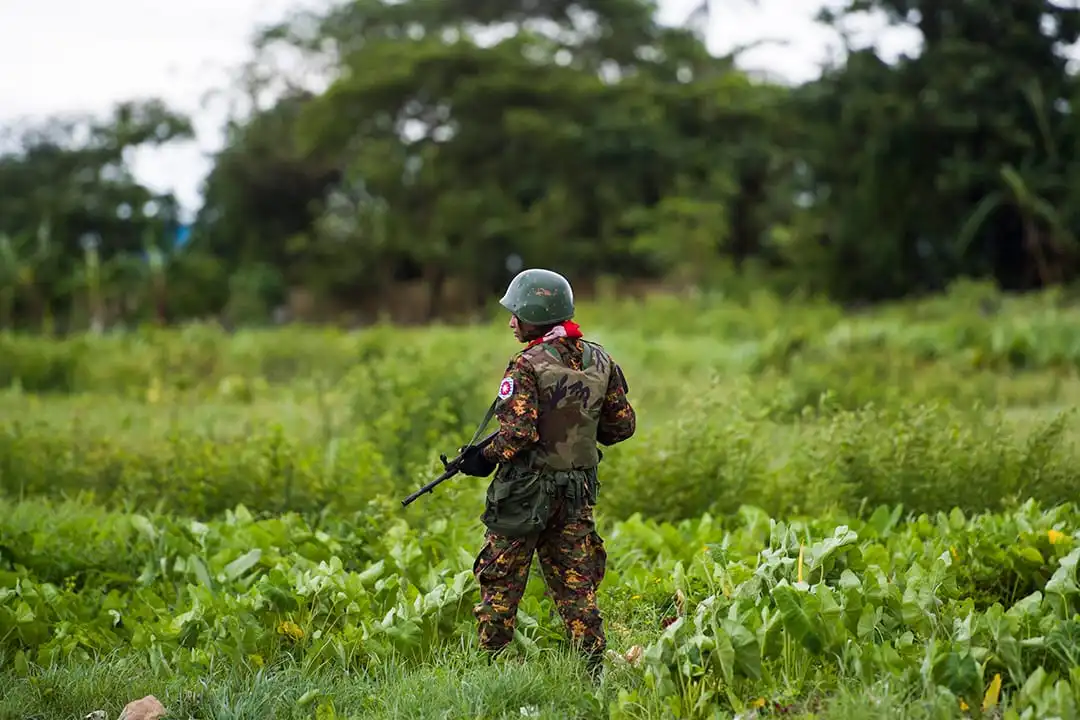 Arakan Army fighters operate in Rakhine State, where resistance forces control much of the territory surrounding key infrastructure projects. Photo: Collected
Significant sections of the oil and gas pipelines running from Kyaukphyu to Kunming pass through territory controlled by the Arakan Army (AA) and the Ta’ang National Liberation Army. Despite the military expending enormous effort to control the Mandalay–Lashio highway on the route to China and the Kawkareik–Myawaddy road to Thailand, Kean noted that 'formal trade is yet to resume’ because armed groups still hold sections of the corridors.
Aung Thu Nyein, a director at the Institute for Strategy and Policy–Myanmar, characterizes the war as a ‘strategic stalemate’. The military has adapted, conscripted new troops and retaken some territory, but ISP–Myanmar estimates that ethnic armed organizations (EAOs) and resistance forces still hold roughly 38 percent of the country’s territory.
‘Completely wiping out the EAOs and resistance forces remains a tall order,’ he said. He expects ‘guerrilla warfare, small-scale skirmishes and wars of attrition’ alongside a ‘coercive push to negotiation' intended to force opponents to the table.
The state retains ministries, a central bank, the air force and control over large cities—what Aung Thu Nyein describes as its 'incumbent advantages.' But formal authority diverges sharply from secure access. As Kean explained, ‘even if a corridor comes back under military control, it is not difficult for ethnic armed groups to carry out attacks to disrupt traffic.'
Who controls the corridors?
Rakhine State shows this new geography most clearly. Kean estimates that the Arakan Army controls about 90 percent of the state, while the military holds three small pockets: Sittwe, Kyaukphyu and Manaung. Kyaukphyu anchors China’s oil and gas pipelines and planned deep-sea port; Sittwe is the maritime terminus of India’s Kaladan project. ‘The Arakan Army does not seem to be able to dislodge the military, but Naypyitaw also seems unable to retake much or any of the ground it has lost,’ Kean said.
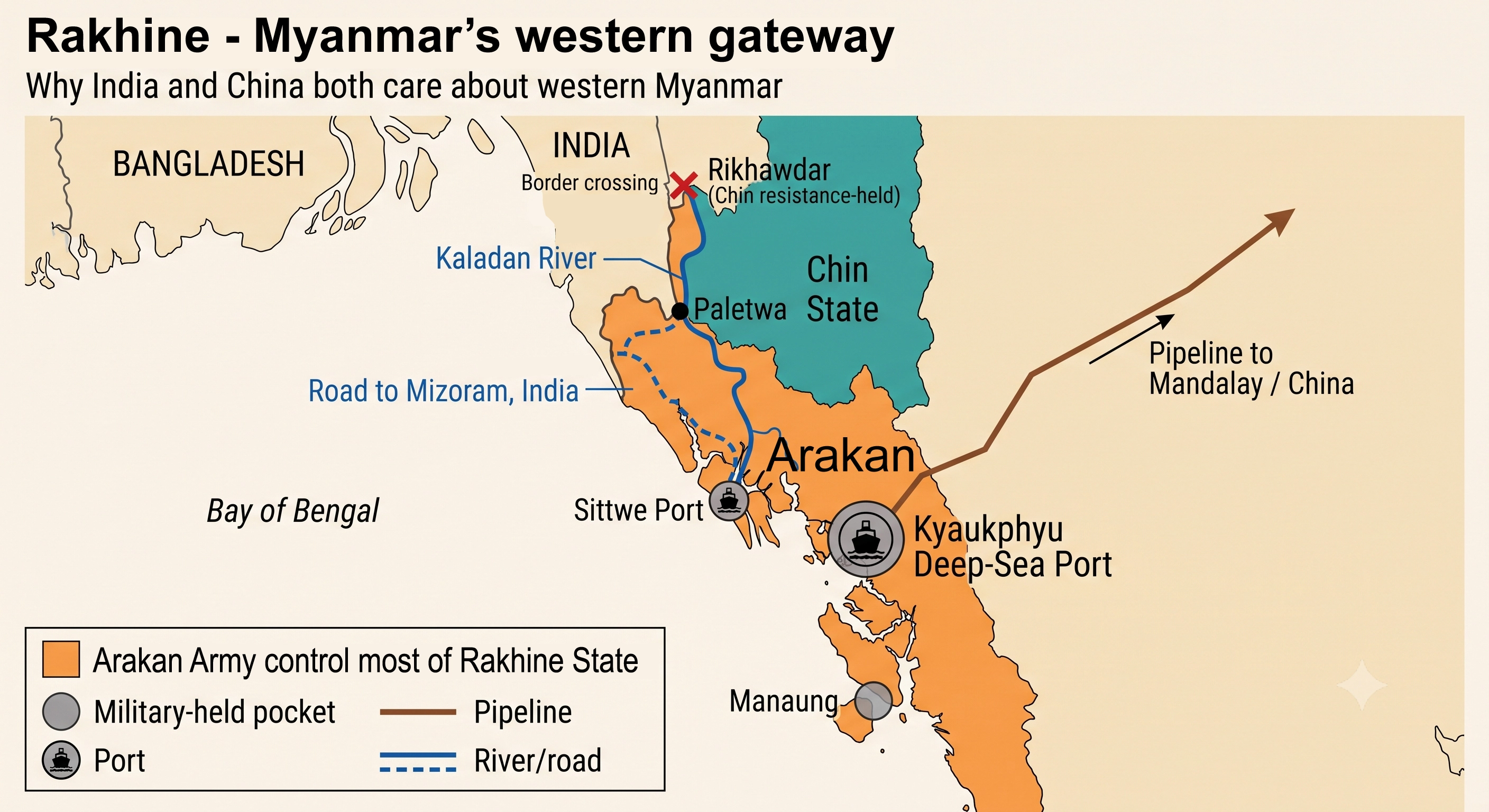 Rakhine State has become a strategic gateway for Chinese and Indian infrastructure projects, despite continuing conflict. Map illustration created by Democracy Asia
Local residents describe fierce fighting concentrated on the approaches into Rakhine. The military relies heavily on air power as it tries to reopen land access and cut the AA’s supply lines. A Kyaukphyu resident, requesting anonymity for security reasons, said natural gas extraction and transmission to Yunnan ‘have never stopped’ and operations remain normal. The resident said armed Chinese security personnel were seen at pipeline facilities in 2025 and later relocated to Maday Island as AA forces advanced. The resident also believed Chinese pressure prompted the AA to pull back from areas near the facilities.
The pipeline’s continued operation suggests that Beijing protects strategic assets through pressure and contact with multiple authorities. ‘China’s policy is primarily access-based,’ said Aung Thura Ko Ko, a visiting scholar with Cornell University’s South East Asia Program. ‘Beijing works with whoever can protect its interests on the ground.’
China formally backs Min Aung Hlaing’s administration, but it ‘cannot simply order the AA to stop fighting or surrender its gains’, he added. Kean described Beijing as ‘essentially trying to establish a balance of power between Naypyitaw and ethnic armed groups’.
India is adjusting more slowly. Official Kaladan contracts remain in Naypyitaw, giving New Delhi a reason to deal with the central administration. ‘Does India worry about its interests being harmed in Myanmar? Yes,’ said Salai Dokhar, founder of the civil society group India for Myanmar. ‘Do they desperately want to reduce Chinese influence? Absolutely. But have they formulated a clear policy? No.’
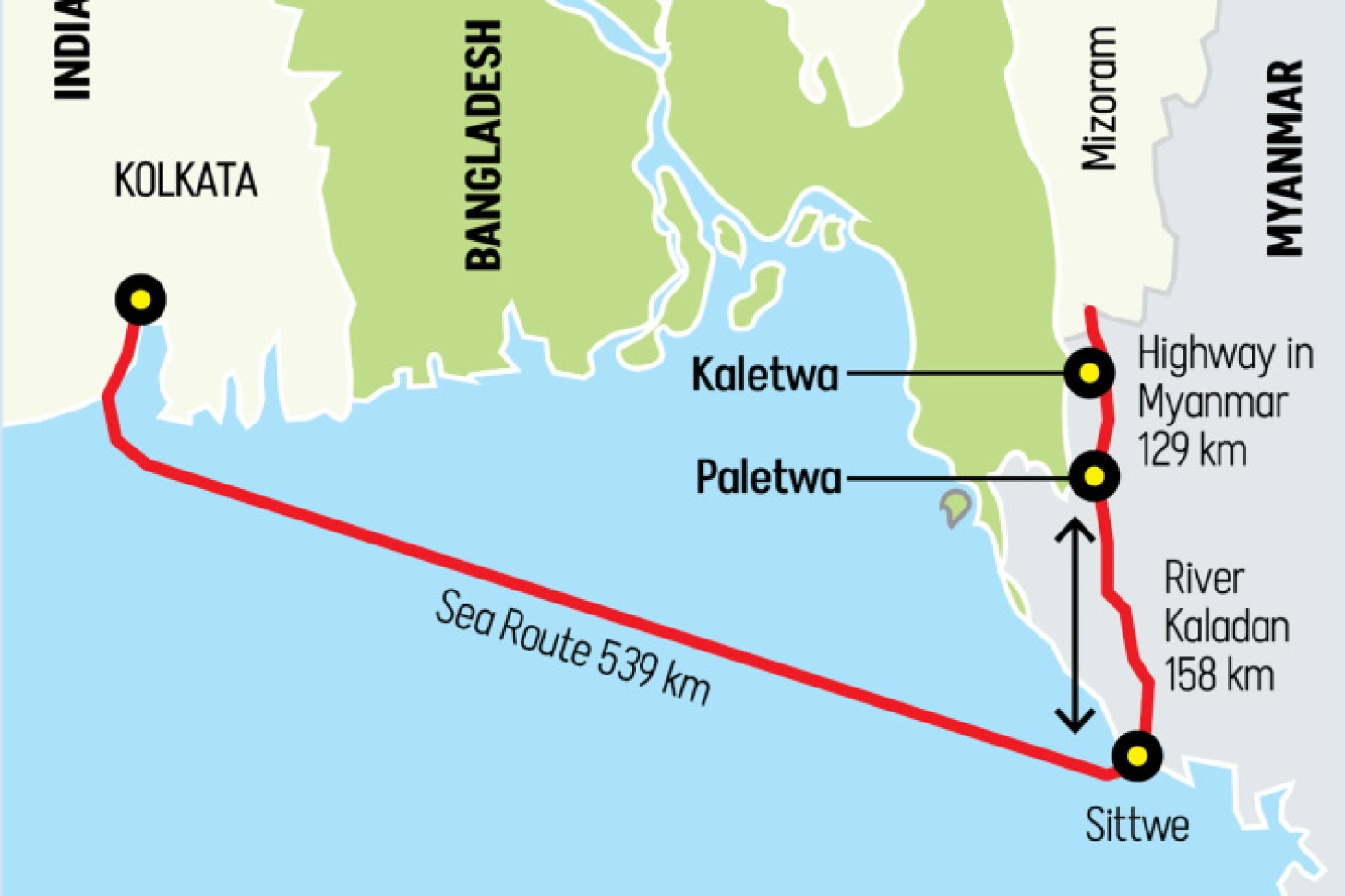 India's Kaladan Multi-Modal Transit Project is intended to connect its northeastern states to the Bay of Bengal through Myanmar. Map illustration created by Democracy Asia
Dokhar said Indian agencies meet ethnic and resistance representatives, but their contacts remain fragmented and focused on specific border or project concerns rather than a coherent Myanmar policy. Aung Thura Ko Ko put New Delhi’s choice plainly: ‘The real choice is between adapting to the new power reality or losing strategic influence in western Myanmar.’
The same access gap extends north into Chin State. The military retook Falam, a strategically important northern Chin town where Chin State’s first airport is located. But local residents say military control does not extend across the surrounding township and that the airport remains too insecure to reopen.
The Rikhawdar–Tedim corridor to India’s Mizoram State remains in resistance hands. ‘There will be times when the military controls certain areas and other times when Chin revolutionary forces take them back,’ said Salai Jacob Thang, who provides technical support to elected Chin lawmakers and resistance institutions. ‘I believe territorial control will continue to shift back and forth.’
Min Aung Hlaing’s diplomatic comeback is real. His administration can sign agreements, issue contracts and deploy devastating forces. But his neighbours are hedging in plain sight—courting Myanmar’s junta chief-turned-president, while maintaining channels with the ethnic armed groups that sit astride his promised corridors. Formal authority remains concentrated in Naypyitaw, while access is negotiated on mountain roads, river ports and pipeline routes far beyond its reliable control.
As Aung Thura Ko Ko put it: ‘The military government can still destroy, but its ability to govern and hold territory is far more limited.’