Myanmar is again the world’s largest illicit opium producer, but a far larger illicit business is industrial-scale methamphetamine – made in Myanmar’s war-torn borderlands and sold across Asia. Myanmar’s drug economy has gone synthetic, as Nyein Chan Aye reports.
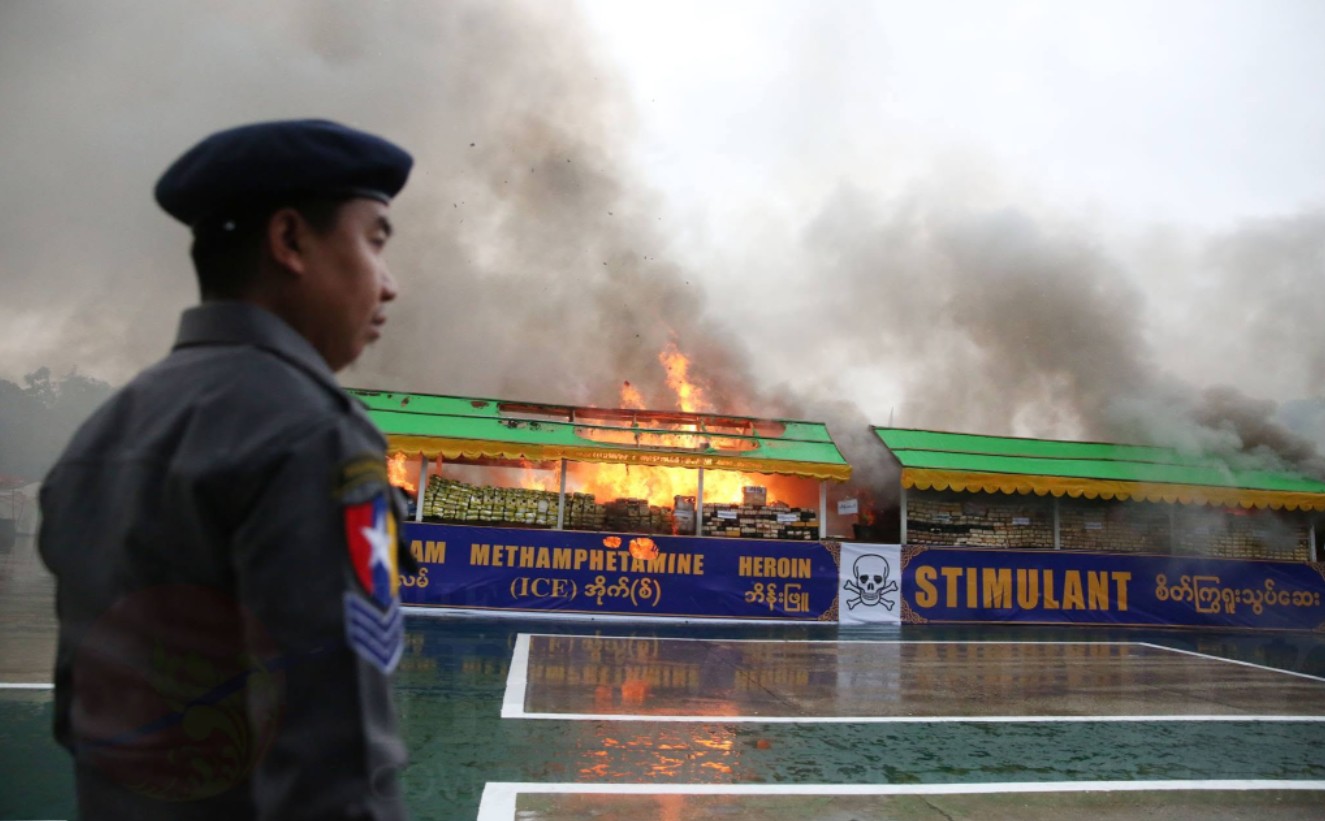
Myanmar authorities destroy seized narcotics, as the country’s illicit drug economy expands beyond opium into synthetic drugs. Photo: Myo Min Soe and Zaw Zaw/The Irrawaddy
Myanmar is again the world’s largest illicit opium producer, but a far larger illicit business is industrial-scale methamphetamine – made in Myanmar’s war-torn borderlands and sold across Asia. Myanmar’s drug economy has gone synthetic, as Nyein Chan Aye reports.
In Yangon, a man in his 50s who asked not to be named, said yaba – cheap methamphetamine tablets – has become ‘practically everywhere’ and much cheaper. On a recent trip to Shan State, he said he saw stimulant tablets being pressed inside homes using small, makeshift machines. The Institute for Strategy and Policy–Myanmar reported a similar trend in February, saying small pill presses allow tablets to be made ‘on the spot’ as production technology becomes more accessible.
That street-level abundance reflects a wider transformation. Alastair MacBeath, Southeast Asia coordinator at the Global Initiative Against Transnational Organized Crime, placed Myanmar among the world’s main methamphetamine centres. ‘Myanmar is certainly one of the largest, if not the largest, synthetic meth producers globally,’ he said. He described the market as ‘a massive generator of wealth’ that is ‘completely integrated into governance systems’.
Meth at scale
Regional methamphetamine seizures reached a record 349 tonnes in 2025, up 48 per cent in a year and more than five times the amount seized a decade earlier. Price trends also point to abundant supply: the United Nations Office on Drugs and Crime (UNODC) recorded Myanmar as the region’s cheapest crystal-meth market in 2024, at about US$6 a gram.
Patrick Winn, author of Narcotopia, said the economics favour synthetics. ‘From satellites, a methamphetamine lab can look like a barn or a school or anything else,’ he said. ‘Synthetics – namely methamphetamine – are the powerhouse pillar of the narcotics economy in Myanmar and Asia writ large.’
Chemicals and landlords
The industry depends on chemicals moving across borders. MacBeath said producers have shifted from tightly controlled ephedrine and pseudoephedrine towards pre-precursors, many with legitimate industrial uses.
Winn said he has seen no evidence of Chinese state involvement in precursor trafficking, but called Chinese commercial supply essential. ‘Point blank, period: without chemicals coming from China, from China’s huge pharmaceutical industrial sector, the narcotics economy in Myanmar would shrivel up within a few months. It absolutely relies on these chemicals.’
Beijing imposed licensing controls on additional chemicals bound for Myanmar, Laos and Afghanistan in 2024. India is another source: MacBeath described diverted pharmaceutical chemicals moving from the Indian state of Mizoram through Myanmar’s Chin State to Shan State. UNODC has also documented increased chemical seizures along the India-Myanmar border.
Both MacBeath and Winn described a ‘landlord’ model in parts of Shan State: professional criminal groups run laboratories, while territorial authorities provide space and protection in exchange for rents or taxes. ‘The armed group that controls the territory is not the main force manufacturing the drugs,’ Winn said. ‘What they are is landlords.’
MacBeath described the military’s role as more indirect, citing revenues from drugs crossing military-controlled checkpoints and possible precursor facilitation by people within the military-government structure. ‘They are, but how they’re involved is quite complex, and it’s people within the military structure that are benefiting,’ he said, while cautioning that firm evidence is difficult to establish.
Winn said military-aligned People’s Militia Forces and some Border Guard Forces have long been allowed to finance themselves through illicit economies in exchange for loyalty. UNODC has also found industrial drug laboratories and scam centres operating side by side in Myanmar, sharing protection, logistics and financial networks.
Meth across Asia
From Myanmar, drugs move through Thailand and Laos, west towards Bangladesh and India, and through Malaysia and Indonesia. MacBeath called Australia and New Zealand ‘the prize’ because prices there are ‘astronomical’. Bangladesh, Winn said, has become an important market for cheaper yaba.
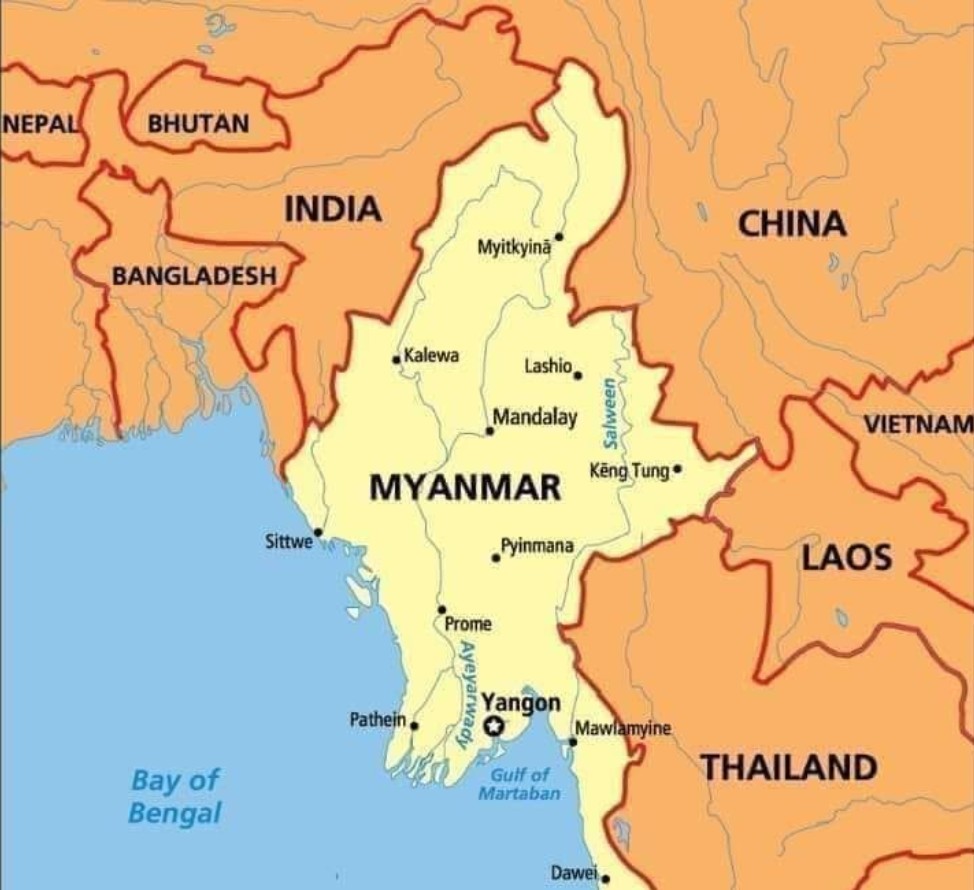
Myanmar and its neighbours, through which its synthetic
drugs reach markets across Asia. Map: ASEAN urbanist
The authorities and armed organisations also publicise anti-drug efforts. In June, Myanmar authorities destroyed more than US$600 million worth of seized narcotics. The United Wa State Army, an anti-government militia dominant in north-eastern Myanmar, cites its 2005 drug ban and describes its territory as drug-free. Its spokesman Nyi Rang did not respond to Democracy Asia’s request for comment on experts’ descriptions of protection arrangements in Wa-controlled areas.
In September, the Trump administration listed Myanmar among 23 major drug-transit or illicit drug-producing countries for fiscal 2027 and among four deemed to have ‘failed demonstrably’ to meet international counternarcotics obligations.
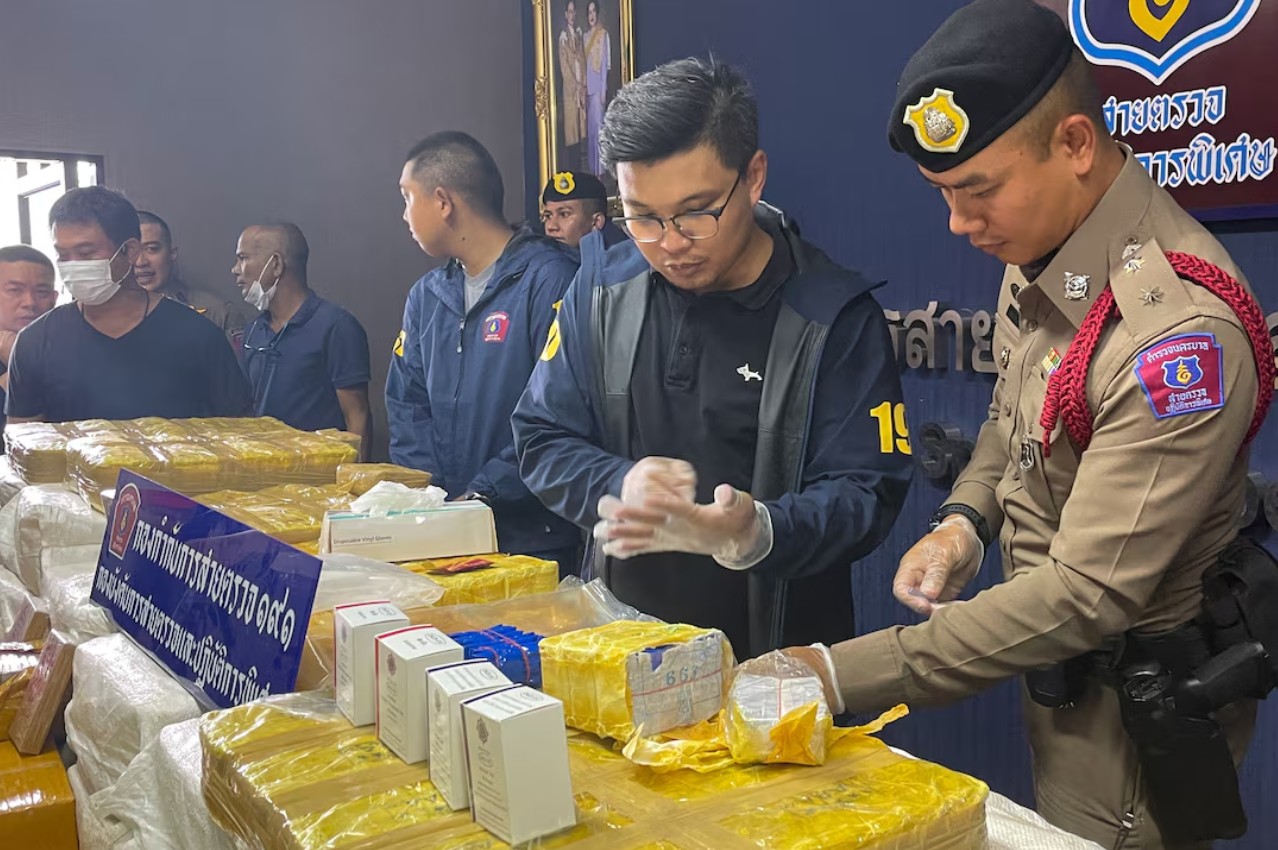
Thai police examine seized drugs in Bangkok, highlighting
the wider regional context of Myanmar’s synthetic-drug
trade. Photo: Reuters/Artorn Pookasook
What the coup changed
Myanmar’s industrial meth trade predates the 2021 coup. A 2026 study by the Global Initiative Against Transnational Organized Crime found a long-term upward trajectory before and after the takeover, driven by improvements in synthesis, management and trafficking rather than a sudden post-coup production surge.
Opium, however, has resurged alongside the boom in synthetics. UNODC estimates cultivation rose 17 per cent in 2025 to 53,100 hectares, a decade high, with Shan State accounting for 88 per cent. Potential production reached about 1,010 tonnes and the gross opiate economy was valued at US$1.05 billion. Winn linked the revival partly to worsening rural poverty, saying more families have turned to ‘the most profitable crop’ available.
In Myitkyina, northern Myanmar, a former heroin user said a bottle of heroin that cost K50,000 when he was a student now sells for about K10,000 – roughly US$2.50 at K4,000 to the dollar, and less than a litre of petrol. ‘Drugs are the only thing I’ve ever seen where the price actually plummets,’ he said.
An aid worker said HIV positivity among detox clients tested there had risen from roughly one in ten to one in two – not a national estimate. Another described private ‘High Rooms’ for drug parties becoming routine in Yangon, Mandalay and the capital, Naypyidaw.
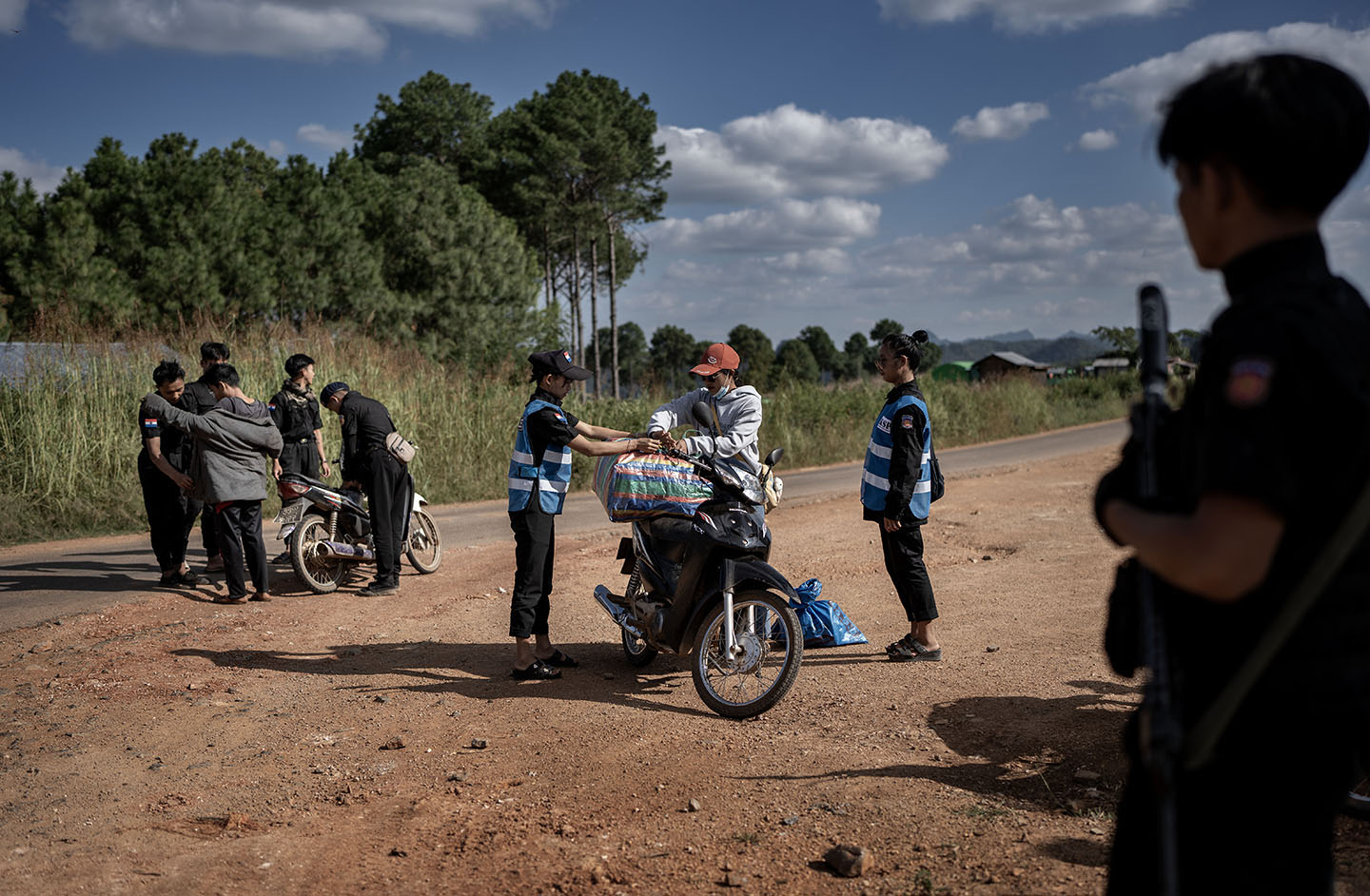
Members of the Karenni State Police search travellers for yaba, a type of methamphetamine, at a checkpoint in southern Shan State, Myanmar. Photo: Gemunu Amarasinghe/RFA
Back in Myitkyina, close to some of northern Myanmar’s heaviest fighting, the same man said military authorities restrict basic goods while police outposts operate in every ward.
‘While people get arrested for transporting cement or oil, nobody gets arrested for dealing or transporting drugs. There is absolutely no way these drugs are moving around without the authorities turning a blind eye.’
According to MacBeath, illicit economies are ‘very much integrated into the politics and the conflict and the peacebuilding side’, rooted in the ‘ceasefire capitalism’ of earlier decades. Any future peace process, he argued, will have to confront them.
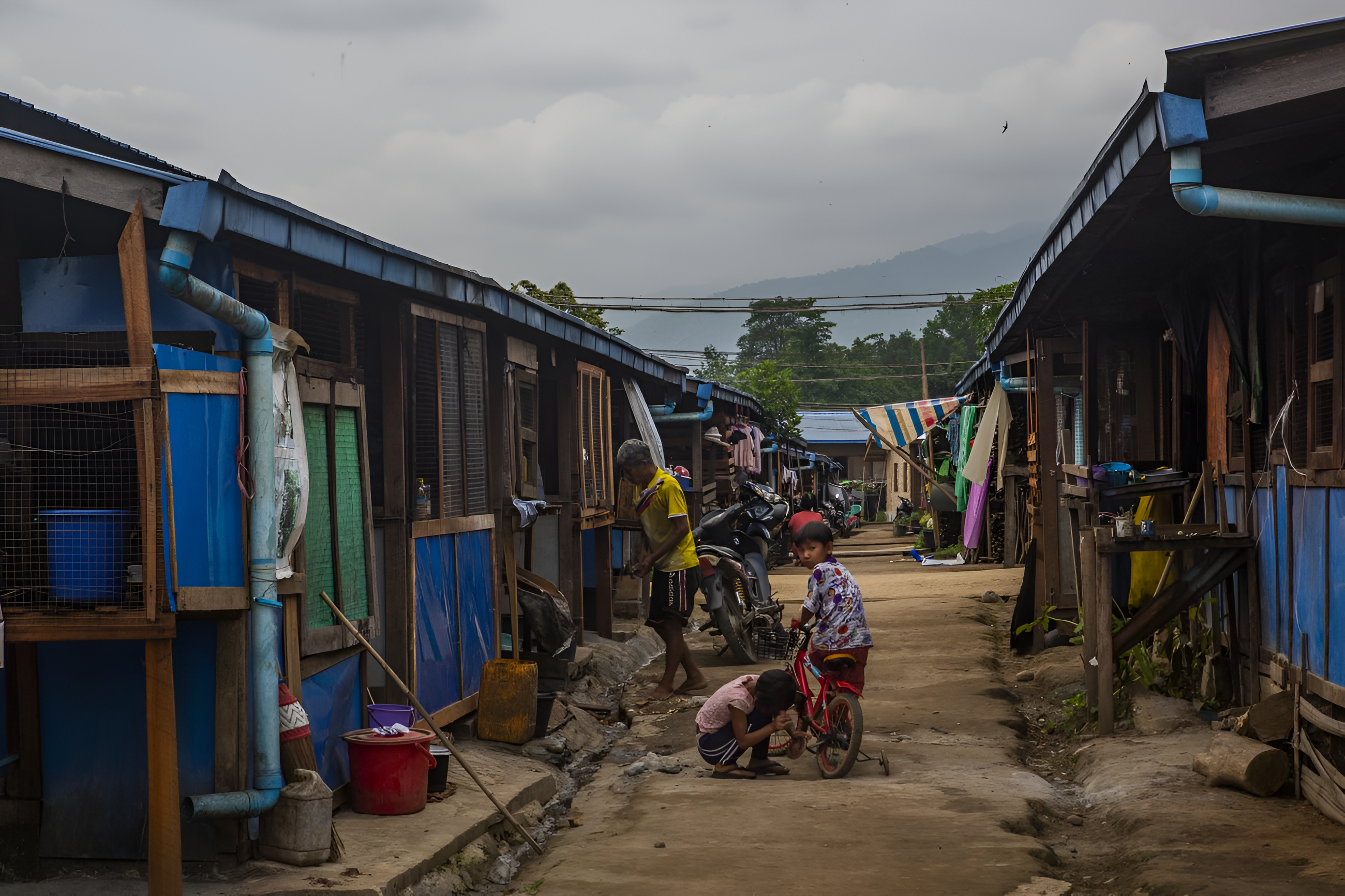 Children play at a camp for internally displaced people in
Myitkyina, Kachin State, where conflict continues to disrupt
everyday life. Photo: Nyan Zay Htet/UNICEF
Nor Does he expect synthetic drugs to become easier to contain. ‘Unlike opium and cocaine, which are crop-based, synthetics can be produced anywhere and they can be integrated into anything,’ MacBeath said. The response, he argued, requires more than seizures: tighter precursor controls, action against underground banking and cryptocurrency platforms, and better tracking of shifting routes.
‘The threat that’s coming out of Myanmar – be it scams, drugs, human trafficking – goes across the world,’ he said. The response, he added, needs ‘a very clear-headed reset’ at the policy level.