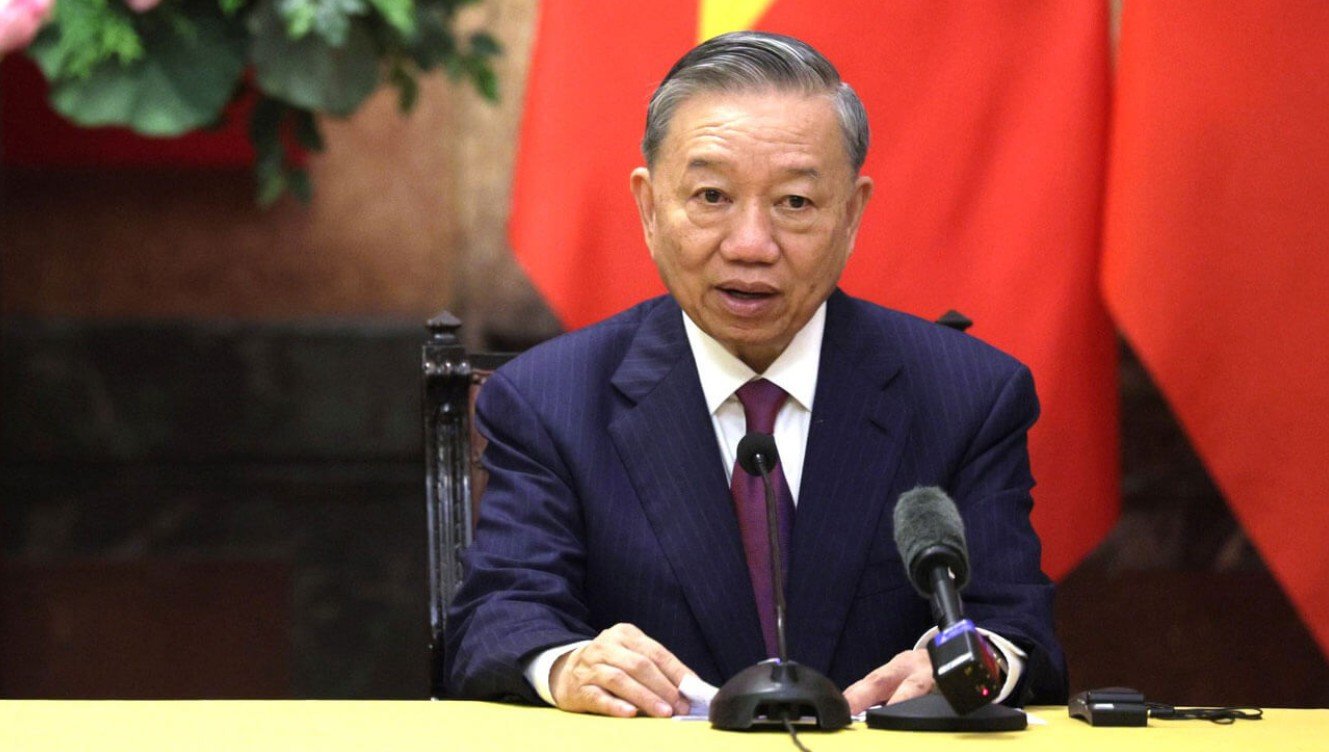
Hu Anyan’s I Deliver Parcels in Beijing, translated by Jack Hargreaves and published in the UK by Penguin Books, offers an intimate account of China’s low-paid and precarious workforce. Drawing on more than two decades of experience in nineteen jobs across six cities, Hu brings the life of a Beijing courier vividly into view, revealing the pressures of algorithms, targets, customer demands and the hukou system. His memoir also speaks to the wider question of dignity and freedom at work. The book is reviewed here by Lijia Zhang, herself a chronicler of ordinary working life in China.
Hu Anyan’s memoir offers an intimate account of life as a parcel courier in Beijing and the struggle for dignity in precarious work.
I read the first six chapters of Hu Anyan’s I Deliver Parcels in Beijing in one sitting. The book has the compelling force of lived experience. Hu does not write from a comfortable distance about China’s low-paid workers: over two decades, he held nineteen jobs in six cities, working as a petrol-station attendant, shop assistant, security guard, night-shift warehouse sorter and, most memorably, a courier delivering parcels in Beijing. His story gives a face to the anonymous figure who appears at our door, hands over a package and hurries away.
Much of the book concerns Hu’s time as a courier in the capital around 2018 and 2019. His working days stretched to twelve hours, with another parcel to deliver every few minutes. He negotiated construction sites, confusing addresses, broken electric-bike batteries, traffic and fierce competition among colleagues. The body itself became an obstacle to efficiency. ‘I sweated so much I never needed to pee,’ he observes. The sentence is funny, but only for a moment. Behind it lies a system in which even drinking water or going to the lavatory can cost a worker money.
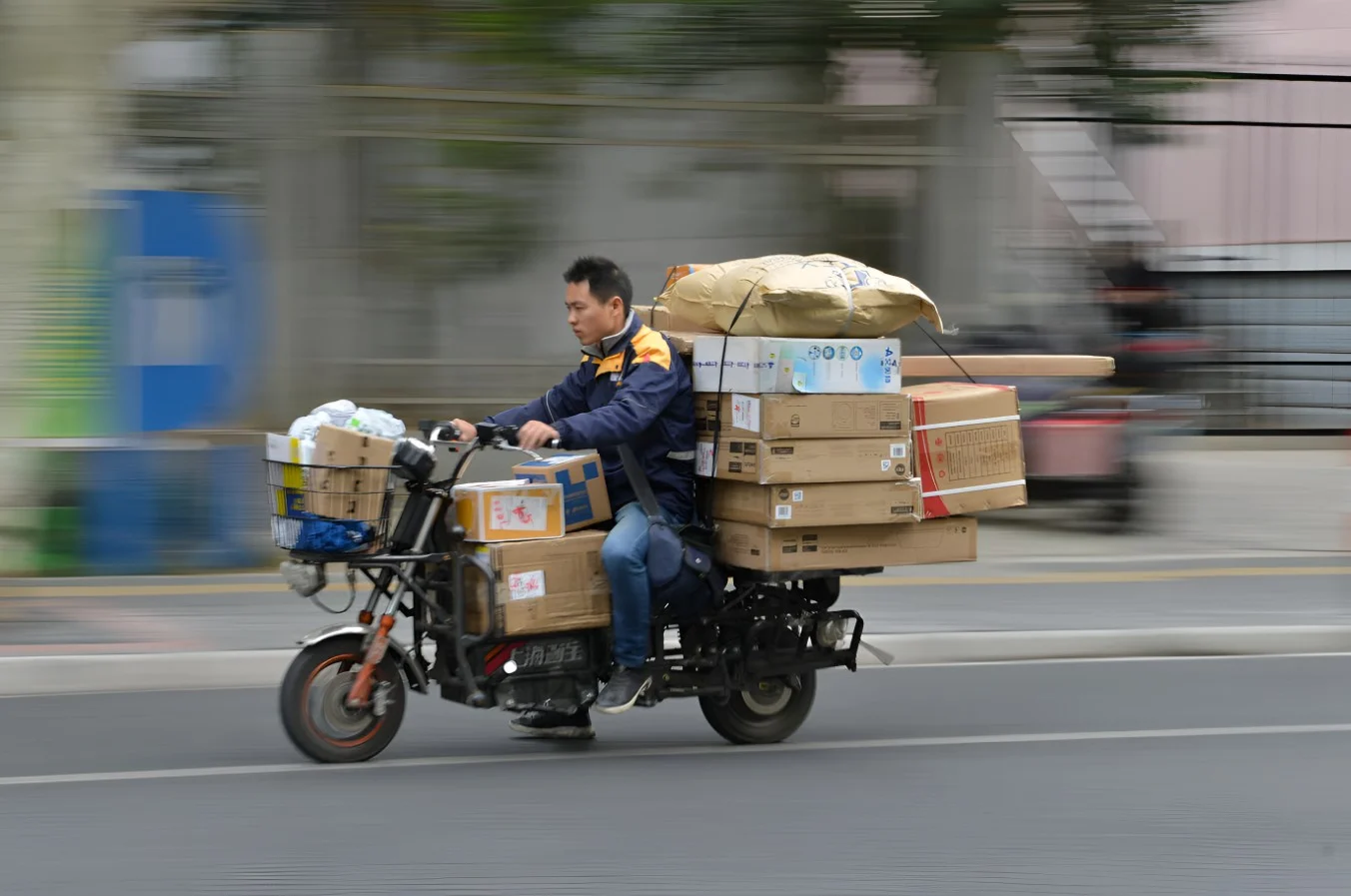 A courier races through Beijing, part of the vast workforce
delivering parcels across China’s cities. Photo: Chang Tian
A courier races through Beijing, part of the vast workforce
delivering parcels across China’s cities. Photo: Chang Tian
I knew delivery work was hard, but not how exhausting and humiliating it could be. Hu’s reflective, often deadpan accumulation of detail makes his argument. Customers sometimes treat couriers with startling contempt. One accuses him of stealing a parcel although a photograph shows that he left it in the designated locker. While the company ‘investigates’, it deducts the item’s value from his wages.
This is the contradiction at the heart of China’s ‘gig’ economy. It promises flexibility, yet couriers and delivery riders are controlled by targets, ratings, fines and algorithms. The boss may be invisible, but his authority is everywhere. Hu puts the paradox memorably: ‘Time is money, but money also devours time.’
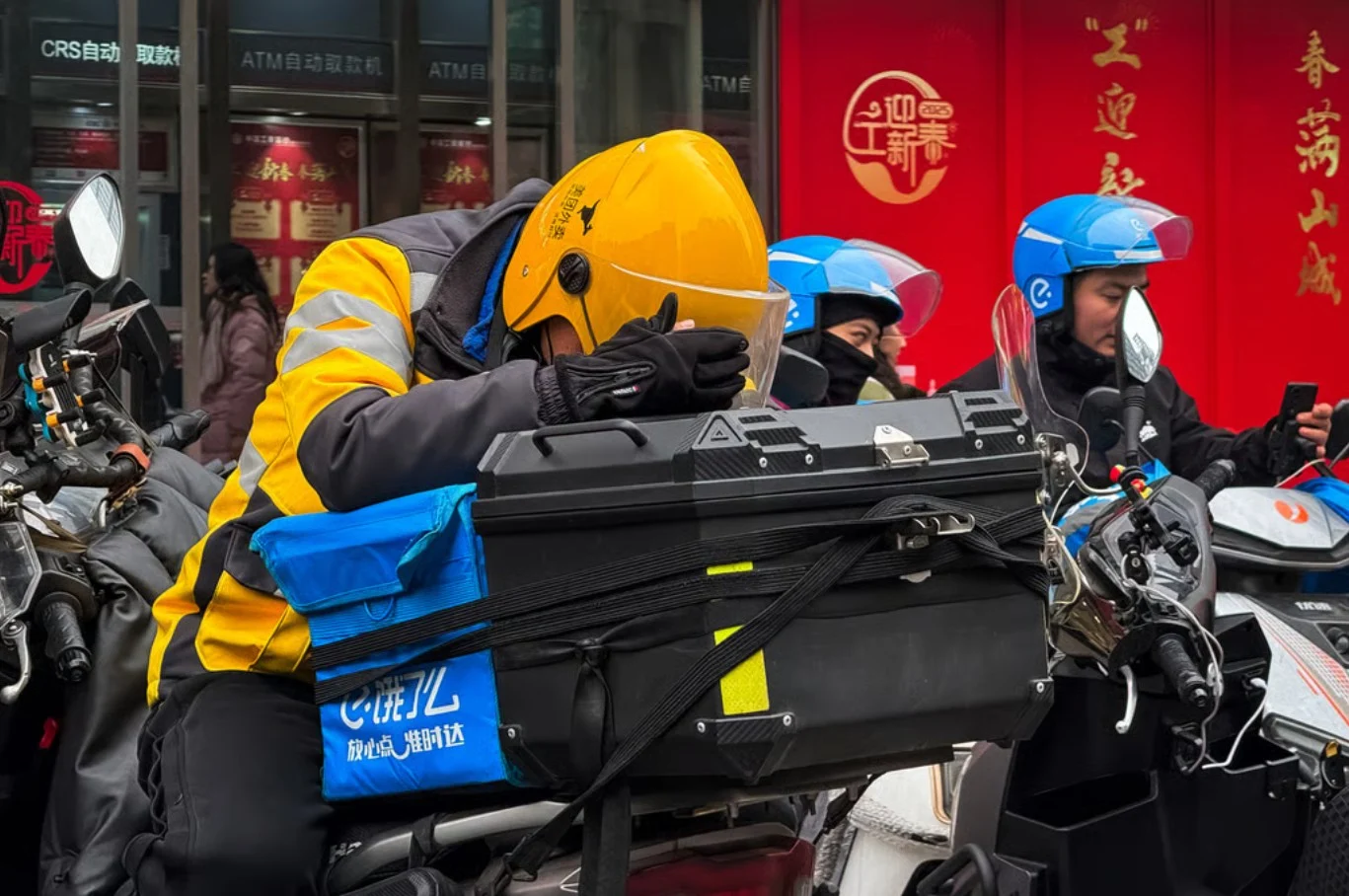 Long hours, relentless targets and physical exhaustion shape
the daily reality of China’s delivery workers. Photo: Getty
Images
Long hours, relentless targets and physical exhaustion shape
the daily reality of China’s delivery workers. Photo: Getty
Images
The people drawn into this economy are mostly rural migrants, part of the vast mobile workforce that built China’s factories, roads and cities. The hukou, or household-registration system, divides citizens according to their place of registration. Despite reforms, migrants in major cities still do not enjoy the same access to schooling, healthcare, housing and social welfare as registered urban residents. Essential to urban life, parcel couriers criss-cross Beijing all day while remaining on its social margins. Their importance becomes especially visible during the Spring Festival, when many return home for their annual holiday.
Hu himself was not exactly a migrant worker in the usual sense. Born in Guangzhou in 1979, he attended a vocational school, where he studied electrical-appliance repair. By his own account, reading and writing offered both solace and an escape from the frustrations of low-paid, precarious work. His experience speaks to me personally. As a young woman, I spent ten years greasing machine parts in a rocket factory in Nanjing. My circumstances were different: I had an urban hukou and a permanent job in a state-owned factory, with the security, however limited, that such employment provided. Hu’s world is far more precarious. Yet I recognise the bodily fatigue, the regimentation of time, the sense of being trapped in menial labour and the hunger for a life beyond repetitive work. Above all, I recognise how easily people at the bottom of society are reduced to a function: a pair of hands at a machine, a uniform at a gate, a figure on an electric bike.
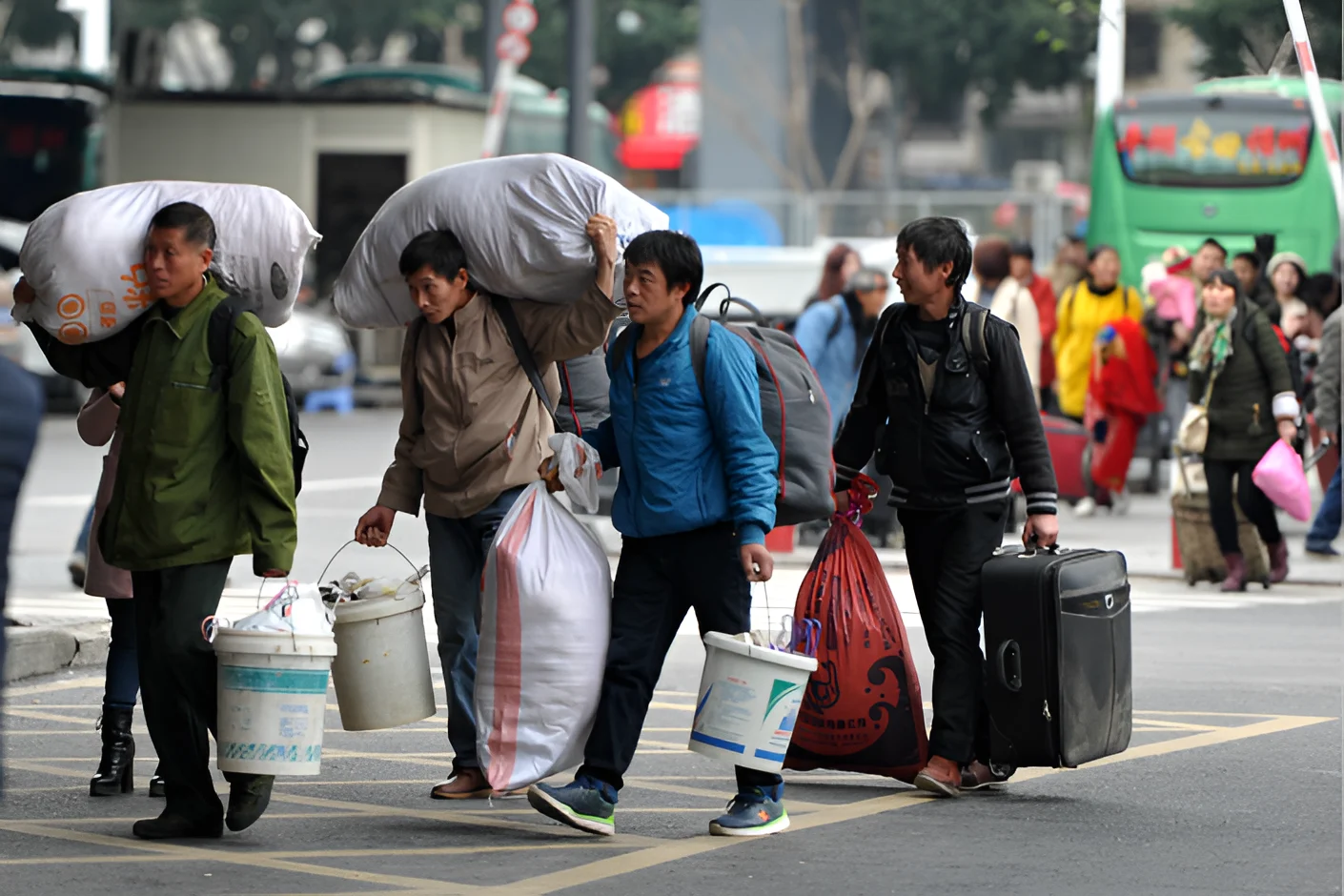 Rural migrants have helped build China’s cities while often
remaining on the margins of urban social services. Photo:
VCG
Rural migrants have helped build China’s cities while often
remaining on the margins of urban social services. Photo:
VCG
Chinese people often call such men and women xiao renwu, ‘little people’. Yet their lives are anything but small: China’s so-called economic miracle was built on their hard work. My factory experience taught me to notice their thwarted ambitions, intelligence and stubborn dignity. When Hu leaves his courier job, several customers send thank-you messages on WeChat. That simple praise gives him something statistics cannot measure: recognition as a human being.
Hu’s book belongs to a growing body of migrant-worker literature in China. Fan Yusu, a rural migrant and domestic helper in Beijing, became famous after her autobiographical essay ‘I Am Fan Yusu’ went viral. Chen Nianxi spent sixteen years as a demolition miner; his poems carry the dust, danger and damaged bodies of that life. More recently, delivery rider Wang Jibing won the Lu Xun Literary Prize for Low Flight, a collection of his poetry. These writers do not provide ‘material’ for professional authors. They seize the pen and describe work from inside the body that performs it.
This literature matters because statistics can tell us how many millions migrate or work for digital platforms, but not what it feels like to race against an algorithm, be insulted by a customer or discover that exhaustion has consumed one’s dreams. Literature restores individuality. It allows the so-called little people to become the central characters of their own stories. It also asks readers to examine our complicity. There is a human cost behind every miraculously fast delivery.
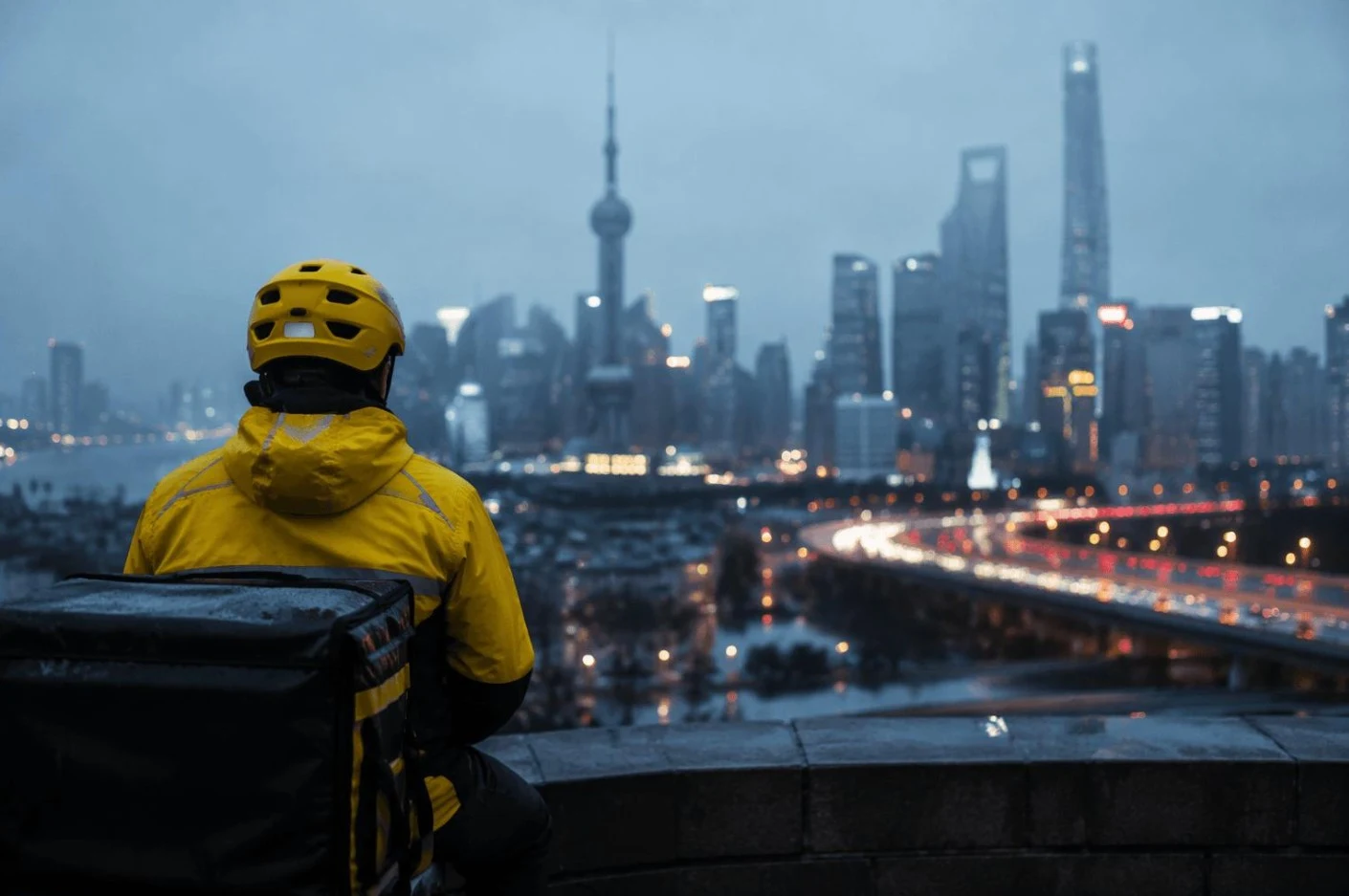 Algorithms, ratings and delivery targets increasingly shape
how China’s gig workers spend their working day. Image: AI
generated
Algorithms, ratings and delivery targets increasingly shape
how China’s gig workers spend their working day. Image: AI
generated
Today, Hu lives in Chengdu and writes full time. The ‘best delivery man’, as one grateful customer called him, has left delivery work and is pursuing his dream of becoming a writer – a modest but satisfying transformation. His memoir may not always achieve the compression of great literature, but its plainness is also the source of its authority. Hu observes and endures without self-pity. Beneath his practical accounts runs a persistent concern with freedom: to leave a bad job, control one’s time and make something that does not belong to an employer.
I am delighted that the book has received considerable recognition. It was shortlisted for this year’s Baifang Schell Book Prize for Outstanding Non-Fiction, and last year was named one of the best books of the year by The Economist, the Financial Times and The Sunday Times.
I Deliver Parcels in Beijing is not only about couriers, migrants or exploitation. It concerns the universal desire for dignity and control over one’s life. Writing cannot repair the hukou divide or protect a worker from an algorithm. But it can make an unseen life visible, turn suffering into shared knowledge and return power to the storyteller. I hope Hu’s recognition as a writer has granted him some of the freedom he sought, and above all, freedom of the spirit.