Narcotopia by Patrick Winn is published in the UK by Icon Books and is reviewed here by Nicholas Nugent.
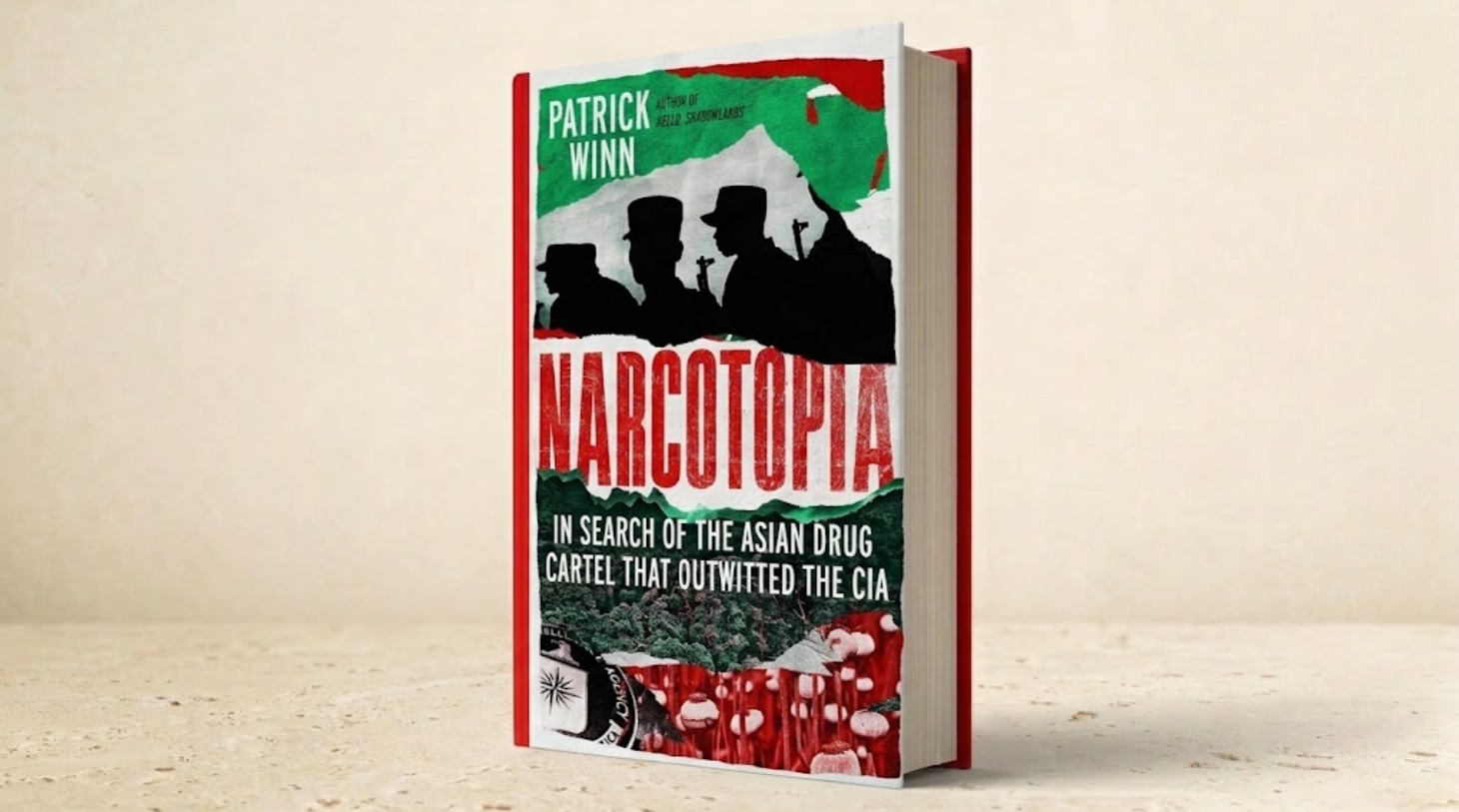
In Narcotopia, Patrick Winn traces Myanmar’s transformation from a major opium and heroin producer into a centre of synthetic drug production, exploring how conflict, local power structures and cross-border networks sustain the illicit drug trade.
Back in the early 1970s, as America’s war in Vietnam ground towards its end, a book was published which became famous for the insight it gave into the production and flow of narcotics in Southeast Asia. The Politics of Heroin in Southeast Asia by Alfred McCoy told how the growing of opium in Burma and subsequent production into heroin fuelled its use across Southeast Asia, not least among American soldiers serving in Vietnam. Heroin was produced in and trafficked from the ‘Golden Triangle’, where Burma, Laos and Thailand meet. The region was notorious for feeding heroin addiction throughout the region and back in the United States, to where returning soldiers smuggled the drug.
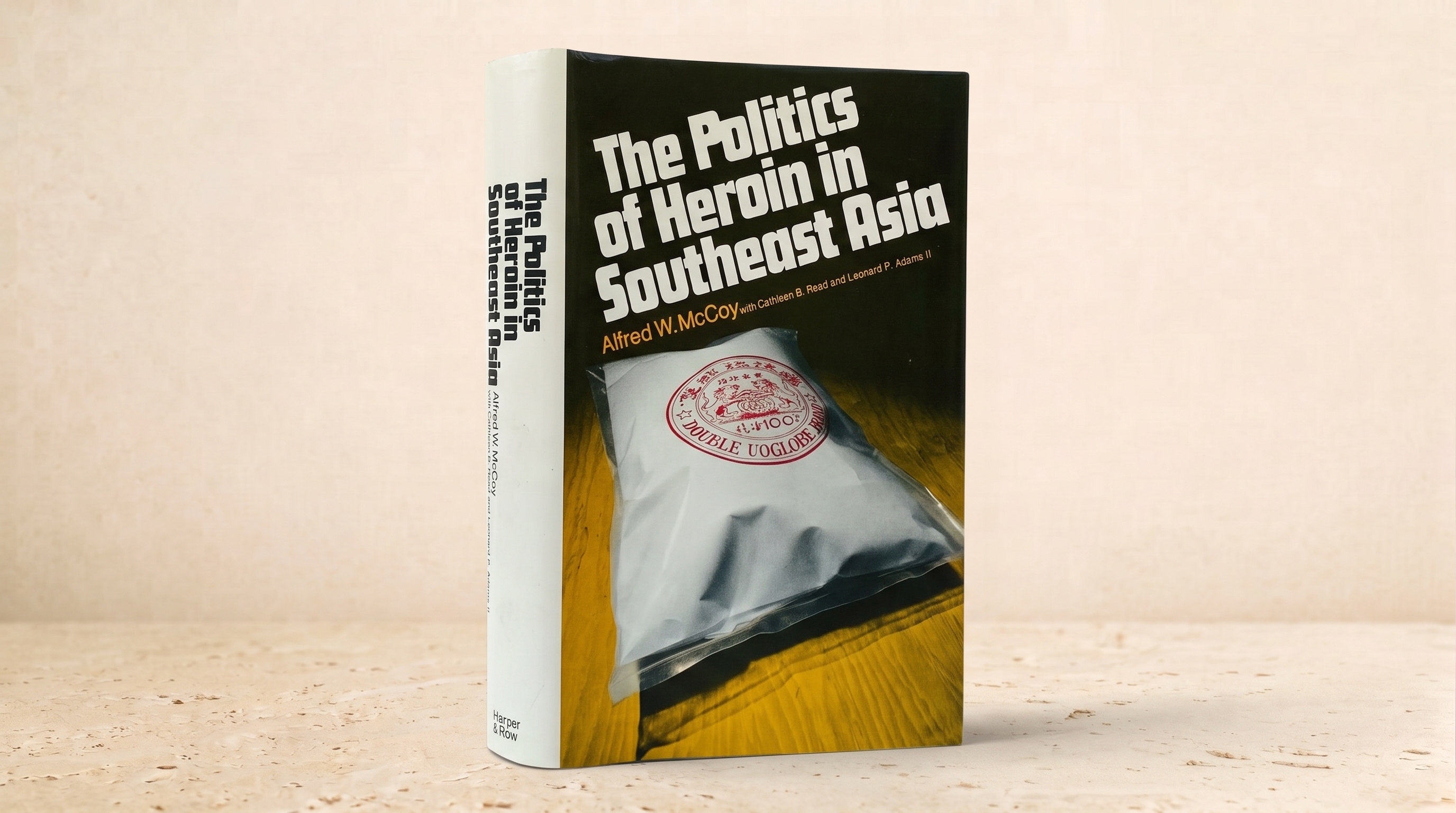 Alfred McCoy’s The Politics of Heroin in Southeast Asia, the landmark
book that documented the opium and heroin trade in Southeast Asia and
its links to the region’s political conflicts.
Just as interesting was what the book told readers about the origins of Burma’s drug production. It had been facilitated by US agencies, notably the CIA, as a consequence of earlier guerrilla activity by the US-backed Kuomintang (KMT) – Chinese Nationalist forces that had retreated into Burma against the fledgling Chinese communist republic, across Burma’s north-eastern border. The spread of heroin in Asia and the West was directly fuelled by America’s war against communism. Heroin was not just a drug: it was a source of income and power across remote regions of north-eastern Burma.
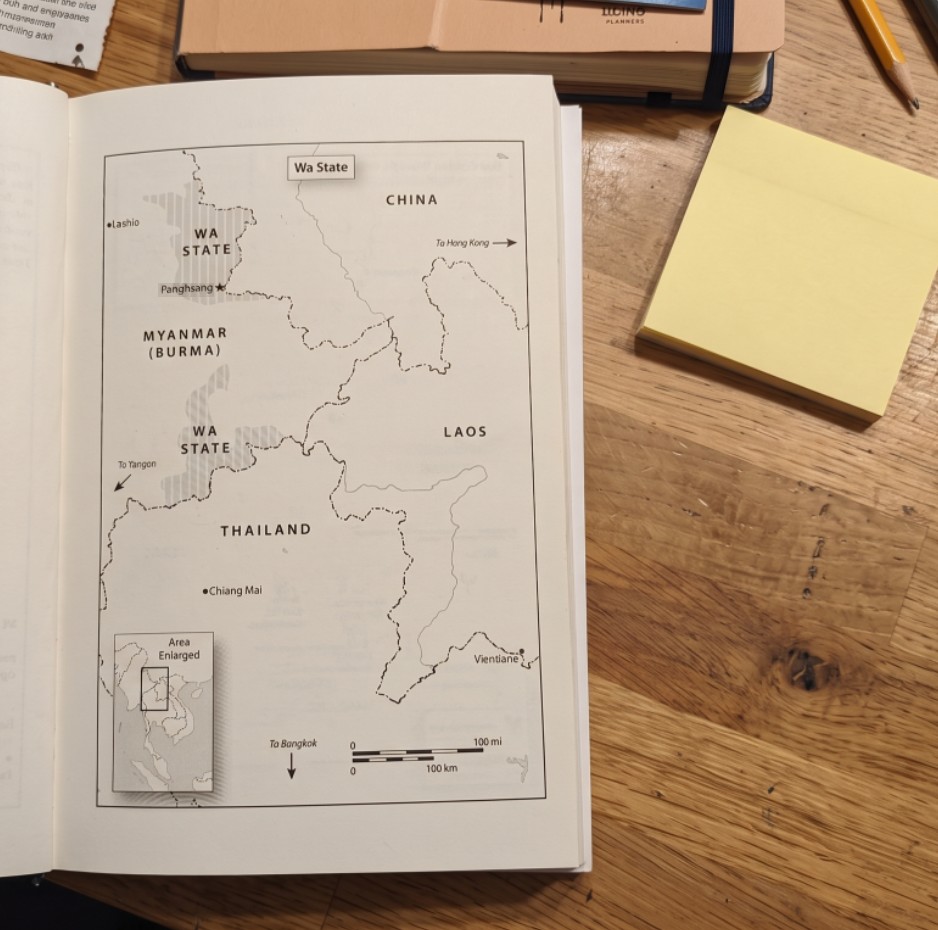
A map from Patrick Winn’s Narcotopia showing Wa State North and South, territories central to the book’s account of Myanmar’s illicit drug economy.
Narcotopia by another American writer, Patrick Winn, picks up the story of the role played more recently by Burmese tribes, notably the Wa people of Shan State in the country now known as Myanmar. Much of the book is about the rivalry between different arms of the US government, the State Department, responsible for embassies around the world, and two other branches of government operating from those embassies: the Central Intelligence Agency or CIA, the US’s spy network, and the Drug Enforcement Administration or DEA, the agency responsible for trying to combat the trafficking of narcotics. According to Narcotopia, these agencies with their different objectives were sometimes working against each other in a chaotic manner.
The book is also revealing about Myanmar’s remote and often mountainous borderlands, which came to be known by a Chinese nickname as Shanzhai Zhongguo – literally ‘mountain fortress China’, for the region straddles Myanmar’s north-eastern border with China’s Yunnan province. Many of its inhabitants are ethnic Chinese. In its largest town, Panghsang, people use Chinese money, the yuan, and observe Beijing time, as if it were an enclave of China within Myanmar. This reviewer has visited another such Shan State ‘enclave’, that of Mong La, which also uses Chinese time and money; there the biggest ‘industry’ is gambling with casinos attracting Chinese visitors from across the border where gambling is restricted.
From McCoy’s book, the world learned of the notorious Shan drug lord Khun Sa. In the new book a leading figure is Saw Lu, who was brought up a Baptist Christian by American missionaries before joining a fight by the tribal militia, the United Wa State Army, against the Communist Party of Burma in a war facilitated by America and financed by the profits from drugs. Later, he played a role in trying to end the region’s drug culture.
If you were to look at a map of Burma/Myanmar, you would not find Wa State since it was ‘created’ by the Wa, a community of 600,000 or so people once known as headhunters, who inhabit 12,000 square miles of what is officially Myanmar’s Shan State. Wa State is the land Patrick Winn calls ‘Narcotopia’ since, following the defeat of the Communist Party of Burma, it appears to exist for the sole purpose of producing and exporting drugs. The writ of the Myanmar government does not run there and Wa State has its own finance minister, whose main role is to collect revenue from the production and export of narcotics, and a foreign minister who – in theory at least – negotiates with the Myanmar and Chinese governments. Not only has this state existed for nearly 40 years, but it has expanded to claim a second territory known as ‘Wa South’ on the border with Thailand.
The conquest of Wa South was ostensibly to end opium growing and heroin production in the remote and inaccessible highlands in favour of a more sedentary and farming-based existence in the lowlands. However, the upshot of the move was the development of a new jungle-based industry producing a synthetic narcotic known locally as yaba – ‘crazy medicine’ in the Thai language – and elsewhere in different variants as ‘shabu’, ‘speed’, ‘ice’, ‘crystal meth’, ‘glass’ or ‘chalk’ and, more technically, methamphetamine. An advantage, from the producer’s point of view, is that since it is not crop-based it cannot be detected from the air, as a field of opium poppies could be.
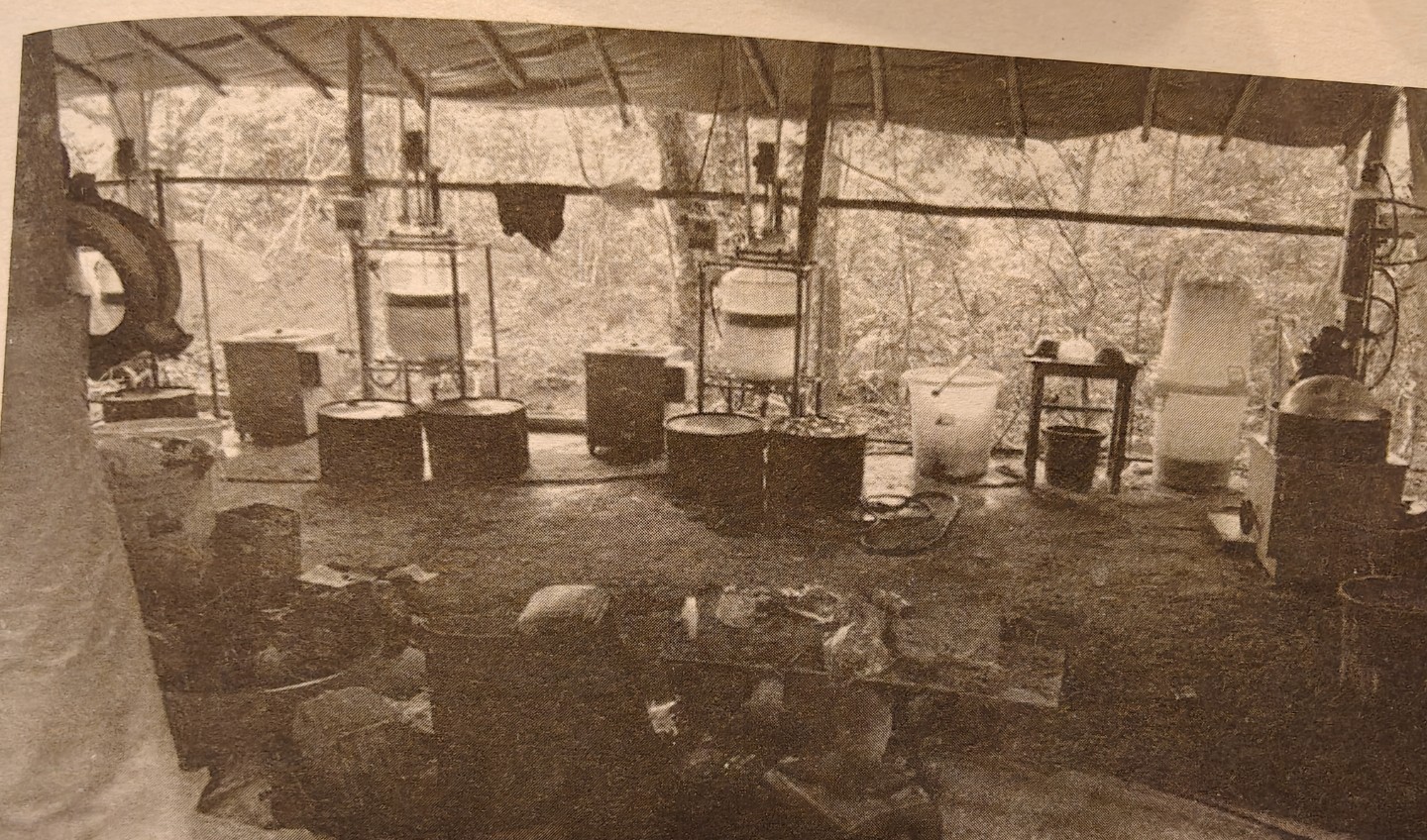 A methamphetamine laboratory near Myanmar’s border with China,
illustrating the shift from opium cultivation to synthetic drug production.
Photo: Myanmar Police, reproduced from Narcotopia
Methamphetamine tablets are produced in jungle ‘laboratories’ from chemicals brought across the border from southern China. The relative cheapness, compared with heroin, of yaba tablets with their distinctive ‘WY’ stamp makes it a favourite drug across much of the region, from Bangladesh where it extends the working day of truck drivers enabling them to work longer hours and earn more, to Thailand, Malaysia and the Philippines where it is often the recreational drug of choice. The drug is of less appeal in the distant United States where the authorities are more concerned by cocaine and fentanyl smuggled across its land borders.
The United Wa State Army, which engineered the migration of Wa citizens into territory previously inhabited by other Shan tribes as well as the move from heroin to methamphetamines, is one of many ethnic armed organisations (EAOs) fighting the military junta which rules Myanmar. Since the military coup of February 2021, which ousted the semi-civilian government of Aung San Suu Kyi, these ethnic armies have become more dedicated to their political objective of ending military rule with considerable success in capturing territory – though not enough to topple the regime.
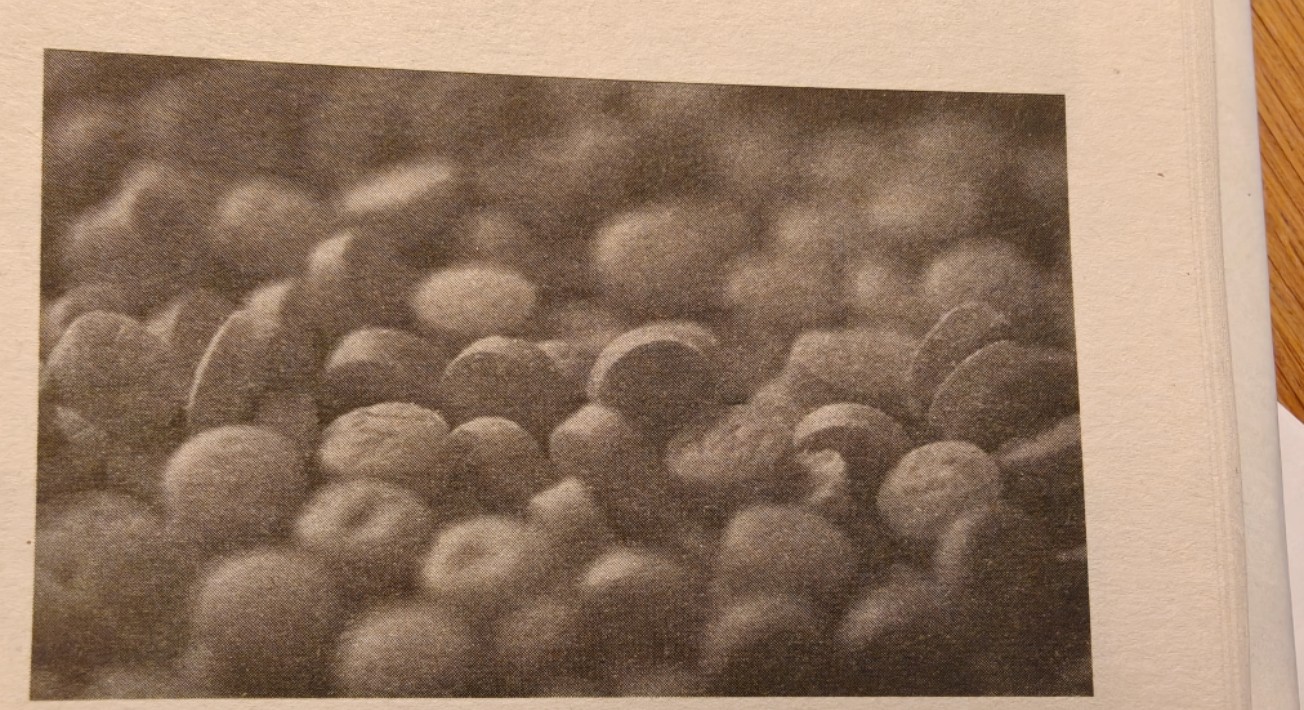 Methamphetamine tablets produced in a jungle laboratory in Myanmar,
reflecting the rise of synthetic drugs described in Narcotopia. Photo:
Myanmar Police, reproduced from Narcotopia
Patrick Winn’s book is fascinating for what it tells us of one of the most lawless parts of Asia which has been fighting different wars from those that make headline news, sometimes on behalf of government agencies and at other times against prevailing authority. If there is a lesson to be learned from the tale it tells, it is that the war against drug production, trafficking and addiction is unlikely to be won unless or until local political rivalries are resolved.