Jung Chang, one of the most celebrated writers in English about China, has produced a sequel to her biographical account of growing up in China, Wild Swans, which brought her fame. Lijia Zhang, who has written about her own early life in China, met Jung Chang to discuss her books.
Jung Chang, one of the most celebrated writers in English about China, has produced a sequel to her biographical account of growing up in China, Wild Swans, which brought her fame. Lijia Zhang, who has written about her own early life in China, met Jung Chang to discuss her books.
In 1988, a decade after settling in Britain, the Chinese-born writer Jung Chang received a visit that would change her life. Her mother, a senior Chinese Communist Party official who had never previously left China, came to London for an extended stay. Freed from political pressures, she began to talk openly with her daughter about her past and that of Chang’s grandmother, once a warlord’s concubine. Chang started recording the conversations. By the time her mother left, she had amassed over sixty hours of tape.
“I said to myself: I’ve got to write this down,” Chang later recalled. The result was Wild Swans: Three Daughters of China (1991), written with her husband, the historian Jon Halliday. The memoir became an international sensation. Tracing a century of Chinese history through three generations of women, the book sold more than 13 million copies, was translated into 37 languages, and became one of the most successful non-fiction paperbacks ever published. J. G. Ballard called it “an unforgettable portrait of the brain-death of a nation”.
Few books have shaped Western perceptions of China so profoundly. At a time when personal accounts of life under Mao – especially women’s stories – were rare, Wild Swans brought China into the mainstream. It inspired readers to study Chinese, visit the country, and write their own memoirs. “It’s impossible to overstate its influence,” the British sinologist Julia Lovell told me; reading the book sparked her own fascination with China.

Jung Chang at a restaurant near her home in Notting Hill, where she met Lijia Zhang last summer to discuss her latest book. Photo: Lijia Zhang
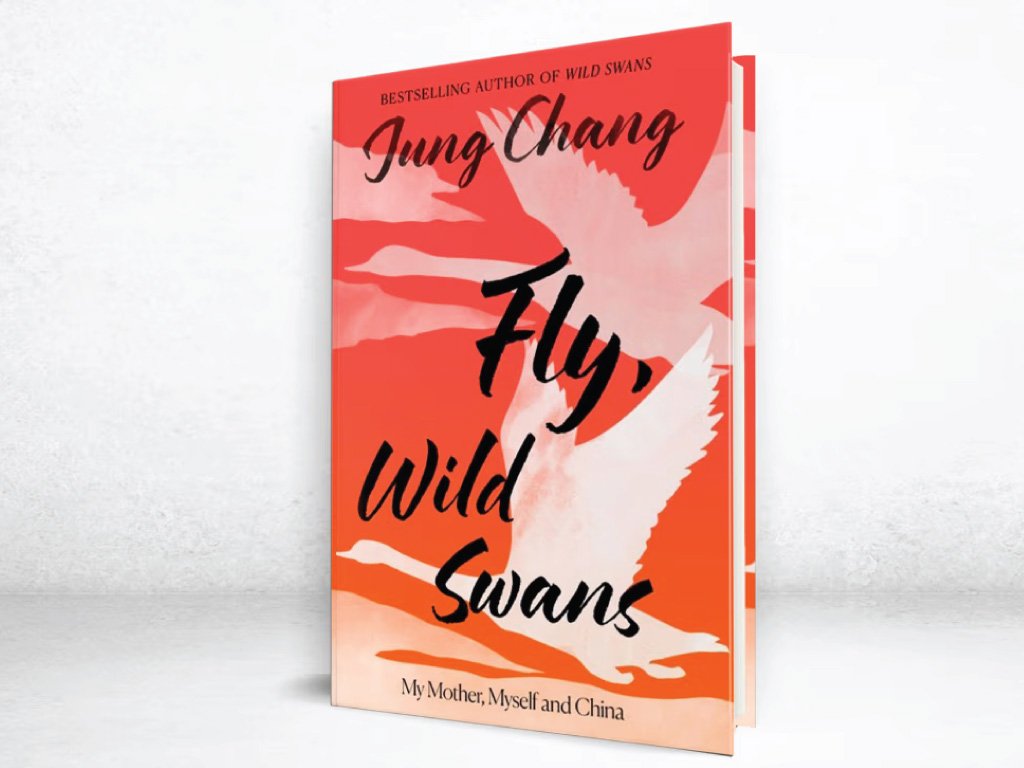
More than three decades later, Chang has returned to that family story with Fly, Wild Swans: My Mother, Myself and China (Harper, 2025). Picking up where the earlier book ends, it explores her mother’s later life as a formidable Communist official navigating post-Mao politics and Chang’s own struggle to reconcile personal freedom abroad with loyalty to family at home. Less a sequel than a reckoning, the book is also an intimate portrait of separation, guilt and ageing. Reviews have been kind, though few expect it to replicate the seismic impact of Wild Swans.
I first met Jung Chang many years ago at a China-related event in London. Over the years, we bumped into each other from time to time and even once shared a stage at a book festival in Bali. Last summer, at a restaurant near her home in Notting Hill, we finally sat down for a proper conversation. Wrapped in a purple Chinese-style jacket and turban, she cut an elegant, commanding figure. Now in her seventies, she radiates assurance. In March 2024, she received the British award of a CBE for services to literature and history. Once grand in manner, she is now officially so.

Wild Swans: Three Daughters of China (1991), Jung Chang’s breakthrough memoir, traced a century of Chinese history through three generations of women and became an international publishing phenomenon.
Yet Chang’s beginnings were far from privileged in the conventional sense. Born in 1952 in Yibin, Sichuan, she grew up inside a guarded compound thanks to her father’s senior role in the provincial propaganda department. A passionate lover of books, he nurtured his children’s intellectual curiosity, buying each of them a dictionary, a rare luxury at the time. Chang devoured translated foreign children’s literature and dreamed of becoming a writer.
That dream was shattered by the Cultural Revolution. In 1967, her father was ordered to burn his own books. As they turned to ash, he banged his head against the wall in despair – a scene Chang recounts as one of the darkest moments in Wild Swans. Both parents were publicly humiliated, beaten and imprisoned. These passages form the emotional core of the book.
Chang herself fared better than her parents. Like millions of young urban people, she joined the Red Guards and was later “sent down” to the countryside. She worked as a barefoot doctor, an electrician and a steelworker – experiences she describes with characteristic understatement as “eye-opening”. In 1973, as universities reopened, she entered Sichuan University as a “worker—peasant—soldier” student, majoring in English. A government scholarship took her to Britain in 1978. She went on to earn a PhD from the University of York, becoming the first mainland Chinese scholar in the post-Mao era to do so.
Chang’s early writing focused on women who shaped history. Her first book, Madame Sun Yat-Sen (1986), co-authored with Halliday, brought the couple together; they married in 1991, the same year Wild Swans was published. The memoir’s success gave Chang complete freedom. She left her teaching post at SOAS and devoted herself to writing.
Riding high, she and Halliday embarked on a far more ambitious project: Mao: The Unknown Story (2005). Twelve years in the making, the book drew on newly opened Soviet and Chinese archives and interviews with Mao’s associates. It portrayed Mao as a brutal, power-hungry tyrant responsible for tens of millions of deaths – worse, Chang and Halliday argued, than Hitler or Stalin.
The book was a commercial triumph but a scholarly lightning rod. While journalists admired its scale, academics were scathing. Rebecca E. Karl summarised the critique bluntly: many scholars believed the authors had exaggerated or distorted evidence. Chang remains unmoved. She insists no reviewer identified factual inaccuracies and argues that personal memoirs alone should have settled Mao’s moral case long ago.
Controversy followed Chang into her next biography, Empress Dowager Cixi (2013), which recast the much-maligned Qing ruler as a moderniser and proto-feminist. Again, reviewers were divided. Pamela Kyle Crossley dismissed the attempt as historical wish-fulfilment, but Chang stands by her revisionist approach, arguing that no one before her had treated Cixi as a serious political actor.
Her 2019 book Big Sister, Little Sister, Red Sister, about the Soong siblings, was more restrained and drew less attention, perhaps, Chang speculates, because it lacked the lurid appeal of her earlier biographies. Or perhaps the pandemic simply swallowed it.
Chang’s mother still lives in China, where her daughter’s books are banned. Although Chang has been allowed to return, she does so cautiously. “The question is not whether I am allowed to go,” she once told me, “but whether I am allowed to get out.”
With Fly, Wild Swans, Chang returns to what she knows best: the intimate intersections of family, memory and history. When Wild Swans appeared, she was among a handful of Chinese-born writers working in English. She paved the way for others – Yiyun Li, Ha Jin, Guo Xiaolu – and stands today alongside Britain’s literary establishment.
For me, however, her position remains singular: the writer who introduced China to the West through lived experience, cutting through ideology and cliché to tell a story only she could tell.
A longer version of this appreciation of Jung Chang appeared in China Books Review.