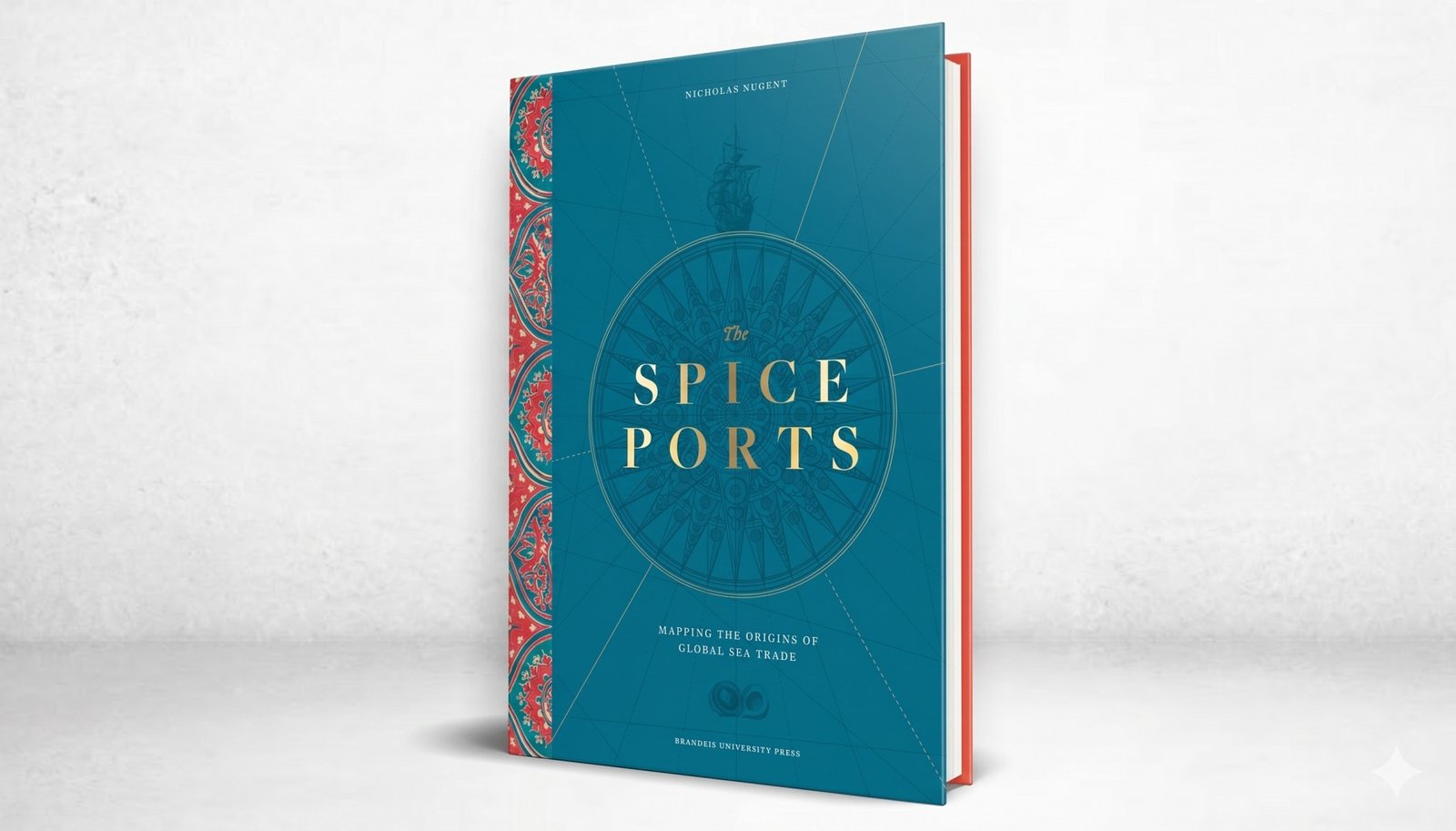
The Spice Ports: Mapping the Origins of Global Sea Trade by Nicholas Nugent, published in London by the British Library and in the US by Brandeis University, is reviewed here by Andrew Whitehead.
When Vasco da Gama landed on Kappad beach, in what is now the Indian state of Kerala, in 1498, his Portuguese mariners proclaimed they were in search of Christians and spices. Religion was part of the Portuguese justification for their determination to find a direct sea route to India. The commercial imperative was black pepper.
As this book demonstrates, the European quest for spices was one of the main impulses behind mercantilism, the seaborne commerce which brought great wealth to Europe’s maritime powers. It provided the initial push to establish trading posts in the spice-producing regions of South and South-East Asia. These often developed into colonial outposts and then metamorphosed into the rapacious imperialism which proved so difficult for emerging nations to shake off.
The merchant powers made huge amounts of money from the spice trade and in so doing left a lasting mark on the world. This commerce was a catalyst in the development of new forms of shipping, navigation, map-making, banking and futures trading. The producing countries benefited far less from this exchange. In the wake of the spice trade came wars, subjugation, the coerced trade in opium and that most awful of stains on our shared history, slavery.
 The Indian Ocean depicted by Dutch cartographer Jan Jansson in 1652.
This reviewer recently visited Pulicat to the North of Chennai where an imposing seventeenth-century cemetery is the most tangible evidence of what was once the nerve centre of the Dutch commercial presence on India’s Coromandel coast. From there over several decades, Dutch traders arranged, through local compradors, for an estimated 40,000 enslaved Indians to be shipped to work on spice plantations in what is now Indonesia. Slavery is often associated with the feared ‘middle passage’ across the Atlantic which took millions of captive Africans to toil in plantations in the United States, the Caribbean and Brazil. In fact, it was a global evil.
The spice trade required spice ports, and the focus of this elegant book is the development of these ports and the role of explorers, pirates, botanists, soldiers, and sultans in enabling the trade. Europe’s maritime powers were late to the party. Chinese and Arabian traders had, centuries earlier, recognised the value of spices, used for everything from flavouring food to serving as an aphrodisiac. The great prize was commercial access to the handful of equatorial islands with volcanic soil in the Moluccas (among the easternmost parts of Indonesia) which produced nutmeg, mace and cloves. The other most sought-after spices – pepper, cinnamon and ginger – were grown in the spice gardens of southern India, Ceylon (now Sri Lanka) and Sumatra.
Nicholas Nugent has researched the history of the spice ports intensively and has travelled across continents in doing so. The seed of the idea for this book took root many years ago when he visited Indonesia’s Banda Islands, the original home of nutmeg. He tells the story well, as you would expect of a former BBC editor and correspondent (and now the editor of Democracy Asia).
Nugent has chapters on twelve spice ports. Five of these are about European (and allied) commercial centres which gained wealth from importing spices: Venice; Lisbon; Amsterdam; London; and the North American city which was initially known as New Amsterdam and then rechristened as New York. Two chapters concern ports which facilitated the trade: the Egyptian city of Alexandria, which was established by Alexander the Great as part of his search for a land route to India and which remains a gateway to the East; and Cape Town, which a Swedish botanist and traveller described in 1772 as ‘an inn for travellers to and from the East Indies, who, after several months’ sail, may get refreshments of all kinds, and are then about half way to their destination, whether homeward or outward bound’.  A view of Goa in India looking south across the Mandovi River, by German cartographer Joseph Friederich Leopold in 1700.
On the export side, Nugent writes about five ports in four Asian nations: Goa, which throughout the sixteenth-century was the principal Portuguese commercial centre in South Asia; Bombay (now Mumbai) which offered a better harbour being able to ‘afford at all Seasons, Reception and Security for whole Fleets’ according to a description dating from 1724; Malacca, the city which can lay claim to being the birthplace of the Malay nation and which the Portuguese and Dutch fought over in ‘the spice wars’; Batavia (now Jakarta) which offered the best access to the clove and nutmeg islands; and Singapore, developed by the British as a harbour free of Dutch control but within reach of the Moluccas’ spice islands.
 An onshore view of the town of Batavia, now known as Jakarta, in 1748 by English engraver Emanuel Bowen. Jakarta was recently declared the most populous city in the world with 42 million inhabitants.
Ports which initially traded spices sometimes went on to become still more prosperous from other commodities. Bombay became India’s commercial capital because it was so important to the supply of cotton, tea and opium. For Singapore, the global demand for rubber transformed its fortunes. But the contemporary map of Asia remains shaped by the spice trade and the imperial rivalries which stemmed from it. Nugent argues that a treaty agreed between the British and the Dutch more than two-hundred years ago laid the foundations of the modern nations of Malaysia, Singapore and Indonesia.
 Spices Europeans fought over and traded: the nutmeg plant with its hard seed at the centre and its outer covering or mace, a distinct spice, depicted in 1800.
The text of this book is compelling; the production standards are exceptional. The Spice Ports includes scores of maps, prints, manuscripts and paintings, with high-quality colour reproduction. Remarkably, as many as a hundred of the maps and illustrations included are from the author’s own collection, outnumbering those sourced from the British Library, the publishers of the volume. Like the best spices, this book is piquant and enticing and deserves a place on the shelves of the discerning.