The International Criminal Court (ICC) in the Dutch city of The Hague has announced it will go ahead with the prosecution of Rodrigo Duterte, a former president of the Philippines, on three counts of crimes against humanity relating to the war on drugs, Duterte’s signature policy as president. Jonathan Miller, who has been following the saga, reports.
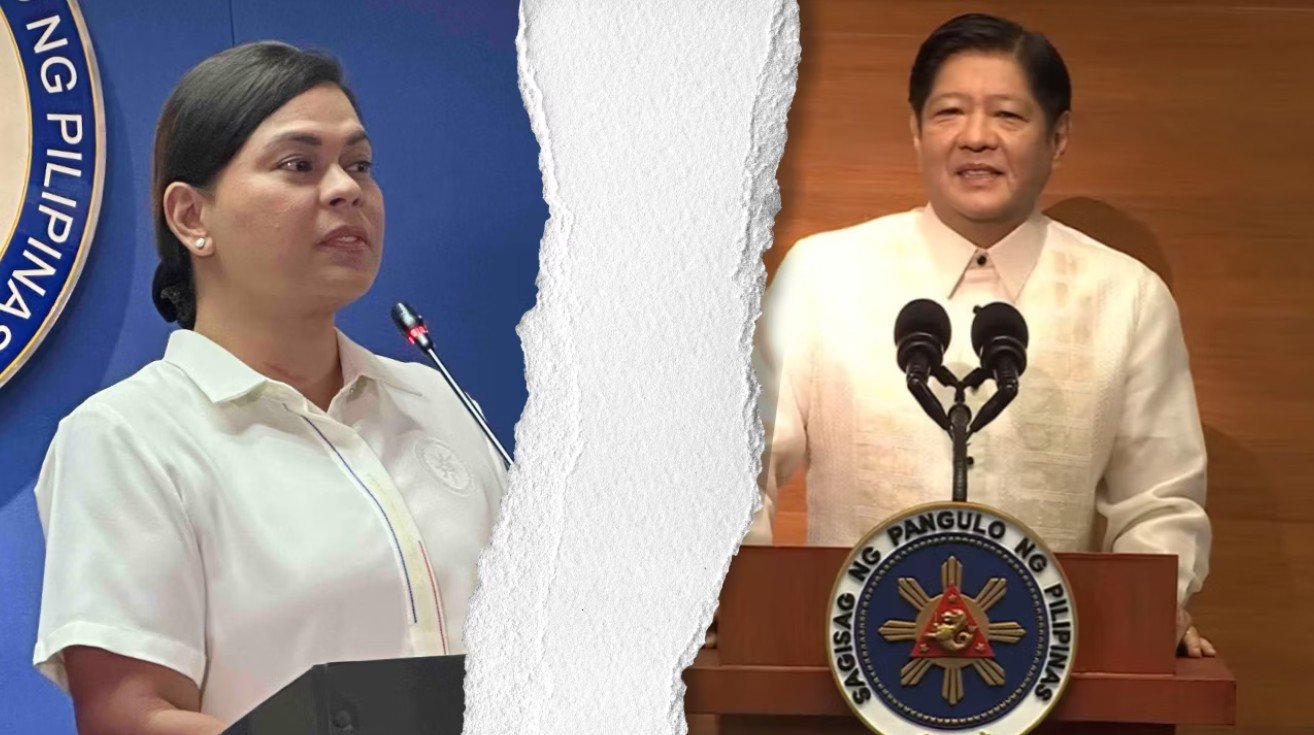
Sara Duterte and President Ferdinand Marcos Jr., once allies in a powerful political tandem, are now locked in a bitter feud that has plunged the Philippines into a high-stakes dynastic power struggle.
Imagine a screenwriter plotting the narrative arc of a political thriller, riddled with bizarre twists and a warren of shocking subplots, rich with intrigue and the promise of blood-drenched prequels and sequels. The chief protagonist is a serving vice president, a celebrity politician with big ambitions, riding high in the polls. But she has a problem. In a fit of rage, she’d threatened to kill her nemesis, the current president, scion of a dead dictator, and faces impeachment.
Meanwhile, in a jail cell half a world away, her ageing father, a former president himself, faces trial too: on charges of mass murder. She defends her legacy and – taking a leaf from his playbook – warns of a ‘bloodbath’ if her impeachment goes to trial. If it does and she is convicted, her presidential ambitions will be thwarted.
 The International Criminal Court in The Hague is considering whether to proceed with the prosecution of former president Rodrigo Duterte over alleged crimes against humanity linked to his war on drugs. Photo: AP Photo/Peter Dejong
But this is not the fictional storyboard of a blockbuster drama. This is real, and it’s playing out in the Philippines, whose 118 million people are hooked on this suspense-ridden political theatre.
 Rodrigo Duterte built his political brand on hardline rhetoric and promises of a violent crackdown on drugs, a policy that now places him at the centre of an international legal battle. Photo: EPA
It’s a couple of years now since the nepo ‘dream team’ alliance between Ferdinand ‘Bongbong’ Marcos (who is known as BBM) and Sara Duterte – which was, frankly, shaky from the outset – imploded and two of the country’s most powerful dynasties went to war. BBM’s first act of political vengeance was brutal, in the Shakespearean tradition. In March last year he handed over his predecessor, Sara’s father, to the International Criminal Court. Rodrigo Duterte was a wanted man, on account of the killing spree he allegedly unleashed during his bloody war on drugs. (By contrast, one of Duterte’s first acts as president was to order the rehabilitation of BBM’s father, Ferdinand Marcos senior, who plundered US$10 billion from national coffers, describing him as ‘the best president the Philippines ever had.’) Infuriated by Marcos junior’s brazen act of betrayal, Sara Duterte branded her father’s extradition a ‘kidnap’.
This gloves-off battle royale between the two ruling clans has relegated Duterte senior’s fate to that of a political sideshow. For Duterte’s detractors and the families of victims, the showdown in The Hague represents their stab at justice and accountability, an outcome long-denied them back home.
Less than halfway through his six-year term, police revealed that the death toll had already topped 29,000, the largest loss of civilian life in South-East Asia since Pol Pot’s rule in Cambodia. For the ICC, Duterte is a prize catch. Some say ‘a prosecutor’s dream’. We are about to find out whether that is the case.
 Families of victims of the Philippines’ brutal anti-drug campaign mourn loved ones, many of whom were from the urban poor and killed in controversial police operations or vigilante-style attacks. Photo: Reuters
Rodrigo Roa Duterte is among a rare breed of politicians who deliver on promises made. Exactly ten years ago, as he set his sights on Manila’s Malacañang Palace in the run-up to the 2016 presidential poll, he pledged a bloodbath. He claimed the Philippines had become a narco-state and said that the ‘slaughter’ of those he deemed responsible was the only way to end a ‘national methamphetamine pandemic’. On the campaign trail, he said ‘God will weep if I become president’ and threatened to dump the bodies of so many drug dealers in Manila Bay that the fish would grow fat feeding on them. He promised to fill the funeral parlours.
Duterte won by a landslide and so began a Latin America-style dirty war across the archipelago. Fear and violence were the favoured tools for imposing law and order. Death squads were the hallmark, as they had been during Duterte’s eight terms as mayor of the southern city of Davao.
 Police anti-drug operations and alleged vigilante killings became defining features of Duterte’s presidency, drawing widespread condemnation from human rights groups. Photo: Dave Tacon
He was a shameless populist authoritarian who told his electorate that vigilante justice was the only viable way to exterminate the ‘vermin’ of the drugs trade. He revelled in the nickname ‘Duterte Harry,’ after Clint Eastwood’s shoot-first-ask-questions-later cop, ‘Dirty’ Harry Callahan.
During his reign of terror, masked killers on motorbikes stalked the country’s slums, responding to the president’s dog-whistle rhetoric. Within six months of his taking charge, more than 7,000 people had been shot dead. Human Rights Watch called Duterte’s first year in office ‘a human rights calamity’. In just one year, three times as many Filipinos were killed than in a decade under Ferdinand Marcos senior. Dozens of lawyers, human rights defenders and journalists were gunned down but most of the dead were the urban poor, some linked to drugs, some not. Scores of children were among those killed. Their deaths were dismissed by the president as ‘collateral damage’. He basked in high approval ratings.
Unlike previous occupants of Malacañang, he spoke the gutter language of the poor and had the bearing of a hoodlum. He loved guns and girls and motorbikes. Filipinos swooned at what they called his ‘gangster charm’. He was, as one former Philippine congressman put it, ‘a fascist original’.
So, if Duterte goes to trial, will the charges stick? The prosecution has lined up star witnesses including a death squad super-grass, at least one assassin-turned-whistle-blower, survivors, priests and a deep throat former senior cop. Its problem is that there is no single order signed by the former president in which he commissioned an actual killing.
Nicholas Kaufman, his Israeli lead defence counsel in The Hague, accuses the prosecution of ‘cherry-picking’ quotes from Duterte’s speeches to present a narrative of ‘murderous intent’. He claims the speeches were taken out of context.
The ICC warrant for his arrest asserts ‘reasonable grounds to believe that Mr Duterte is individually responsible as an indirect co-perpetrator for the crime against humanity of murder’. The crimes of which he stands accused date back to 2011, when he was mayor of Davao City, and continue to 16 March 2019, when Duterte pulled the Philippines out of the ICC. The Rome Statute, on which the court is founded, requires that the prosecution demonstrate that Duterte ‘made an essential contribution to the commission of those crimes’.
 Now held at the ICC detention unit in Scheveningen, Rodrigo Duterte faces the prospect of trial as prosecutors attempt to link his rhetoric to thousands of killings.
In power, Rodrigo Duterte liked to project an image of invincibility. Even now, he retains a fanatical fan base among Duterte die-hards back home who hanker after the good old days when there was ‘law and order.’ But he has had a year to confront his demons and has sought to present himself as diminished and defeated as he sits in Scheveningen Prison, the ICC detention unit, with convicted war criminals for company.
According to Kaufman, his lawyer, he maintains ‘I’ve never murdered anyone’. The defence counsel quoted Duterte’s final instructions to his team. He said: ‘I was a faithful servant of the people and that is how I wish to be remembered. I have now accepted my fate and I realise that I could die in prison’.