Malaysia has an unusual system of governance in that both its parliament and its monarch are elected. But while adult citizens elect their parliamentary representatives, the king is elected from a field of nine sultans, hereditary rulers of their respective states, and only sultans get to vote.
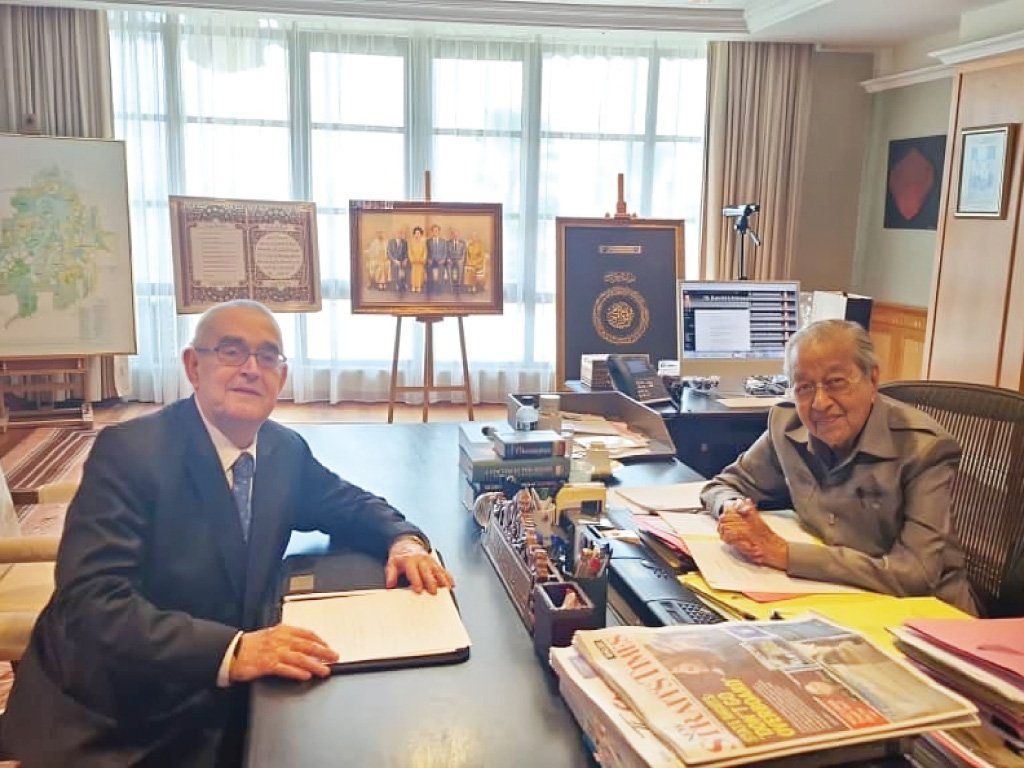
Malaysia has an unusual system of governance in that both its parliament and its monarch are elected. But while adult citizens elect their parliamentary representatives, the king is elected from a field of nine sultans, hereditary rulers of their respective states, and only sultans get to vote. Stephen Woodhouse went to meet former Prime Minister Dr Mahathir Mohamad, now aged 100, to learn how the system works.
Malaysia is both a monarchy and a fully-fledged democracy with an elected parliament. The prime minister is answerable to the people through their parliamentary representatives or MPs. As with other constitutional monarchies, one of the king’s most important roles is to invite the leader of the largest party or coalition in parliament to form a government after an election.
What makes Malaysia unique is that the head of state, the Yang di-Pertuan Agong or king, occupies the post not directly as a hereditary right. He – and it only can be a man – is elected by and from among the nine sultans who rule over their respective states within the Malaysian federation.
This makes for an interesting and potentially contentious relationship between an elected monarch, one of the hereditary sultans, and an elected prime minister and government, though constitutionally most of the power resides with parliament. Monarchs do sometimes express themselves publicly on controversial matters at the risk of being put down by the prime minister of the time.
I sat down with Dr Mahathir Mohamad, who was for 24 years the country’s prime minister (1981–2003, 2018–2020), giving him a unique vantage point in assessing how well the system works. He told me that the degree to which successive kings speak out publicly on issues they deem to be important is directly correlated with how powerful the prime minister is perceived to be, as measured by the size of his parliamentary majority. He says that kings tend to be “quieter” when prime ministers have strong parliamentary majorities.

Dr Mahathir said that in the early years of his premiership there were cases in which, as prime minister, he had to rule on matters concerning a king. One had physically abused a hockey coach, while a subsequent king declined to pay an outstanding debt. Such cases led Dr Mahathir’s government to establish a special court to try cases of abuse of power by a king. That court and its procedure remains in force today as an instrument for holding the monarch accountable. Dr Mahathir was able to set this court up despite royal objections owing to his strong legislative majority.
Notwithstanding these problem cases, Dr Mahathir believes that the system works well and there are no significant differences or problems between the elected head of state and elected prime minister. Each is fully aware of his power and limitations. In recent years, statements by the ruling king have emphasised the importance of national unity and the showing of equal respect, dignity, and religious tolerance for all the country’s citizens. Such statements have often coincided with divisive political statements made by politicians aiming to exploit ethnic and other tensions emanating from the multi-ethnic and economic divisions that reflect Malaysia’s make-up.

The present king of Malaysia Sultan Ibrahim of Johor
One reason for such tolerant and progressive statements by the rulers could be that every one of the current batch of sultans has enjoyed an overseas education, mostly in the UK, US, or Australia. They attended establishments ranging from Oxford and Harvard universities to Sandhurst and Fort Benning, military academies in the UK and US respectively. The current king, Sultan Ibrahim Ismail of Johore, attended Trinity Grammar School in Sydney, Australia, followed by military training at Fort Bragg and Fort Benning in the US. Prior to Malaya’s independence on 31 August 1957, British colonial authority was exercised both directly over parts of the Malay Peninsula and indirectly through the hereditary sultans who ruled their own independent sultanates but deferred to British overall control. This was replaced by that of Japan from 1942 to 1945, before Britain again took control from 1945 to 1957. Malaya became Malaysia following the incorporation of Sabah and Sarawak in the federation in 1963.
Malaya’s first elected prime minister, Tunku Abdul Rahman, realising the importance of the nine hereditary sultans in governing their respective sultanates, introduced the system of rotating paramount rulers, elected for five-year terms by their peers through a Council of Rulers. The main roles of the paramount ruler or king are to appoint a prime minister on advice from the legislature and to prorogue or dissolve parliament on advice from the prime minister. Additionally, he is empowered to grant clemency or to commute sentences of capital punishment on advice from the Pardons Board and to safeguard the status of Islam as Malaysia’s paramount religion.
Nowadays, the presiding king consults the other eight sultans through the Conference of Rulers, which meets regularly to discuss issues of national concern. Dr Mahathir spoke of his regular meetings with a total of five kings during his long tenure, saying that he had a good relationship with all of them and was invariably kept informed of a king’s proposed public statements.

As head of state an image of the king adorns Malaysia's banknotes
The influence of the monarch on national public opinion and policy formulation by an elected government varies according to two factors. First is the relative economic and demographic power of the sultan who is king at a particular time, so the voices of the Sultans of Johor, the current King, and of Selangor – which is economically strong, highly populated, and incorporates the national capital Kuala Lumpur – tend to be more influential than those of the more rural and less economically strong sultanates.
Secondly, as related to me by Dr Mahathir, when the prime minister is dependent on support from a more divided and fractured legislature than was the case during his long tenure from 1981 to 2003, the moral authority and influence of royal statements tend to be stronger. Thus far the unique system of rotating royal rule or reign and its interface with the elected system of government seems to have functioned relatively smoothly. The role of successive monarchs in promoting a sense of national unity and diminishing the power of narrow political interests seems to have functioned especially well.
A system which has been in place for nearly 70 years has been effective for Malaysian governance, but is open to challenge. The sultans represent the Muslim Malay people in a country with significant Chinese, Indian, and tribal communities. Also the states without sultans, Penang, Melaka, Sabah, and Sarawak, never get a turn to place their representative as overall head of state.
The system could be at risk if a king should overstep his constitutional powers. The last King issued a partial pardon allowing former Prime Minister Najib Razak to serve his sentence under house arrest instead of remaining in jail without showing deference to the views of the official Pardons Board.
The present King enjoys strong popularity among the general public, while the Prime Minister, Anwar Ibrahim, sees the monarchy as adding value to overall governance of Malaysia, playing a similar role to that of the House of Lords in the UK in providing a “second opinion” and as the nation’s moral voice in pursuit of national unity and ethnic and religious harmony.