Thailand’s snap election of 8 February produced two clear winners, the conservative Bhumjaithai Party and Thailand’s armed forces. The party’s aggressive support for the military during last year’s clash with Cambodia proved a decisive factor. Pravit Rojanaphruk explains how the election has reinforced the army’s role in a country where it is often described as a ‘state within a state’.
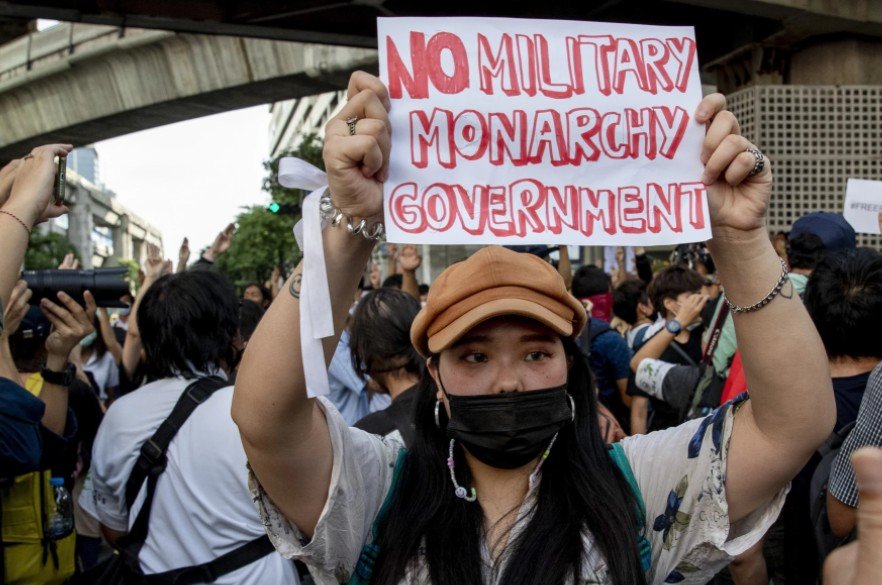
Thailand’s democracy continues to operate under the enduring shadow of military power and constitutional constraints shaped by past coups. Photo: AP
Although Thailand has not experienced a military coup since May 2014, the country still lives with the legacy of that putsch and of a junta-sponsored constitution it brought in to favour conservative forces. In 2023, Pita Limjaroenrat, leader of the party that won the most seats, was blocked from becoming prime minister by the junta-appointed Senate, which under the constitution was allowed to join the elected lower house in voting for the prime minister.
By February 2026, the political landscape had shifted. While many commentators expected the opposition People’s Party to win on a platform of military reform, it was Anutin Charnvirakul’s conservative and royalist Bhumjaithai Party (BJT) that secured a decisive victory. Anutin’s promotion of a hard-line stance toward Cambodia proved particularly popular.
The BJT won 191 of the 500 seats in the lower house – a massive leap from the 71 seats it held in 2023. Meanwhile, the People’s Party (formerly Move Forward) saw its influence wane, dropping from 151 seats in 2023 to just 120 in 2026. The main opposition, which had questioned the military's necessity, became the biggest loser of the night.

Anutin Charnvirakul’s Bhumjaithai Party surged to victory in 2026, reflecting a shift toward conservative and pro-military politics.
The border conflict with Cambodia last year boosted the military’s popularity after Thai forces secured several disputed areas. Lt Gen Boonsin Padklang, commander of the Second Army Region, became a national hero and later toured schools and universities giving motivational talks. This surge in military prestige is reflected in the numbers. Following the BJT victory, the Bangkok-based The Nation online reported on 13 February that online army recruitment for 2026 surpassed all expectations.

Despite winning the most seats in 2023, Pita Limjaroenrat was blocked from becoming prime minister by the junta-appointed Senate. Photo: The Nation
A legacy of military intervention
Even before the undeclared war with Cambodia, the military was an omnipresent force. If tourism is what Thailand is famous for, its frequent military coups are what make it infamous. Since the end of the absolute monarchy in 1932, Thailand has experienced 13 ‘successful’ coups, an average of one every seven years. When you include seven ‘unsuccessful’ coups, Thailand is seen to be one of the world’s most coup-prone nations.
The 1991 and 2014 coups are particularly notorious. In 1991, Prime Minister Chatichai Choonhavan was seized on an aircraft while travelling for a royal audience. Prominent military reporter Wasana Nanuam wrote of the 1991 coup in her book about the National Peace Keeping Council: ‘The seizure of power by the NPKC occurred at an opportune moment, as the public had grown weary of the government but admired the military leadership. Amid public despair toward the government, the prime minister, and politicians, the NPKC became a kind of hope. People watched to see whether it could accomplish more for the public than when state power was in the hands of politicians.’

Boonsin Padklang, commander of Thailand’s Second Army Region, engages with students during a school visit as rising military prestige—fuelled by the Cambodia border conflict—boosts recruitment and public support for the armed forces.
The King allegedly advised General Suchinda not to make the people disappointed. Suchinda later became prime minister but resigned after soldiers shot and killed at least 52 demonstrators protesting in Bangkok. He granted himself amnesty before leaving office, and no army officer was ever held responsible.
In the most recent coup in 2014, General Prayut Chan-o-cha declared martial law at 3 am, ousting the Pheu Thai government, detaining politicians and critics – including this writer – for ‘attitude adjustment’. Five years of junta rule under General Prayut Chan-o-cha followed before the country transitioned to a military-dominated, semi-elected government that lasted until 2023.
Today, former coup leaders hold prestigious positions; Gen Prayut and Gen Surayud Chulanont (who took power after the 2006 coup) both serve on the Privy Council, the King’s advisory body. Given this history, foreign observers often ask: ‘When is the next coup?’
In June 2025, the Washington-based Council on Foreign Relations noted that Thailand remains the only middle-to-high-income country with ‘regular’ military interventions. The pretext is almost always a combination of widespread corruption and a perceived threat to the monarchy, the latter claim being impossible to debate publicly due to strict lèse-majesté laws. The military’s influence is woven into the fabric of Thai society through several ‘special characteristics’: on National Children’s Day, the armed forces display tanks and fighter jets, encouraging children to ‘play’ with weaponry and climb onto armoured vehicles.

From an early age, the military is embedded in Thai society, with children encouraged to engage with armed forces displays. Photo: Reuters
Also, through propaganda and education: official history emphasises the military and monarchy as the sole defenders of the nation, often portraying historical wars with neighbours like Laos, Myanmar, and Cambodia in a one-sided, heroic light.
The military’s influence is reinforced by its institutional reach. The army owns two national television stations and controls many radio frequencies, while the defence ministry is almost always headed by a retired general. In contemporary Thailand, genuine civilian control of the armed forces remains elusive.