As Myanmar’s military rulers attempt to consolidate their hold on the country through elections, intended to restore at least a semblance of civilian rule, an independent programme outside the country known as the Myanmar Accountability Project (MAP) is on a regional mission to hold the military authorities accountable for their brutality. Director of MAP, Chris Gunness, reports on a visit to Timor-Leste.
As Myanmar’s military rulers attempt to consolidate their hold on the country through elections, intended to restore at least a semblance of civilian rule, an independent programme outside the country known as the Myanmar Accountability Project (MAP) is on a regional mission to hold the military authorities accountable for their brutality. Director of MAP, Chris Gunness, reports on a visit to Timor-Leste.
After a week in Timor-Leste with survivors from Myanmar of some of the most brutal crimes I have encountered, I am more convinced than ever that justice and accountability are key to democracy, stability and peace. Politicians who subjugate the rule of law to economic development – not to mention their own careers – are living on borrowed time.
I went to Dili with representatives of Myanmar’s Chin Human Rights Organisation (CHRO), which for over three decades has documented crimes committed by the country’s military. Chin State is a Christian region in Myanmar’s north-west, on the border with India. Its citizens constitute a minority in an overwhelmingly Buddhist nation. Chin State’s depleted population of 370,000 has suffered severely since the military coup of February 2021. Our case was designed to illustrate the various forms of brutality to which the junta has subjected civilians.

The interior of a Christian church in Chin State after a military attack, one of a series of assaults on civilian infrastructure protected under international humanitarian law. Photos: CHRO
There were five elements to the criminal complaint we filed at the Prosecutor’s Office in Dili: the gang-rape of a seven-month-pregnant woman in front of her husband; the massacre of ten people, including a journalist and a thirteen-year-old boy, among a group of eight who had their hands tied behind their backs and their throats slit; a disproportionate and indiscriminate aerial attack on a hospital which killed four medical staff and four patients; the killing of a Christian pastor and three deacons; and a series of deliberate attacks on Christian churches, civilian infrastructure protected under international humanitarian law.

An aerial view showing widespread destruction of civilian homes and infrastructure in the Chin town of Thantlang during military operations. Photo: CHRO
Universal jurisdiction
Action to hold the Myanmar military accountable for these crimes is feasible under Timor’s penal code according to the principle of universal jurisdiction, which allows state authorities to take action regardless of where the crimes took place or the nationality of the victims and perpetrators. We have been assigned a Timorese Prosecutor who is looking into the practicalities of a case, as well as their legal ramifications. To be clear, we have initiated action against a group of perpetrators, including the coup leader, Senior General Min Aung Hlaing.
This is the first time a member of the Association of Southeast Asian Nations (ASEAN) has formally initiated legal action against a fellow member for atrocity crimes. But we are pushing for more. Our hope is that the authorities will open a formal investigation and issue arrest warrants. We are under no illusions about the political obstacles that lie in our path. Despite ASEAN’s Human Rights Declaration promising that “all people are born free and equal in dignity and rights” and are entitled “to equal protection of the law”, in reality the Association’s infamous injunction to non-interference has trumped justice.

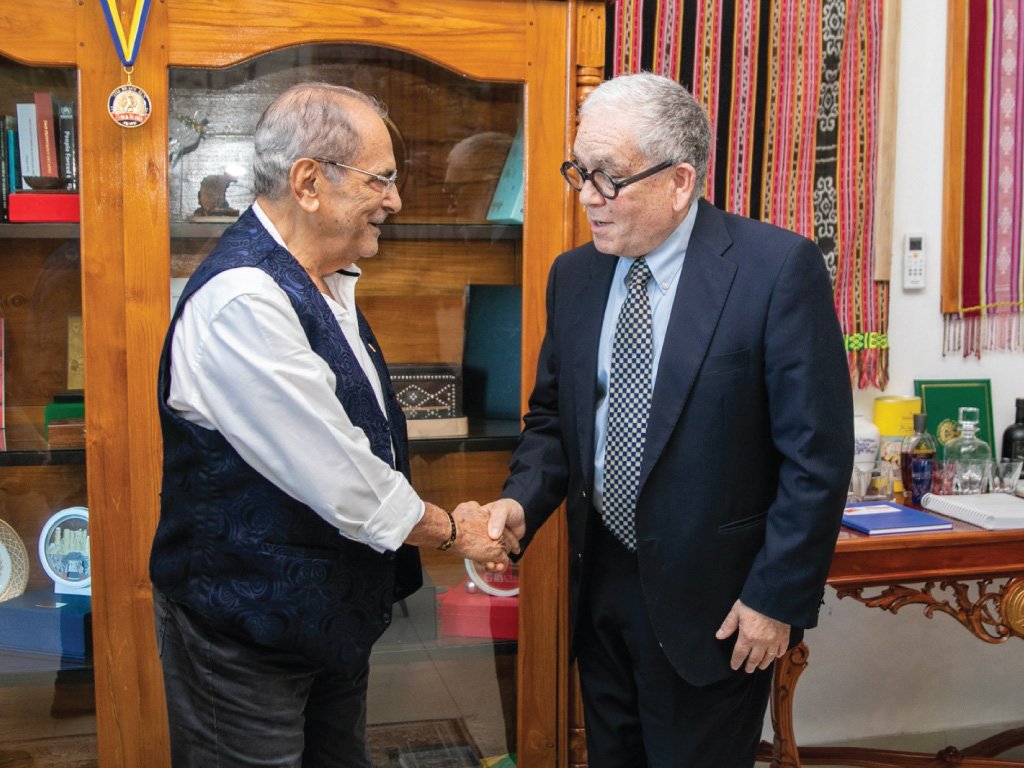
Representatives of the Chin Human Rights Organisation and Myanmar Accountability Project discuss the situation in Myanmar with President José Ramos-Horta. Photo: CHRO/MAP
President Ramos-Horta takes a lead
Nonetheless, our case in Timor-Leste offers the hope of change within ASEAN. Tellingly, after we held a lengthy meeting with President José Ramos-Horta, he issued a statement which took the country’s stance in support of democracy and human rights to new heights. The President said our discussions were “dedicated to promoting justice and accountability at the regional level” and
that he and our Chin interlocutors had “reflected on their shared history of struggle for self-determination, underscoring the deep bonds of solidarity between Timor-Leste and Myanmar in the defence of democracy, freedom, and human dignity”. He stressed Timor-Leste’s role as “the moral conscience of ASEAN”.
On the specific question of our criminal complaint, President Ramos-Horta reaffirmed what he called “the fundamental importance of an independent judicial system”, saying “that judicial processes must follow their normal course, free from any political interference”.
Predictably, the Myanmar junta issued a public statement condemning our case and expelling Timor-Leste’s envoy from the country. But subsequent meetings with the Timorese executive and civil society reinforced the view that despite Timor-Leste’s inability to come to terms with its own violent past, accountability and the rule of law are indispensable if nations like Myanmar are to transition away from dictatorship and if ASEAN is to deal with the scourge of transnational crime involving drugs, scam centres and human trafficking.

ASEAN member states face growing pressure to engage with justice and accountability mechanisms for atrocity crimes.
Elsewhere in ASEAN
My organisation has focused its attention on ASEAN, where universal jurisdiction remains under-developed. We have initiated legal action against the Myanmar junta in Manila and Jakarta where, I am sorry to say, political considerations have hampered progress.
In the Philippines we based a criminal complaint on an attack on the Chin town of Thantlang in September and October 2021. At the time we filed, controversy still smouldered over former President Duterte’s decision to withdraw the Philippines from the International Criminal Court, which was threatening action against him; there was also concern that our case might highlight the brutal excesses under the regime of former President Ferdinand Marcos, father of the current president, Marcos Junior. The Philippines’ Prosecutor would not register our case, and as a result we are moving to appeal.
In Jakarta we petitioned the Constitutional Court, demanding a case be heard in the country’s Human Rights Court. The Court was sympathetic to our arguments but ultimately, in what was clearly a politically motivated judgement, our petition was rejected out of hand.
Looking to the future
While Asia is largely hamstrung, international justice mechanisms continue to turn, however slowly, outside the region. The International Criminal Court in The Hague has issued arrest warrants for President Putin and Israel’s Netanyahu. At the International Court of Justice, where Rohingya genocide survivors have been testifying, a decision is expected this year on whether Myanmar has violated the 1948 Genocide Convention. A court in Argentina has issued arrest warrants for the Myanmar coup leader, Min Aung Hlaing, and other alleged perpetrators of crimes against the Rohingya, including the imprisoned former State Counsellor, Aung San Suu Kyi.
Countries in Asia have a choice: they can either join the conversation about justice and universal jurisdiction and get involved in developing customary international law; or be left behind and play catch-up when rules created outside the region are imposed. By taking the stand that he has, President Ramos-Horta has signalled that the rule of law and accountability are central to his vision of a stable and prosperous ASEAN.
He has thrown down a gauntlet. I urge other ASEAN nations to take up the challenge. They should begin by ditching the false notion that accountability is the enemy of stability and accept that it is the best friend stability ever had.