After Nations: The Making and Unmaking of a World Order by Rana Dasgupta, published by William Collins, is reviewed here by William Crawley. We live in an age in which we think in terms of ‘the nation state’ – but what comes next? As globalisation seems to be coming to an end there is no shortage of books written within the same global framework. Rana Dasgupta’s After Nations: The Making and Unmaking of a World Order will rank as one of the most authoritative and entertaining.
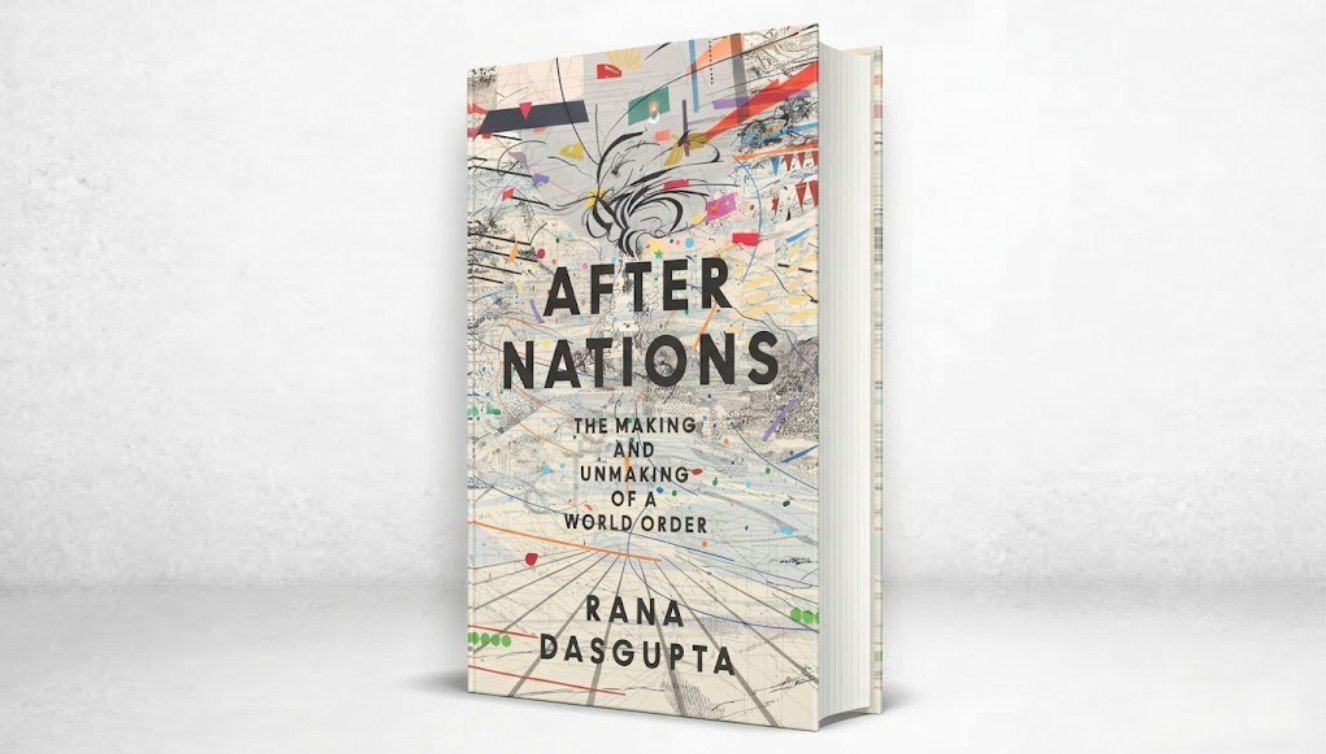
Rana Dasgupta’s After Nations explores the rise, crisis and possible transformation of the nation state in an era of fragmentation, corporate power and shifting global empires.
Rana Dasgupta takes as his central theme the history of the nation state. He describes how it came into existence, why it appears to be weakening, and what might be done to sustain it from the wreckage. It is a far cry from ‘the end of history’ described by Francis Fukuyama in the 1990s when it seemed that a predominantly neo-liberal world order was unchallengeable.
That vision seems even more remote now than when it was first put forward and Dasgupta gives it short shrift. His own four-part framework also requires some suspension of disbelief. He takes France as the epitome of an era in which political order was sanctified by God; Britain as the prime actor representing the supremacy of money and by extension the sanctity, even ‘dictatorship’, of property; America of Law; and China of Agriculture.
Dasgupta modestly says that his book contains no new information. He re-interprets the work of a multitude of historians and specialists on economic, ecological and social revolutions, and other major changes. As a novelist himself, he insists that writing history is another kind of storytelling, much like a novel. The categories he uses are less strictly historical than recurring patterns. Theology may be sparsely used in today’s intellectual world, yet Dasgupta uses the term ‘theological’ to explain the idea of the state as a ‘mortal god’ as opposed to the transcendent ‘immortal god’ of much religious belief. Dasgupta himself prefers the term ‘cosmological’ but he sees the concepts as essentially similar. The 19th century French writer Charles Maurras – not a name much cited today in orthodox international relations theory – is identified as a prime source of 21st century right wing conceptions of the state.
Asia looms large in the rise of Money because the Chinese empire had needed nothing from Europe and her luxury products could only be bought with silver bullion. When that was in short supply, British merchants, primarily the East India Company, created and sustained a growing addiction to opium, and in spite of an imperial ban forcibly used it as a substitute currency of exchange.
 British merchants used opium as a tool of trade with Qing China, turning commercial imbalance into imperial domination and accelerating the collapse of the old order. Photo: Asia Pacific Curriculum
Moreover, the empires that preceded the nations of today are re-appearing in a new form. The prime example is China where the concept of tiangxia or ‘everything under heaven’ was taken to describe the extent of Chinese imperial sovereignty. But this sovereignty was not absolute. It could be exercised for hundreds of years by one dynasty but if, as with the Qin dynasty and its successors, the dynasty was unable to provide the protection and support that was expected, sovereignty and tiangxia would be presumed to have been forfeited and pass to a stronger successor.
Dasgupta’s analysis of China’s imperial legacy and its troubled and violent evolution as a nation state is particularly relevant to his argument. Foreign aggression and the so-called ‘unequal treaties’ sapped its strength and ultimately though by no means inevitably led to revolution. In the perception of the CCP their eventual victory validated the passing of ‘everything under heaven’ (with the exception of the Nationalist stronghold of Taiwan) to the People’s Republic. This owed much to the influence on Mao Tse Tung of the traditionalist, even conservative, reformer Kang Youwei (1858-1927), described by a contemporary as the ‘Martin Luther of Confucianism’. This gives it, in Dasgupta’s reading, a unique status as a nation state with a difference. It also provides an example of how future nation states may evolve in the wake of fragmentation and in some cases collapse.
 Reformer and philosopher Kang Youwei profoundly influenced modern Chinese political thought, blending Confucian tradition with visions of state reform that later shaped competing ideas of China’s future.
The post-1945 world system was largely shaped by the Bretton Woods conference. Its principal architects were the British economist John Maynard Keynes and the American Harry Dexter White. The system, dominated by America, established two major institutions the IMF and the World Bank which remain at its centre today. The latter (initially called the International Bank for Reconstruction and Development or IBRD) was to be headed permanently by an American citizen. The irony of these powerful institutions (though Dasgupta does not mention this) was that Dexter White has subsequently been shown to have been a long-standing Soviet agent. Dasgupta does, however, note that even before World War II America was finding that it needed the support of big American corporations to manage the imperial system that it was inheriting. And he notes that democracy was significantly downgraded as a core priority in its management. American corporate power has subsequently been matched by Chinese corporate power within the same framework.
 The post-1945 international system built at Bretton Woods institutionalised American-led global finance through the IMF and World Bank.
Dasgupta’s concluding chapter addresses the issue implicitly posed by the book’s title, —essentially, what comes next? Can we create systems for future generations beyond the nation state? He dismisses as ‘absurd both in practice and theory’ the idea that there can be a ‘world government’ with similar trappings to the nation state. He derives from the practice of wealthy individuals moving offshore or on to a virtual network the idea (credited to Balaji Srinivasan) of a ‘network state’, a sort of glorified Facebook.
One of the book’s central fascinations is how the millennia of world history can be accommodated in the very broad framework of Dasgupta’s scholarship. The book ranges widely: readers encounter Donald Trump alongside Qin emperors to illustrate a characteristic of ancient Chinese history which has remained contemporary. His final message is one of ‘hope, not despair.’ The creative ability of humanity to invent new social systems for new eras has been demonstrated time and again and he is confident that it can happen again.