
Advertisement Ad

Democracy Asia Magazine brings you trusted timely and thought-provoking stories from around the globe.

Quick Contact:

  • 07974960666
  • info@democracyasia.com
  • 35 Bow Road, London, England, E3 2AD
Get In Touch
Share on:

Source: View

Life in an open-air prison camp

My family’s journey to the camp began in 1991, when Burma’s military launched an exclusionary operation known as Operation Pyi Thaya, or ‘Clean and Beautiful Nation’. They crossed into Bangladesh as refugees. In 1993, under an agreement involving UNHCR, Bangladesh and Burma, now known as Myanmar, a process called ‘Operation Hope’ promised protection and voluntary repatriation. More than three decades later, that hope remains unfulfilled. I am Forid Alam and this is my story.
7-minute read

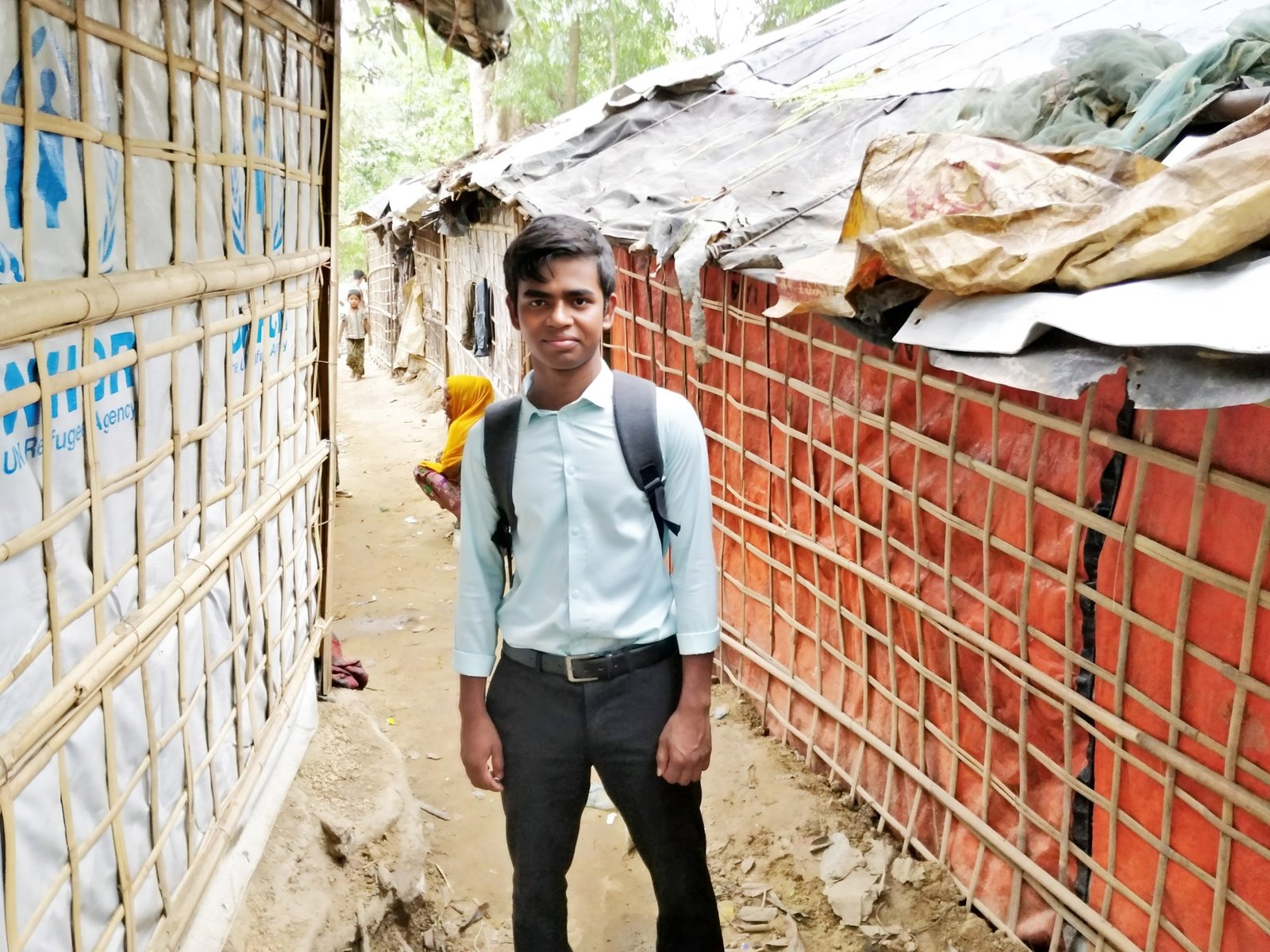
Forid Alam, born in Kutupalong refugee camp in Bangladesh, where he continues to live as part of a generation growing up in long-term displacement and statelessness.

I was born a refugee in Kutupalong camp in Bangladesh in   December 1998. The camp became my first sky, my first road,  my first prison. I inherited confinement. I was born into a  refugee-hood that for my parents has lasted more than three  decades. My story is of a people trapped between survival and  rejection, between memory and uncertainty. 

People often call the camps ‘shelters’, but it is an open-air prison  in its true sense. The fences may not always be made of  unbreakable iron, but they exist in every part of our lives. We  have been denied freedom of movement and expression, proper  education, livelihood, dignity, equal treatment and, for many  families, unity itself. 

We grew up watching roads that we could see but could not walk.  The outside world felt physically close yet unreachable. A refugee  born in the camp can spend decades living within a few  kilometres of land without ever experiencing freedom.  Restriction became normalised, as if movement itself were a  privilege rather than a human right. Checkpoints, surveillance  and the threat of arrest shaped ordinary life. A Rohingya asking  for rights was often treated as ungrateful; one demanding justice  could be seen as dangerous. 

The camps themselves were overcrowded and suffocating.  Families of six, eight, sometimes ten people lived in tiny  12-by-10-foot shelters made from bamboo, tarpaulin and mud.  During monsoon seasons rainwater entered homes and  destroyed belongings. In summer, the heat became unbearable.  Fires regularly turned entire blocks into ashes within hours. 

Camp residents gather around a tube well for water  and daily washing. Shared facilities and overcrowding are part of everyday life in Kutupalong. 

Education was one of the cruellest forms of deprivation. For  decades, formal education was heavily restricted. We were  allowed only limited learning up to primary, often without  recognised curricula, proper certificates, or opportunities for  higher studies. A refugee child could dream of becoming a  doctor, engineer, teacher, or writer, but the system reminded us  every day that such dreams were not meant for us. Those of us  who tried to study beyond the permitted limits had to do so  secretly, sometimes by hiding our identity within the host  community. 

I remember studying under difficult conditions, fighting against  the darkness of refugee-hood, hiding my identity, studying with  few books, little electricity and almost no opportunity. Yet  education became our resistance. Many Rohingya students  studied in secret like me, borrowed books from others, and  taught younger children voluntarily inside the camps, even  though such efforts were often discouraged or restricted. We  believed that knowledge was the only thing the fences could not  fully imprison. 

Despite restrictions on formal education, many Rohingya students continue to pursue learning as a path toward dignity, opportunity and self-determination. 

But even educated Rohingya refugees faced another painful  reality: there was no future waiting for us. We were not allowed  meaningful employment. Seeking livelihood was often portrayed  as a burden on the host country’s economy. Those who tried to  work outside the camps risked harassment, detention, or  exploitation. We became dependent on humanitarian aid, not  because we wanted dependency, but because policies denied our  self-reliance. Poverty inside the camps was not accidental; it was  manufactured by restriction.

This dependency slowly destroys human dignity. Imagine  growing up knowing your food, movement, education, and  future depend on decisions made by others. Imagine being  treated not as a human being with rights, but as a problem to be  managed. That is what concentrated refugee-hood feels like in  Bangladesh. Bangladesh is not a signatory to the UN Refugee  Convention, and its government often presents its role as a  humanitarian burden carried on behalf of the world. For those of  us inside the camps, this does not answer the deeper question:  what is the plan for a life beyond dependency, restriction and  indefinite waiting? 

Rice supplied to refugees bears the label  "Origin: Myanmar", a reminder of the country many Rohingya were forced to flee but remain unable to return to safely. 

Asking for justice, fair treatment, or protection was interpreted  as ingratitude. Inside the camps, justice was never equal. Power  belonged to host administrators, security forces and systems  beyond our control. A refugee’s voice carried little weight.  Complaints often disappeared into silence. Abuse, exploitation,  and discrimination became things many endured quietly  because speaking out could bring punishment. Back in 2002, my  father raised his voice against a government plan for ‘forced  repatriation’ and was jailed three times as a result. My father  struggled quietly to preserve our dignity while having almost  nothing. 

Growing up in the camp also meant growing up stateless.  Statelessness, for me, is not only the absence of citizenship. It is  the absence of protection, belonging and recognition. It means  watching illness, death and hardship pass through a family  without the security that others take for granted. 

Perhaps the most painful denial has been family unity. Refugee  resettlement programmes, while lifesaving for some, also created  invisible divisions inside my family. Some were split across  continents, leaving behind emotional fractures that never  healed. My family carries this wound across generations. Years  ago, through a resettlement scheme to the United Kingdom, my  grandmother and three of my father’s brothers, along with  around twenty family members, were resettled abroad. My  father, however, remained trapped in the refugee camp with his  children. From that moment, an invisible line separated our  family into two worlds, those allowed to live with dignity and  opportunity, and those left behind in confinement.

My father spent the rest of his life in the camp without seeing his  mother again. He watched others rebuild their lives abroad while  he remained with the same restrictions, poverty and uncertainty.  He died in the camp, separated not by love, but by systems and  

borders. 

Years of displacement and overseas resettlement have separated many  Rohingya families, leaving relatives divided across countries and  generations. 

Today, I am living through the same experience. After my father’s  death, two of my elder sisters, who had become the heads of our  family, were resettled in Canada. Again, part of the family  escaped the camp while the rest remained trapped inside it. I live  with my younger siblings in uncertainty, somewhere between  hope and abandonment. 

This division is not only physical; it is psychological. One family  member speaks of university, work, healthcare and freedom;  another speaks of food rations, checkpoints, camp violence and  survival. Even love struggles to bridge such unequal worlds.  Refugee-hood slowly creates emotional distances that geography  alone cannot explain. 

I grew up with trauma inherited from parents who fled massacre,  rape and persecution in Myanmar, only to face confinement in  Bangladesh. For my family, hope itself has become a 35-year  refugee experience. We have lived generation after generation  inside temporary shelters that became permanent prisons.  Without rights, my younger siblings and I fear ending our lives in  the camp, as my parents and grandparents did. 

I constantly struggle with one question: what does it mean to be  human if your humanity is always questioned? A child who  cannot study. A mother who loses hope. A father who cannot  provide. A student whose talent remains trapped behind fences.  These are not abstractions. They are the lives around me. 

No human being deserves to spend their entire life inside an  open-air prison. I do not ask for luxury. I ask for what every  human deserves: dignity, freedom, education, safety, justice and  the right to live as human beings, not as permanent outsiders to  the world.

By Forid Alam

He was born in Kutupalong refugee camp in Bangladesh and continues to live there despite having found a way to gain a university education.

Related News

India’s cockroach swarm: youth anger and democracy’s warning signal

By Dr Madhavi Ravikumar July 2026

In May an unexpected political emblem emerged in India’s increasingly restless democratic landscape: the cockroach. An insect commonly associated with filth, nuisance and extermination was transformed into a symbol of resistance after the Chief Justice of India likened unemployed young activists and online critics to ‘cockroaches’ and ‘parasites’. What might have passed as an insensitive remark sparked an extraordinary act of political reclamation. Within hours, the insult was transformed into a rallying cry. Madhavi Ravikumar reports.

Bangladesh’s Rohingya community: a crisis without an exit

By Sushmita S Preetha July 2026

When Bangladesh’s new BNP-led government assumed office, Rohingya refugees once again found themselves listening closely to the language of power in Dhaka. The familiar words had returned: repatriation, shortage of funds, national security, and international cooperation. Sushmita S Preetha reports from Dhaka.

Power lines across the Himalayas

By Dr Udisha Saklani July 2026

For much of the past two decades, South Asia’s energy security has been defined by distance, particularly its dependence on oil and gas imports from the Gulf. Recent volatility in the Middle East has added urgency to a quieter, longer-term trend: the push to trade electricity across the region’s own borders. Udisha Saklani reports.

India and neighbours weather the Hormuz blockade

By Kavita Chowdhury June 2026

South Asian countries have been badly affected by the virtual closure of the Strait of Hormuz. Kavita Chowdhury reports on how fuel shortages are affecting people in India, Bangladesh and the Himalayan region.

Subscribe and login

Unlock Your Daily Briefing

Get the latest headlines, exclusive reports, and important updates delivered directly to your inbox.