In May an unexpected political emblem emerged in India’s increasingly restless democratic landscape: the cockroach. An insect commonly associated with filth, nuisance and extermination was transformed into a symbol of resistance after the Chief Justice of India likened unemployed young activists and online critics to ‘cockroaches’ and ‘parasites’. What might have passed as an insensitive remark sparked an extraordinary act of political reclamation. Within hours, the insult was transformed into a rallying cry. Madhavi Ravikumar reports.

What began as an insult was transformed into a symbol of resistance, as young Indians used the cockroach to express frustration with unemployment, exclusion and unresponsive institutions. Photo: CJP Website
The transformation began when Abhijeet Dipke, a 30-year-old political communications strategist studying in the United States, posted a provocative question on social media: ‘What if all cockroaches come together?’ Days later, he launched the Cockroach Janata Party (CJP), a satirical political formation that described itself as a movement ‘of the youth, by the youth, for the youth’.
What began as a digital joke quickly evolved into a political phenomenon. Millions followed the movement online, hundreds of thousands signed petitions, and the cockroach became a symbol of a generation that feels increasingly ignored, ridiculed and excluded from institutions meant to represent it. The movement’s appeal lies not merely in its satire but in its ability to channel a growing sense of democratic exclusion. As Dipke himself put it, ‘People are frustrated because they don’t feel heard or represented’.
The economic roots of youth anger
The judicial comment may have been the spark, but the fuel had been accumulating for years. India has more than 300 million young people aged 15–29, yet the promise of education as a pathway to social mobility is increasingly fragile. According to Azim Premji University’s State of Working India 2026 report, nearly 40 per cent of graduates under 25 are unemployed, while unemployment among graduates aged 25–29 stands at around 20 per cent. Half of all young Indians in this age group are unemployed, underemployed or trapped in insecure work.
These figures challenge a core assumption of post-liberalisation India that education automatically leads to opportunity. For millions of young Indians, degrees have become credentials without guarantees, often resulting in insecure jobs, low wages, or prolonged unemployment. The outcome is not only economic insecurity but a profound sense of betrayal as a generation promised upward mobility confronts shrinking prospects.
 Millions of educated young Indians face unemployment, underemployment or insecure work despite rising levels of educational attainment. Image AI generated
Behind these statistics are personal stories. Ankita Sharma, a 24-year-old engineering graduate from Hyderabad, said she was ‘overqualified for my job and also underpaid’. Nikhil Sood, a 23-year-old MBA graduate from Bengaluru echoed a similar frustration: ‘I have the degree, but where are the opportunities? This feels like the first time someone is speaking for us.’
Examination scandals and the erosion of trust
Repeated examination scandals have deepened this sense of betrayal. Controversies surrounding the medical entrance exam, recruitment examinations in general and evaluation procedures have eroded confidence in systems once viewed as pathways to meritocratic advancement.
The movement’s success reflects how political communication has evolved in the digital era. While conventional parties rely on ideology, organisation, and leadership structures, the Cockroach Janata Party thrives on irony, memes, humour, and cultural references familiar to digitally native generations. Its deliberately absurd membership criteria masked serious concerns about employment, educational accountability, media ownership, and political representation. What sets the movement apart from many online campaigns is its transition from digital visibility to physical mobilisation.
 Repeated controversies involving entrance and recruitment examinations have weakened confidence in systems once seen as pathways to opportunity and merit.
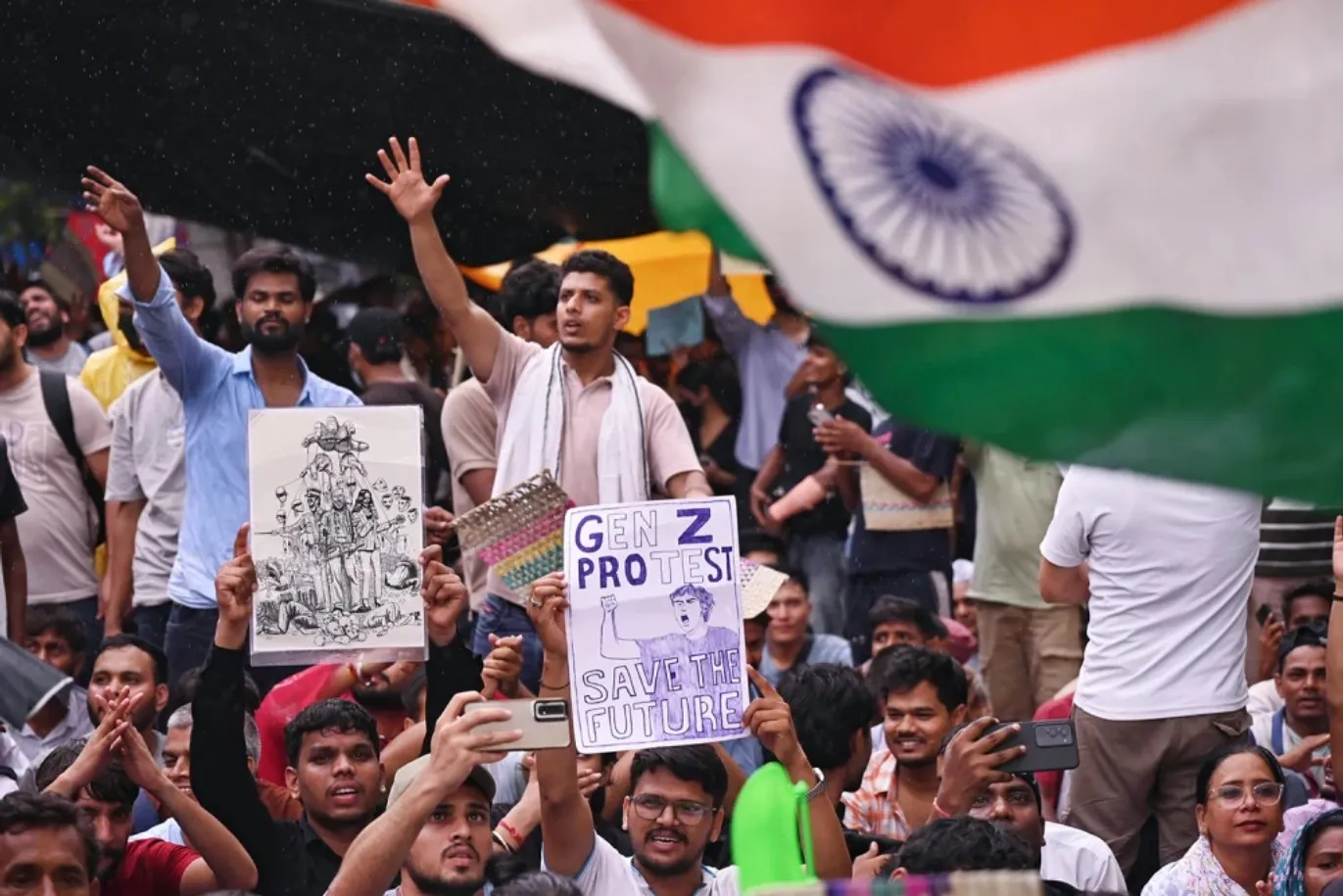
The 6 June protest at Delhi’s Jantar Mantar drew thousands demanding accountability over examination controversies and educational governance failures, sparking similar demonstrations in Pune and Hyderabad in the days that followed. Many demonstrators wore cockroach masks, transforming a symbol of humiliation into one of defiance. Supporters described the movement as providing a voice where none previously existed. One participant admitted that many young people had ‘almost given up’ before the movement emerged. ‘Now there is a platform for us.’
Digital repression and the politics of visibility
The rise of the CJP has exposed a growing tension in contemporary democracies. As the movement gained momentum online, supporters alleged that some of its social media accounts faced restrictions, suspensions, hacking attempts, and heightened scrutiny. Whether these disruptions stemmed from platform moderation, coordinated reporting, cyberattacks, or administrative intervention remains contested, but their democratic implications are difficult to ignore.
 Digital platforms allowed dispersed frustrations over jobs, education and representation to coalesce into a nationwide movement. Photo: Britannica Website
For a movement born on social media, visibility is not merely a communication tool but its primary political resource. The CJP emerged because digital platforms transformed dispersed frustrations over unemployment, examination scandals, and political exclusion to coalesce into a collective voice. When access to those platforms becomes uncertain, questions of free expression, political participation, and democratic accountability inevitably arise.
A regional pattern of youth discontent
The CJP also fits into a wider Asian pattern. From Bangladesh’s student protests to Nepal’s Gen Z mobilisation and Sri Lanka’s Aragalaya uprising, educated young people have used digital platforms to challenge unresponsive institutions. India’s context is different, but the underlying tension is familiar: strong growth coexists with anxiety over jobs, education and social mobility. The harder question is whether online solidarity can last. Social media can spread anger quickly, but durable politics requires organisation, trust and long-term commitment. Digital activism can be rapid and powerful, but it often lacks the institutions — unions, parties, campuses and civic associations — that turn anger into sustained political change.
A democratic warning sign
Indian political commentator R. Jagannathan has argued that the ‘cockroach’ should be seen not as a nuisance, but as a signal of a larger democratic challenge. India’s political establishment remains dominated by older generations, while its future depends on young citizens facing growing uncertainty. The generational disconnect is becoming increasingly difficult to ignore. Youth dissatisfaction is no longer merely an economic issue but a democratic one. When young people feel excluded from meaningful participation, democratic legitimacy comes under strain. India’s demographic dividend will matter only if young people see credible jobs, fair exams and meaningful representation.
 Supporters wearing cockroach masks gather at Delhi's Jantar Mantar during a protest over examination controversies, unemployment and youth representation. Photo: PTI
Beyond the swarm
Whether the Cockroach Janata Party survives as a political organisation remains uncertain. Many digital movements fade quickly, while others are absorbed into mainstream politics or reshape public debate. The cockroach is less important than the conditions that produced it: unemployment, exam distrust, insecure work and a sense that institutions are not listening. As one supporter put it: ‘The cockroach survives everything—we will too.’ For India’s democracy, the challenge is not to suppress the swarm but to listen to it. Across Asia, unemployment, economic insecurity and democratic disillusionment are reshaping politics. India’s cockroach swarm is unlikely to be the last sign of this trend.