Yavar Abbas lived the first part of his life in undivided British-ruled India and the second in Britain, maintaining close contacts with the land of his birth. Last year, at a celebration to mark the end of the Second World War in Asia, in which Yavar fought in Burma, he brought tears to the eyes of King Charles III and Queen Camilla by speaking publicly of the King’s battle with cancer. Yavar is nearing his 106th birthday, so Democracy Asia felt this centenarian deserved to express his personal view.
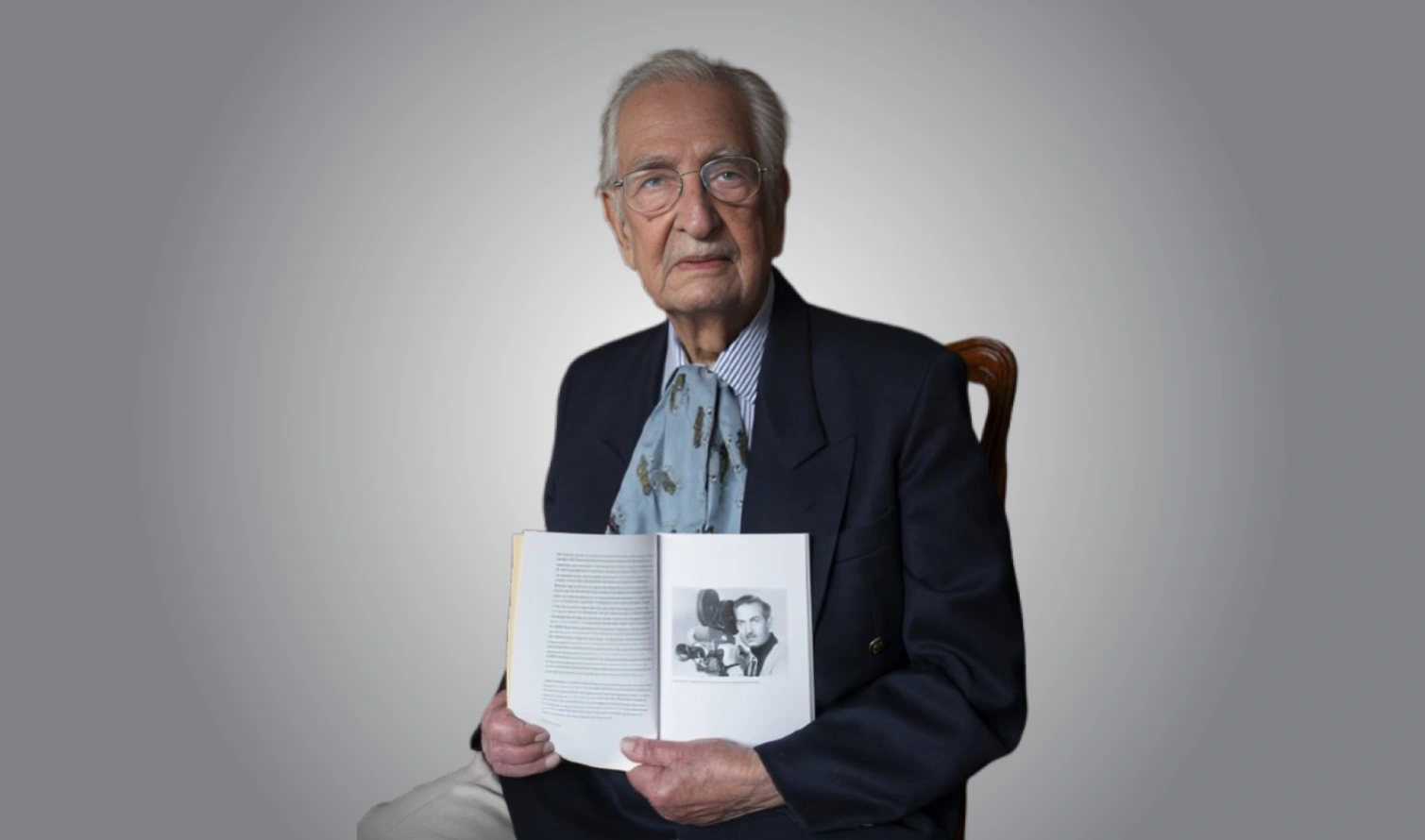
Yavar Abbas, veteran, writer and film-maker, reflects on the legacy of Partition, arguing that the division of British India was a historic mistake. Photo: Royal British Legion
My wife persuaded me to write my memoirs and I was getting on well – I’d completed twelve out of sixteen chapters. And then Benjamin Netanyahu intervened with his ghastly war in Gaza. How can he hound Palestinians out of their rightful homeland in the way he is doing? What gives him the right to determine nation states according to religion? Israel may have been granted the right by international powers to create a Jewish homeland in Palestinian territory. But nobody gave him the right to hound Palestinians out of their homeland in the way he has been doing.
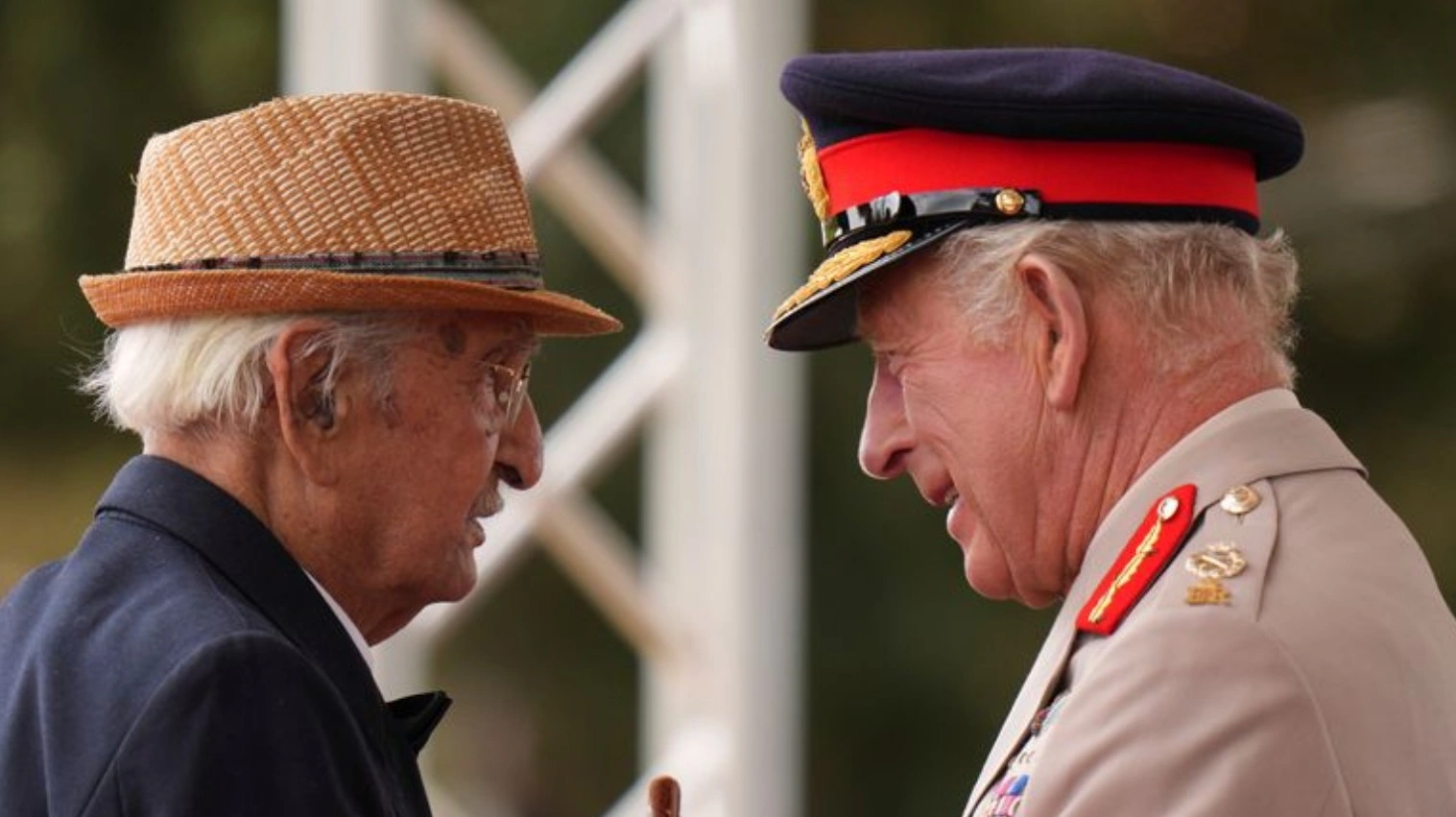 Yavar Abbas greets King Charles III at the VJ Day 80th anniversary service in 2025. The veteran's reflections at the event renewed attention to his memories of war, Partition and South Asia. Photo: PA Media
The imbroglio in the Middle East made me think of my own homeland: India! My India! By that, I mean the ‘real’ India, unpartitioned India, whose constituent parts are Bharat, Pakistan and Bangladesh. It is facing an existential threat because it is living and perpetuating a monumental lie: that Hindus and Muslims are two different nations.
Let us take Pakistan first, which was created on the basis of a spurious ‘two-nation’ theory. It has no moral, or perhaps even legal, basis for existence as the theory which was its lifeblood was drained dry by the creation of Bangladesh. Its founders had in 1970 convincingly won what was arguably the only fair and clean election ever held in the short history of Pakistan. It is indeed Bangladesh, as the majority shareholder in a wasting asset, who had a prior claim to the brand Pakistan. ‘Pakistan’ ceased to exist in 1971, except in the imagination of a set of people who continue to flog a dead horse in the vain hope that it will revive and run again.
 Yavar Abbas shares his reflections on Partition, arguing that its legacy continues to shape South Asia today.
Bangladesh itself missed a golden opportunity. It should have reunited with another absurd entity called West Bengal (for the name assumes there is an East Bengal) to become a natural Bangladesh – thus setting an example for the mockery that are the two Punjabs. So, Bangladesh too is facing a potentially existential crisis if it continues to pursue its ‘Islamic’ agenda to become, like Pakistan, a pale copy of Saudi Wahabistan.
As for our Bharat, it is facing the more serious existential threat of Balkanisation with its current regime pushing through its Hindutva agenda. The South will never accept the northern version of the mythical Ramayana and will continue to venerate Ravana instead of Rama. The ‘Dalits’, conveniently so called, will never accept their institutionalised status as a sub-caste in the evil of the caste system devised by Brahmins and their cohorts. The Ambedkarite Buddhists will not always be peaceful chelas [disciples] and will fight to break the chains of thousands of years of shameful slavery being re-tightened under the cloak of Hindutva. And the Kashmiris will never submit to India’s remit and will fight against the tyrannical occupation of their beautiful and otherwise peaceful land by both Bharat and Pakistan.
Reverting to Pakistan, Sindhis will never reconcile themselves to the hegemony of Punjab or the MQM [political party]; Balochistan will be even less inclined to be rolled over willingly by the Punjabi juggernaut; as for the Frontier Province, the very name change, Khyber Pakhtunkhwa, sends out a clear hint of their intent to assert their own separate entity. That leaves just half of Punjab, the other half being in Bharat, holding a tattered flag as a fig leaf.
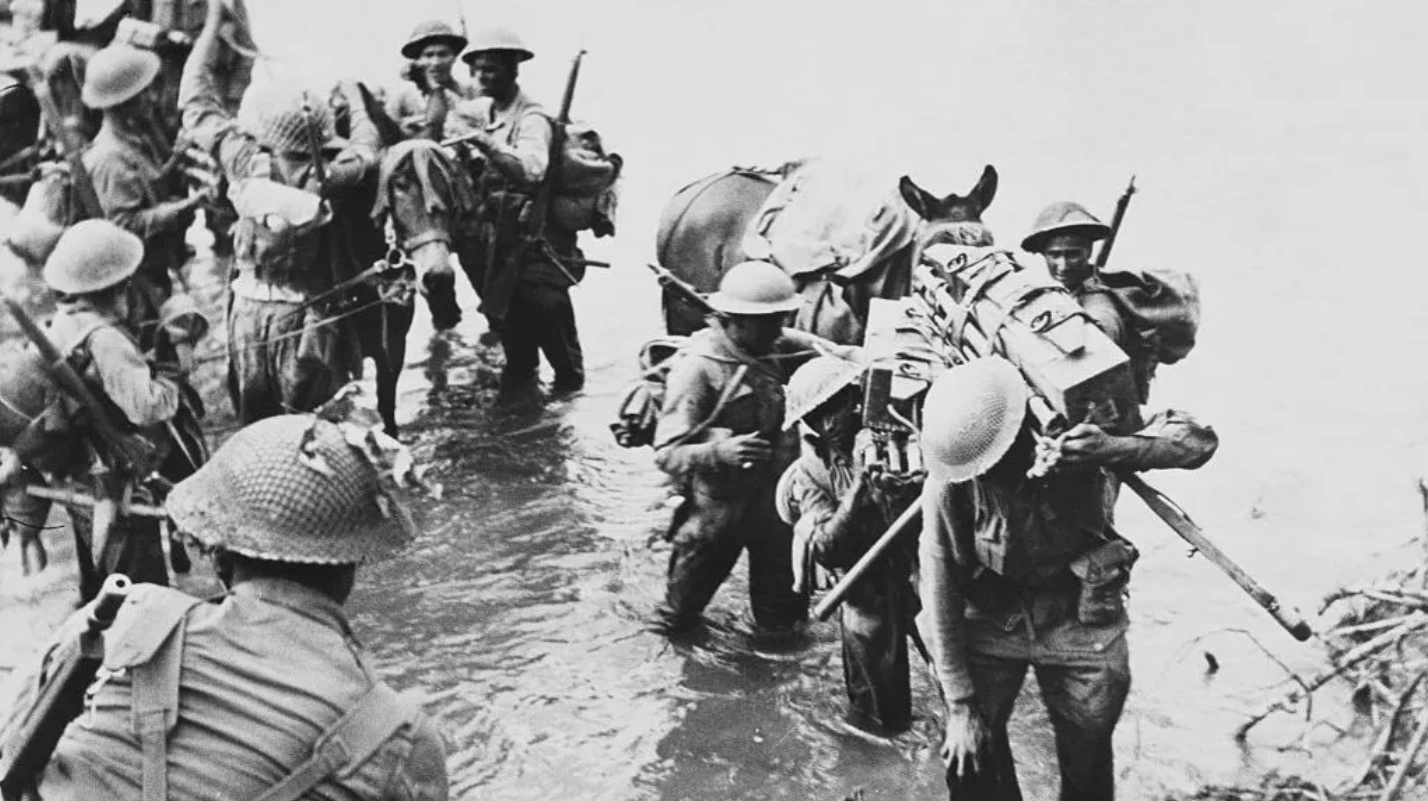 The British Fourteenth Army fought to retake Burma during the Second World War. Yavar Abbas served in the campaign with the Sikh Regiment. Photo: Archive Photos/Getty Images
I am using the term ‘Bharat’ intentionally, because it is part of the coinage the flip side of which is Pakistan and Bangladesh. India! My India!, on the other hand, was something different – a wholesome entity where Hindus, Muslims, Sikhs, Christians, Parsis, Jains, Jews and Gentiles had learnt to live together in spite of an alien power sowing the seeds of discord, first as traders turned part-time rulers and later as rulers turned part-time traders. And when the trade was no longer profitable, the rule was hurriedly folded up. Partition was seen as the cheapest way out of the mess they themselves had created, and let the devil take the hindmost. In hindsight, though, it emerges that Partition was something no one really wanted – not Jinnah, not Nehru, not Gandhi, not the Muslim League, not the Indian National Congress and not even, towards the end, the British.
It may be argued that I am inventing the sequence of events to suit my version of what happened. Let me give you the evidence straight from the horse’s mouth. Maulana Abul Kalam Azad, whose credentials as a freedom fighter can only be denied by people who know little about the freedom struggle and care even less, is my witness. He was there, twenty-four-seven, as the events moved to the tragic denouement of Partition, and he was there right at the centre of the talks as the chief negotiator for India in his capacity as the president of the Indian National Congress. The model for the British Cabinet Mission Plan of 16 May 1946 was the statement publicly issued by the Maulana the previous month, which deserves to be quoted here.
‘I have considered from every possible point of view the scheme of Pakistan as formulated by the Muslim League. As an Indian I have examined its implications for the future of India as a whole. As a Muslim I have examined its likely effects upon the fortunes of Muslims in India. Considering the scheme in all its aspects I have come to the conclusion that it is harmful not only for India as a whole but for the Muslims in particular. And in fact it creates more problems than it solves.’
‘I must confess that the very term Pakistan [which means ‘land of the pure’ in Urdu] goes against my grain. Further it seems that the scheme of Pakistan has been built up on the analogy of the Jewish demand for a national home. One can sympathise with the aspiration of the Jews for such a national home, as they are scattered all over the world and cannot in any region have any effective voice in the administration. The condition of Indian Muslims is quite otherwise. Over 90 million in number, they are in quantity and quality a sufficiently important element in Indian life to influence decisively all questions of administration and policy.’
‘Let us consider dispassionately the consequences which will follow if we give effect to the Pakistan scheme. India will be divided into two states, one with a majority of Muslims and the other of Hindus. In the Hindustan State there will remain three and a half crores [35 million] of Muslims scattered in small minorities all over the land. They will awaken overnight and discover that they have become alien and foreigners. Backward industrially, educationally and economically, they will be left to the mercies of what would become an unadulterated Hindu raj.’
What a prescient statement. Why oh why did we not listen to our own seer? To his credit, Azad tried desperately to stop victory being swallowed up by the jaws of defeat. But by then, to mix the metaphors, he had handed over the baton to a younger member of the team in the hope that he would take it to the finishing line in great style. But unfortunately, the baton became a mighty clanger that was dropped in panic.
It is human to make a mistake, but it is madness to make more serious mistakes to justify the original one. We can see that Bharat, Pakistan and Bangladesh are not working, but we are persisting in trying to push a square piece in a round hole. Talking of holes. We dug one for ourselves in 1947 and we keep on digging without realising that the hole is getting deeper and deeper and, if we keep on, it will be impossible to come out of it even if we wanted to.
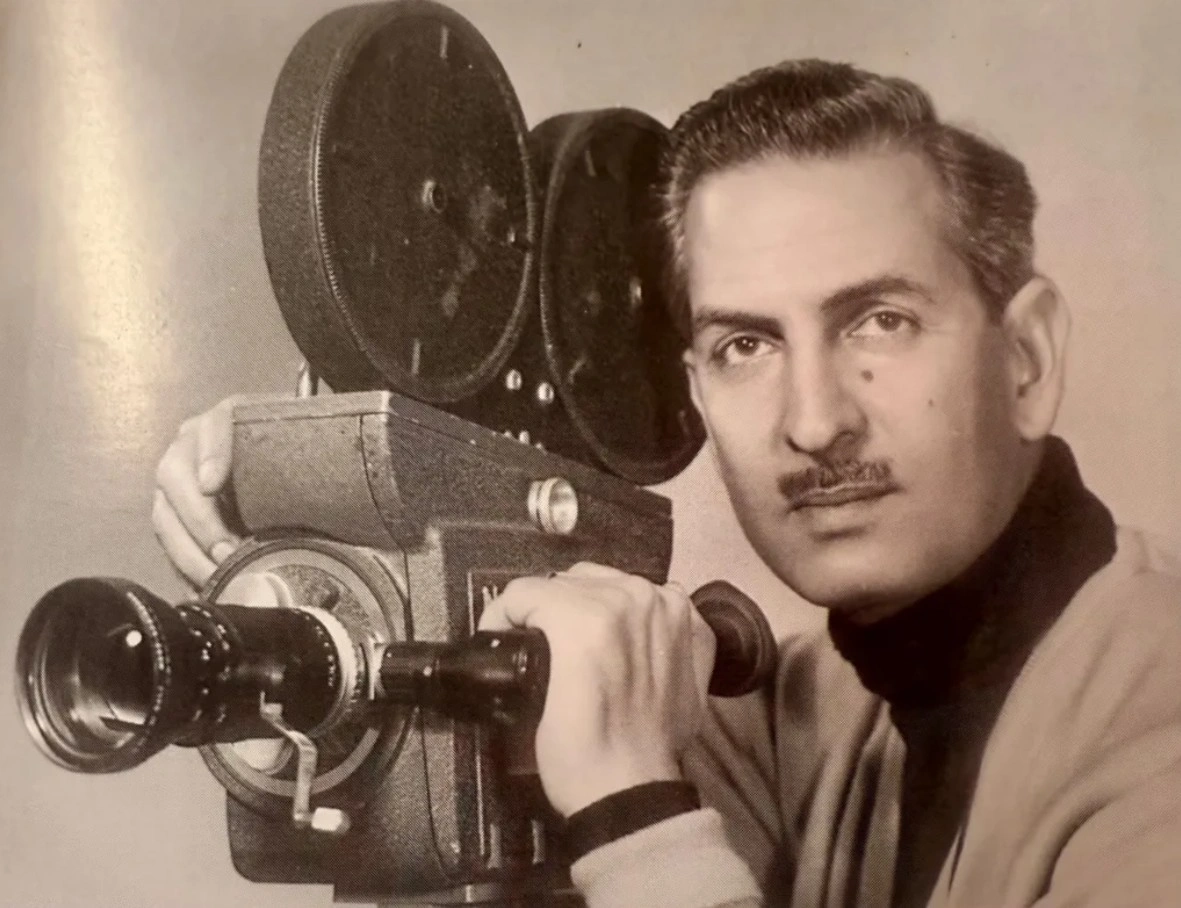 After the war, Yavar Abbas worked for the BBC as a cameraman, producer and writer, documenting events around the world. Photo: Yavar Abbas
So, I say ‘Stop digging. There is still time. It is still possible to crawl our way out of it.’ And when we do, we will be able to see clearly in daylight and begin to put the broken pieces together again. And this time we will build with the full knowledge that we have been there, done that, and have seen that it doesn’t work. That is about the only plus that we can rescue from the ruins of the historic blunder of 1947: the uncomfortable and visible evidence that Partition of India doesn’t work. It has brought nothing but misery on an industrial scale to all the partitioned parts of India, be they Bharat, Pakistan or Bangladesh, who are all outdoing each other, marching backwards. The beards are getting bushier, the hijabs are graduating to burqas, and the lynchings are becoming the new sport.
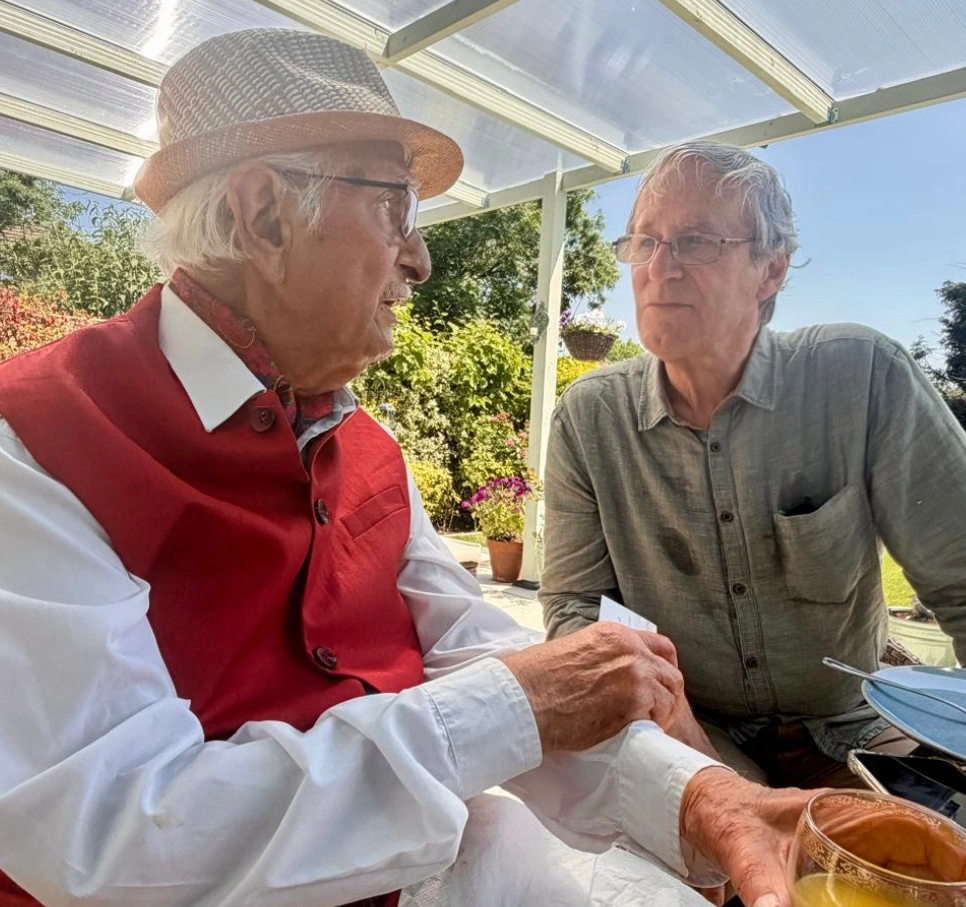 Yavar Abbas with Democracy Asia editor Nicholas Nugent, whose conversations with the veteran inspired this reflection on Partition and its enduring legacy.
We have the examples of Ireland – the division of the island by religion that doesn’t work. Even worse, that of Palestine, divided around the same time as India and still in turmoil, at war as a result of the division of a land by religion.
So please stop digging in India. Come out of the hole. There will be helping hands to haul you up. Come out and start building a truly secular and wholesome United States of India – something that was within our grasp, thanks to Maulana Abul Kalam Azad, and we let it go for a mess of pottage.