India is often narrated as two separate stories that only occasionally touch: those of the world’s largest democracy and of a developing economy still trying to provide prosperity on a continental scale. A Sixth of Humanity rejects that separation and argues instead that India’s politics and economics have never been parallel tracks; they are one braided history, each strand tightening or loosening the other, and the knot they form is what the authors want us to see. Rahul Jaywant Bhise has been reading this weighty book.
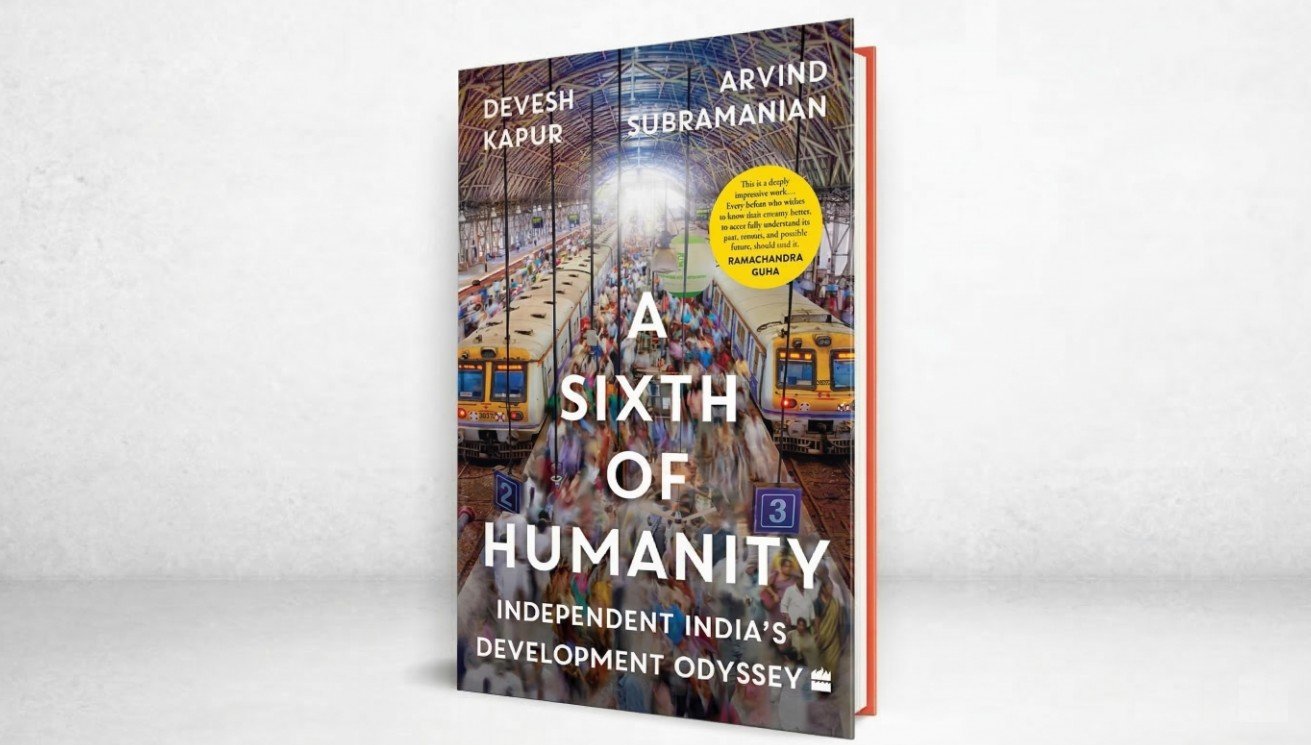
The book A Sixth of Humanity: Independent India’s Development Odyssey examines how India’s politics and economics evolved together over seventy-five years of independence. Publisher: HarperCollins India
India is often narrated as two separate stories that only occasionally touch: those of the world’s largest democracy and of a developing economy still trying to provide prosperity on a continental scale. A Sixth of Humanity rejects that separation and argues instead that India’s politics and economics have never been parallel tracks; they are one braided history, each strand tightening or loosening the other, and the knot they form is what the authors want us to see. Rahul Jaywant Bhise has been reading this weighty book.
Devesh Kapur (a political scientist) and Arvind Subramanian (an economist and former chief economic adviser to the Indian government) take on an old ambition with an unusually disciplined method: to explain seventy-five years of India as a single developmental experiment carried out under extreme constraints: mass poverty at Independence, radical social diversity and universal adult franchise from day one.
The book’s core claim arrives early and echoes throughout: India has been ‘precocious’ − attempting tasks ‘ahead of their time’, in an order that defied the familiar scripts of development: democracy before development; services before manufacturing; globalisation that rewarded the mobile and educated before the poor had ladders to climb; laws and rights promised faster than administrative capacity could deliver them.
‘Precocious’ is not used here as praise or scolding; it is the authors’ way of making timing itself into an explanatory variable. In their telling, chronology becomes causality: doing the ‘right’ things in an unusual order can produce achievements no model predicts − and frictions no model easily resolves.
Political scientist Devesh Kapur and economist Arvind Subramanian bring together policy history, economics and political analysis. Photo: Midland the Bookshop
The sheer scale of A Sixth of Humanity − around 760 pages − signals that this is not a quick argument, it is an attempt at synthesis: politics, economic policy, state capacity, social transformation, nation-building, and the often-overlooked machinery of Indian federalism.
India, uniquely, attempted four concurrent transformations − building a state, creating an economy, changing society, forging a sense of nationhood − under universal suffrage. The book keeps returning to this fourfold frame, not as a slogan but as a discipline: any claim about markets must be reconciled with the pressures of democracy; any claim about national unity must be reconciled with the realities of caste, patriarchy, region, language.
Methodologically, the authors place unusual weight on the state’s own paper trail − thousands of official reports and policy documents, read as artifacts of how India’s policy-makers understood the problems of their time. That archival seriousness gives the narrative a particular texture: it is not only a story of what India became, but of what it thought it was trying to become at different moments.
And yet the book is not written like an archive. Its stance is closer to a long walk than a lecture: sweeping in horizon, but attentive to the stubborn details that keep tripping big theories.
The book refuses to romanticise the post-Independence decades which, the authors argue, were marked by sluggish growth, persistent poverty and limited structural transformation − particularly the failure to move labour at scale from agriculture to productive industry. They try not to judge the 1950s and 60s by the moral confidence of hindsight. Scarcity was real; national fragility was real; and the instinct to build a public-sector-led economy was, in context, understandable.  India’s Parliament reflects the book’s central argument that democracy came early in the country’s development journey, shaping policy choices and state capacity. Photo: Ministry of Parliamentary Affairs (GODL-India)
But they also argue that India’s version of planning was distinct in a damaging way: it not only sheltered domestic industry from foreign competition; it constrained India’s own private sector through a dense lattice of permissions and controls − the infamous Licence Raj − which stunted entrepreneurship and created fertile ground for corruption.
Democracy as a constraint
If ‘precociousness’ is the book’s master concept, democracy is its most complicated character. Kapur and Subramanian treat Indian democracy as a developmental instrument, not merely a constitutional ornament. Democracy, in their framing, was central to nation-building: it offered a way to forge political belonging in a society divided vertically by caste and gender and horizontally by language, region and religion.
The book insists that sustaining electoral democracy and ‘a modicum of order’ at India’s scale − especially through poverty − counts as a major achievement in itself. This is an argument about what success looks like when your unit of analysis is not a city-state or a small nation, but one-sixth of humanity. And then comes the book’s second move: democracy also exacted economic costs. Leaders could not rely on coercive tools used elsewhere; land reform never became transformative; electoral pressures favoured visible welfare spending over slow-burn investments in public goods like learning and public health. Subramanian describes democracy as something that ‘gives and takes’.
The book does not try to resolve this tension into a verdict. It keeps it alive. It asks the reader to inhabit the contradiction: democracy is both India’s great adhesive and one reason the state struggled to become a high-capacity developmental machine.
The book’s signature argument about India’s economic structure is sharper: India’s growth has been unusually tilted. It found global success in high-skilled services, while failing to generate enough low-skill, productive manufacturing jobs for the vast majority of its workforce.
India climbed – yet the ladder often lacked middle rungs. One of the book’s most useful reorientations is its insistence on looking away from Delhi. The authors emphasise that many of the sectors that determine daily well-being − health, education, agriculture, law and order, electricity − sit constitutionally with state governments. If development is lived locally, then development must be explained locally. Bengaluru’s technology sector illustrates the book’s argument that India’s growth has been unusually driven by high-skill services rather than large-scale manufacturing.
Their portrait of Indian federalism is not romantic. Accountability failures and corruption are often worse at the state level, they argue, even as some regions have demonstrated striking dynamism after liberalisation − evidence that states can be engines of both stagnation and transformation.
Here the book becomes something rarer than a national economic history: it becomes a map of unevenness, a reminder that ‘India’ is frequently shorthand for a set of divergent political economies loosely bound by a common constitution.
A Sixth of Humanity is not only a history of what India built. It is also a history of what India could not easily stop building, regulate down or simplify. The ‘exit problem’ turns out to be an institutional explanation with moral consequences: when governments cannot exit badly designed policies, citizens live inside the clutter.
That emphasis − exit as discipline, not just entry as ambition − may be the book’s most quietly original contribution to how we talk about governance.
What lingers?
In the end, the great achievement of A Sixth of Humanity is not that it tells India as a new story; rather it persuades you that India is not one story at all, but a set of simultaneous stories forced to cohere.
Its most lasting question is less ‘Why didn’t India become China?’ but more unsettlingly ‘What does development mean when democracy arrives first, when society changes unevenly, when markets expand before the state can regulate fairly, and when nationhood must contain rather than homogenise?’
The book’s title is not metaphorical; it is arithmetical. If one-sixth of humanity succeeds, or fails, the consequences do not remain Indian. The authors’ deeper wager is that to understand those consequences, we must stop treating politics and economics as separate shelves.
India’s development, in their telling, is not a march it is an odyssey: movement without guarantee, progress without linearity, and a destination that keeps changing shape as the traveller grows.
Rahul Jaywant Bhise is an independent journalist and public policy professional, with a focus on urban governance, political economy and urban development.