The Indonesian capital Jakarta has overtaken previous front runners Dhaka and Tokyo to become the world’s most populous city according to a United Nations report which reveals that all but one of the world’s largest cities are in Asia. Rahul Jaywant Bhise reports.
The Indonesian capital Jakarta has overtaken previous front-runners Dhaka and Tokyo to become the world’s most populous city, according to a United Nations report which reveals that all but one of the world’s largest cities are in Asia. Rahul Jaywant Bhise reports.
The UN’s World Urbanization Prospects report puts Jakarta’s population at close to 42 million, compared with around 37 million in Dhaka and 33 million in Tokyo. This reflects a new way of counting. Instead of relying on administrative boundaries, the UN now measures contiguous built-up urban areas, tracing where the city’s physical fabric merges into surrounding settlements. A city is defined by uninterrupted streets and neighbourhoods rather than by the borders of municipalities or provinces.
That distinction is crucial. Administrative boundaries are often historical artefacts: too tight to capture dense commuter belts and too loose to reflect lived urban reality. Commuting, water supply, housing markets and flood risk do not stop at jurisdictional lines. Counting built-up areas is an attempt to align statistics more closely with how metropolitan regions actually function.

Commuters crowd a train platform in Jakarta during peak hours, highlighting the intense daily movement across the wider Jabodetabek metropolitan region. Photo: Fajrul Islam/Shutterstock
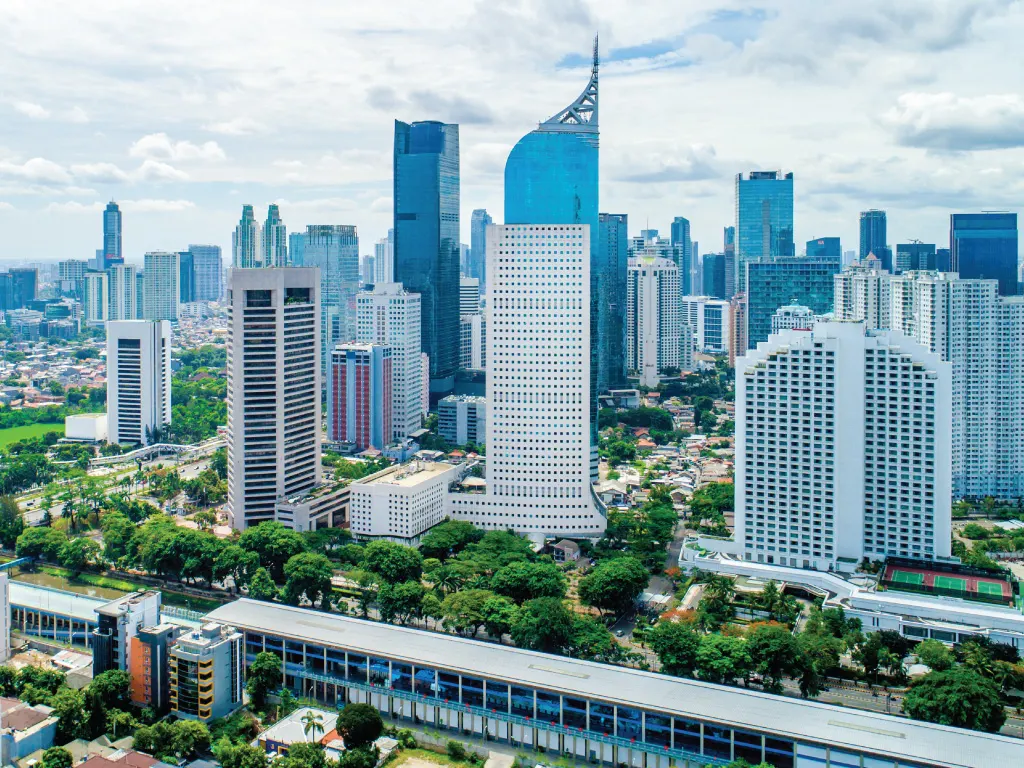
By that standard, Jakarta no longer looks like a capital with suburbs. It appears as a sprawling metropolitan mass. Indonesians have long described this reality through the acronym‘Jabodetabek’, linking Jakarta with Bogor, Depok, Tangerang and Bekasi. The conurbation is held together by commuting patterns, industrial zones, logistics corridors and housing estates that stretch far beyond the city’s formal limits. Where one ends and another begins is often a matter of signage, not urban form.
The broader pattern is unmistakable. Nine of the world’s ten largest cities are in Asia. Alongside Jakarta, Dhaka and Tokyo are New Delhi, Shanghai, Guangzhou, Manila, Kolkata and Seoul. The Egyptian capital Cairo is the lone exception. Urban scale, once associated mainly with Europe and North America, has shifted decisively east and south, following demographic momentum and the pull of expanding labour markets.
This goes beyond statistical rearrangement but shows a profound shift in people's lifestyles and occupations. Nearly half of the world's population now lives in cities, and the number of megacities has increased significantly in recent decades. Asia is home to more than half. However, size is not the whole picture. With fewer resources and less political focus, many of the fastest-growing urban places are smaller cities dealing with comparable constraints, such as housing, transportation, public services, and climate risk. An extreme example of a broader trend is Jakarta, where institutions are finding it difficult to keep up with the rate of urban transformation.

Heavy traffic clogs a main road in central Jakarta, where rapid urban growth has placed severe pressure on transport infrastructure. Photo: Oryzapratama/ Shutterstock
Jakarta’s rise has been long in the making. For decades, the city has drawn people from across Java and from other islands such as Sumatra and Sulawesi, pulled by jobs, education and the promise – often elusive – of social mobility. The capital concentrates universities, hospitals, corporate headquarters and state institutions, anchoring Indonesia’s finance, trade and media industries. Migration is a rational response to where opportunity and services remain densest even as costs rise.

Residents wade through floodwater in a Jakarta neighbourhood, as land subsidence and rising sea levels increase the city’s vulnerability to extreme weather. Photo: RAF.Contributor/Shutterstock
There is growth everywhere and it manifests itself in different ways. The rapid development of high-rises is changing consumption habits and skylines. Long-standing kampungs or villages draw more residents into their set footprints at street level, increasing the number of stories and making daily life more intense. Long commutes and a greater reliance on long-distance travel are caused by new subdivisions and industrial parks encroaching on formerly agricultural areas on the outskirts of cities.
These pressures explain Indonesia’s decision to move its political capital to Nusantara, a new city being constructed out of jungle on the island of Borneo. The planned move is a reaction to demands on governance and concern that Jakarta is sinking thus increasing the risk of severe flooding. Yet the UN report underlines a reality: shifting ministries does not shift people. Jakarta remains the country’s dominant urban and economic centre and the wider metropolitan system will continue to shape national productivity and inequality.

High-rise apartments tower over a densely populated kampung in Jakarta, illustrating the stark contrasts created by rapid urban development. Photo: Een Arin Pakaludin/Shutterstock
Cities of this scale test the limits of governance. Transport networks, water systems, housing supply and waste management operate across municipal boundaries, while authority remains fragmented. Jakarta is not unique in this respect, but its size magnifies the problem. A rail extension, flood barrier or zoning decision in one jurisdiction can generate effects across the entire urban basin.
Inequality sharpens the picture. Opportunity is concentrated, but access to services is uneven. While low-income people are forced to live in places more vulnerable to flooding and environmental stress due to a lack of affordable housing, high-end developments are located near informal settlements. Environmental pressure adds another layer. The UN report notes that, globally, cities have expanded their physical footprint far faster than their populations since the 1970s, often consuming farmland and wetlands. For low-lying coastal cities such as Jakarta, the consequences are already visible as dense settlement collides with flooding, subsidence and rising seas.
Jakarta’s new status is therefore more than a headline about size. It offers a concentrated view of Asia’s urban future. Almost all global population growth to mid-century will take place in cities, largely in Asia and Africa. The lesson from Jakarta is not simply about scale, but about speed, coordination and the widening gap between urban growth and the institutions meant to manage it.