Democracy rankings are back in view this spring. The latest Democracy Index from the Economist Intelligence Unit (EIU) suggests that after eight years of global decline, democratic performance may be stabilising. Freedom House and V-Dem have also released updated assessments, offering fresh perspectives on how democracy is evolving across regions. Rahul Jaywant Bhise reports.
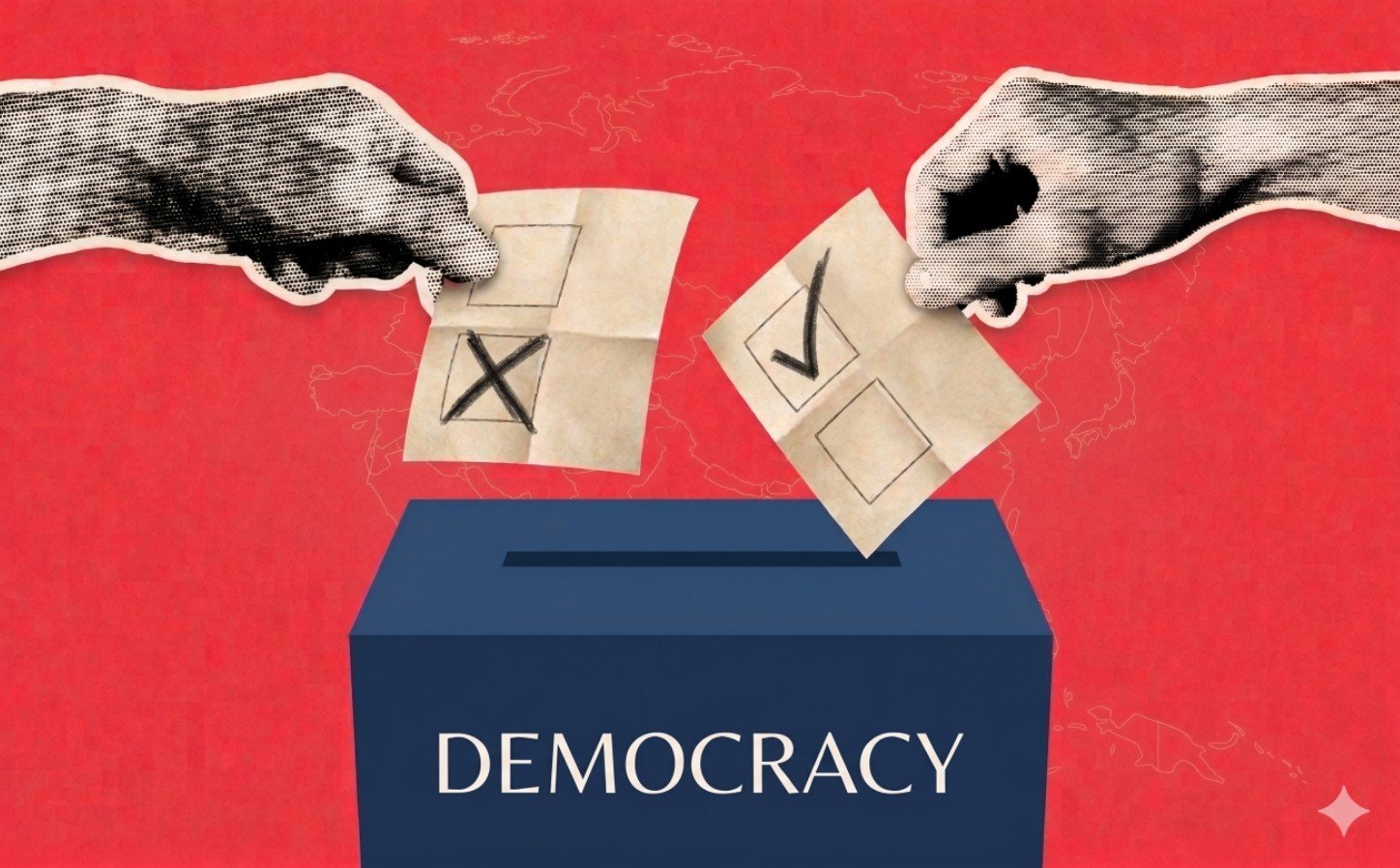
Across Asia, democracy is measured in different ways, revealing sharp contrasts between electoral strength, civil liberties and institutional balance. Image AI generated
Across Asia, countries such as Japan, Taiwan and Australia tend to rank near the top of democracy indices, while others including China, Vietnam and North Korea consistently perform less well. Taken together, these rankings raise a question that matters in Asia as much as anywhere: who decides what counts as a democracy?
At first glance, such rankings look authoritative enough. They come with tables, scores and categories, and seem to promise a neat answer to an untidy subject. Yet they are not simple scoreboards. Each reflects a set of judgments about what democracy really is. Is it mainly about free and fair elections? About civil liberties? About whether institutions can restrain those in power? Or about the broader health of representative government as a whole? The answer varies according to who is doing the measuring.
The EIU’s approach is the broadest in political terms. Its Democracy Index measures countries across five categories: electoral process and pluralism, functioning of government, political participation, political culture and civil liberties. It then sorts them into four broad types: full democracies, flawed democracies, hybrid regimes and authoritarian regimes. The strength of this approach is that it tries to capture democracy as a working political system, not simply a set of formal rights. It is interested not only in whether elections are held, but in whether democratic life functions convincingly overall.
Where the EIU is concerned with the broad performance of representative democracy, Freedom House is more squarely interested in whether people are genuinely able to vote, speak, organise, publish and dissent without intimidation or arbitrary coercion. That sharper rights-based focus often gives its judgments a different character.
 Source: EIU Democracy Index 2025 | Analysis: Democracy Asia | Design: Rahul Bhise
V-Dem is broader again, but in a more academic way. It distinguishes between several kinds of democracy — electoral, liberal, participatory, deliberative and egalitarian — and pays particular attention to whether democratic quality is deepening or weakening over time. It is therefore useful in identifying movement: countries that are drifting away from democratic norms, or edging back towards them.
Even defining Asia is not entirely straightforward. The EIU’s regional grouping includes Australia and New Zealand but excludes Central Asian countries. Other indices cut the map differently. That may sound like a minor technicality, but it is worth noting because even a regional league table reflects a prior decision about who belongs in it.
Still, some broad patterns do emerge. Authoritarian systems such as China and Vietnam, along with closed regimes like North Korea, consistently rank at the lower end of these indices. The EIU’s latest assessment points to a growing bifurcation within the region, with a stable group of high-performing democracies in Northeast Asia and Australasia alongside increasing political stress in South and South-East Asia. In its latest index, the region’s average democratic score fell again, extending a six-year decline and making Asia a drag on the tentative global stabilisation seen elsewhere. Only Australia, Japan, New Zealand and Taiwan are in the top category of full democracies. That alone challenges some easy assumptions about the region. Any older sense that South Korea, Malaysia or India belong comfortably in the same front rank no longer fits this picture.
 Democracy rankings across Asia and Australasia highlight a widening gap between high-performing democracies and more constrained systems. Credit: Economist Intelligence Unit, Democracy Index 2024
The EIU’s regional table makes these contrasts visible at a glance. New Zealand and Australia sit at the top alongside Taiwan and Japan. India occupies an intermediate position as a flawed democracy, reflecting relatively strong electoral competition alongside persistent concerns about civil liberties and institutional balance. The table as a whole underscores the region’s uneven democratic landscape, where high-performing democracies coexist with fragile and authoritarian systems.
South Korea is one of the more revealing cases in the region. On the EIU’s reading, the turmoil surrounding President Yoon Suk-yeol’s brief declaration of martial law in late 2024 was serious enough to push the country down into the category of flawed democracy. Freedom House continues to rate South Korea as free, with a strong score by regional standards. V-Dem suggests something more hopeful still, placing South Korea on its watchlist of democratisers. That reflects three different emphases.
One index is responding to a constitutional and political shock. Another sees robust protections for rights and liberties. A third is asking whether the country’s overall trajectory may in fact be improving. The differences are revealing rather than confusing.
India presents another kind of problem. On one view, its 2024 general election demonstrated the continuing vitality of electoral politics, with the ruling party losing the commanding dominance many had expected. On another, the condition of civil liberties, media freedom and institutional independence remains deeply troubling. The EIU’s 2025 index reflects this tension, noting a decline in India’s score amid concerns over electoral violence and pressures on civil liberties. It is here that the contrast between the indices is most instructive. One puts weight on the resilience of electoral competition; another focuses more heavily on pressures on rights and institutions. Neither approach is wholly wrong. But they are not asking precisely the same question.
 In India, strong electoral competition coexists with growing concerns over civil liberties and institutional balance. Photo: Election Commission, GODL-India
If there is one clearer positive story in South Asia, it is Sri Lanka. After years of crisis and disillusion, it stands out in the latest assessments as a country that has, at least in some respects, improved. Freedom House identifies it as one of the more notable risers in the current cycle as does the EIU. That does not make Sri Lanka a model democracy overnight, nor does it settle the question of how deep or durable the improvement will prove. But it does offer an example of movement in a better direction, not simply another example of democratic decline.
Elsewhere in South Asia, the picture is more troubling. Pakistan’s score fell to its lowest level since the EIU index began, while Bangladesh and Nepal also saw sharp declines linked to political restrictions and institutional instability.
Taiwan and Japan, by contrast, show where the indices broadly converge. Both continue to appear near the top of Asia’s democratic field. Taiwan combines competitive politics with a vigorous public sphere and strong institutions; Japan benefits from long-established democratic habits and stability. They are not identical cases, but both suggest that there remain countries in Asia that perform well across quite different democratic yardsticks.
Malaysia is more ambiguous. It still attracts attention because it has often been seen as a country with reformist potential, yet the latest evidence suggests a more qualified picture than any simple narrative of democratic ascent would allow. One purpose of these indices is not to confirm old assumptions but to test them.
What, then, should readers make of all this? Not that one index is right and the others wrong, still less that democracy can be reduced to a single number. The better conclusion is that democracy is a compound idea. But as experience across Asia shows, the process of building democracy is not always smooth or stable, and can carry significant political and social risks. Elections matter, but so do liberties. Institutions matter, but so does political culture. Participation matters, but so does the ability to restrain those in power. The EIU, Freedom House and V-Dem all measure democracy seriously, but each gives these elements a different weight.
That is why their disagreements are so valuable. They remind us that democracy is not a fixed formula but a contested and evolving idea — shaped as much by lived experience as by how it is measured. The most useful question, then, is not simply who ranks first or who has slipped down the table. It is the larger one behind every table and every score: who decides what counts as a democracy?