Humphrey Hawksley has been reporting from different parts of Asia for a quarter of a century. Here he muses on what democracy means in China and Hong Kong, in Sri Lanka, the Philippines and Taiwan, and elsewhere.
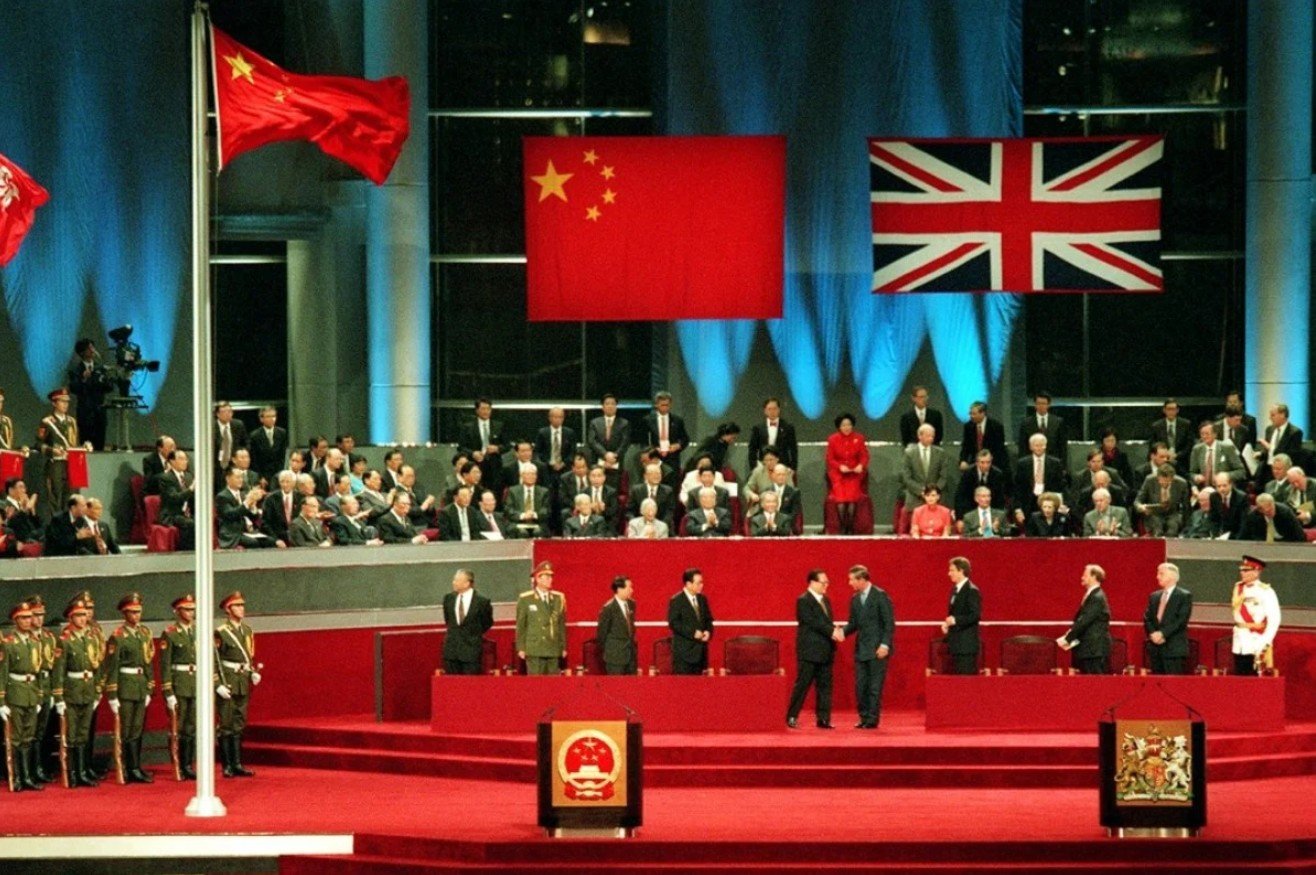
Hong Kong’s handover to China in 1997 symbolised the uneasy transition between Western democratic ideals and rising authoritarian power. Photo: Handout
What do the democracy reforms mean for the people of Hong Kong?’ a London banker friend asked me in 1992 as Britain was preparing to hand back its colony to China. Only three years earlier, China had become a global pariah by its forceful ending of the Tiananmen Square protests. Yet, in five years’ time, Britain was to hand over control of its biggest remaining colony to the Chinese communist dictatorship.
The optics among British voters were appalling. How could the government allow such a ruthless regime to run Hong Kong? So, Chris Patten, a top-flight Conservative politician, was sent in as Hong Kong’s last governor. Patten’s job was to re-write the narrative so Britain could stage an honourable withdrawal.

The 1989 Tiananmen Square crackdown reshaped global perceptions of China’s political trajectory. Photo:Jeff Widener/Associated Press
News headlines sang with stories about his political reforms. But very little was possible because, as Patten himself said, the ink was already dry on the agreements with China. His achievement was to inject hope, a glimpse of what Hong Kong people could enjoy if they fought for democracy. As I told the banker that day, ‘Imagine being asked to visit a beautiful sun-strewn beach where everything is wonderful. To get there, however, you need to run through a field of machine gun fire.’
At the time, Western elites were basking in the collapse of the Soviet Union with the belief that we had reached the ‘end of history’ when all societies, including China, would naturally evolve into liberal democracies. My analysis of Hong Kong went against mainstream thinking.
But, as a BBC foreign correspondent for more than a quarter of a century, I still conclude that democracy can be dangerous and bloody when implemented badly, too quickly, or against overwhelming resistance.
My first assignment in 1986 was in Sri Lanka to cover the civil war, where the political system, bequeathed by the British, was one of birthright democracy. Most people did not vote on issues, but along ethnic and religious lines. A minority of Sri Lankans are Hindu Tamils, while the majority are Buddhist Sinhalese, who would always hold power. An easy way to win Sinhalese votes was to brand the Tamil community as a threat. The result was a 26-year civil war.
In 1987, I was posted to the Philippines after the dictator, Ferdinand Marcos, was overthrown in street protests. I found myself reporting on regular and violent attempts by the military to take over the civilian government, bodies in the street, buildings burnt, attacks on the presidential palace and so on. Naïve politicians, vested interests, and weak institutions created a cocktail of failure in a society that had little understanding of the compromise needed to make a democracy work.
 The fall of Marcos did not bring stability, but a turbulent cycle of coups and democratic fragility.
Meanwhile, Western advisers flooded in, talking up those ‘sun-strewn beaches’ of democracy I used as a metaphor in Hong Kong. They seemed oblivious to their own history in that Western democracy emerged over centuries of massive bloodshed, including two world wars. At the same time, European and North American societies are anchored in shared cultural values and administrative systems. Asia, by contrast, is a mix of religions, ethnicities and governments. The glue that binds the region is not democracy, values and elections, but trade and wealth creation. Therefore, this democracy conundrum poses three questions.
The first, as in Hong Kong, is what to do if one society is up against another that is more powerful and operates with different values. Other examples include Pakistan with India, the Palestinians with Israel and Taiwan with China.
The second is how a society can move from dictatorship to democracy without violence. Examples of recent Western failure can be seen in Afghanistan, Iraq and Myanmar. One recurring issue is birthright voting, which I encountered in Sri Lanka.
 Rapidly imposed democratic systems in Afghanistan and Iraq revealed the limits of externally engineered political change. Photo: Reuters
The third is what to do when an embryonic democracy delivers a result opposed by the West. Examples are Iran (1953), Vietnam (1956), Chile (1973), and Egypt (2012) when ‘Arab Spring’ elections delivered an Islamic Muslim Brotherhood leader who was ousted the next year in favour of a pro-Western military government.
In the eyes of Asia and the wider Global South, the issue of how to deal with an unbeatable foreign force applies to all powers, not just authoritarian ones and specifically to America. One society, Taiwan, stands as a model for how to face down a hostile, stronger neighbour and tread the precarious path to democracy. Interestingly, Taiwan was heavily mentored by the US, and its shift from dictatorship can be broken down into five elements.
The first is economic development, creating an awareness of private ownership and personal responsibility. Second is taxation, which introduces a pact between government and citizens. Third is slowly allowing civil society, political parties, commerce, travel and press freedom, all of which boost government accountability. Fourth is growing the economy, building infrastructure, creating impartial institutions and introducing laws suited to a developed democracy.
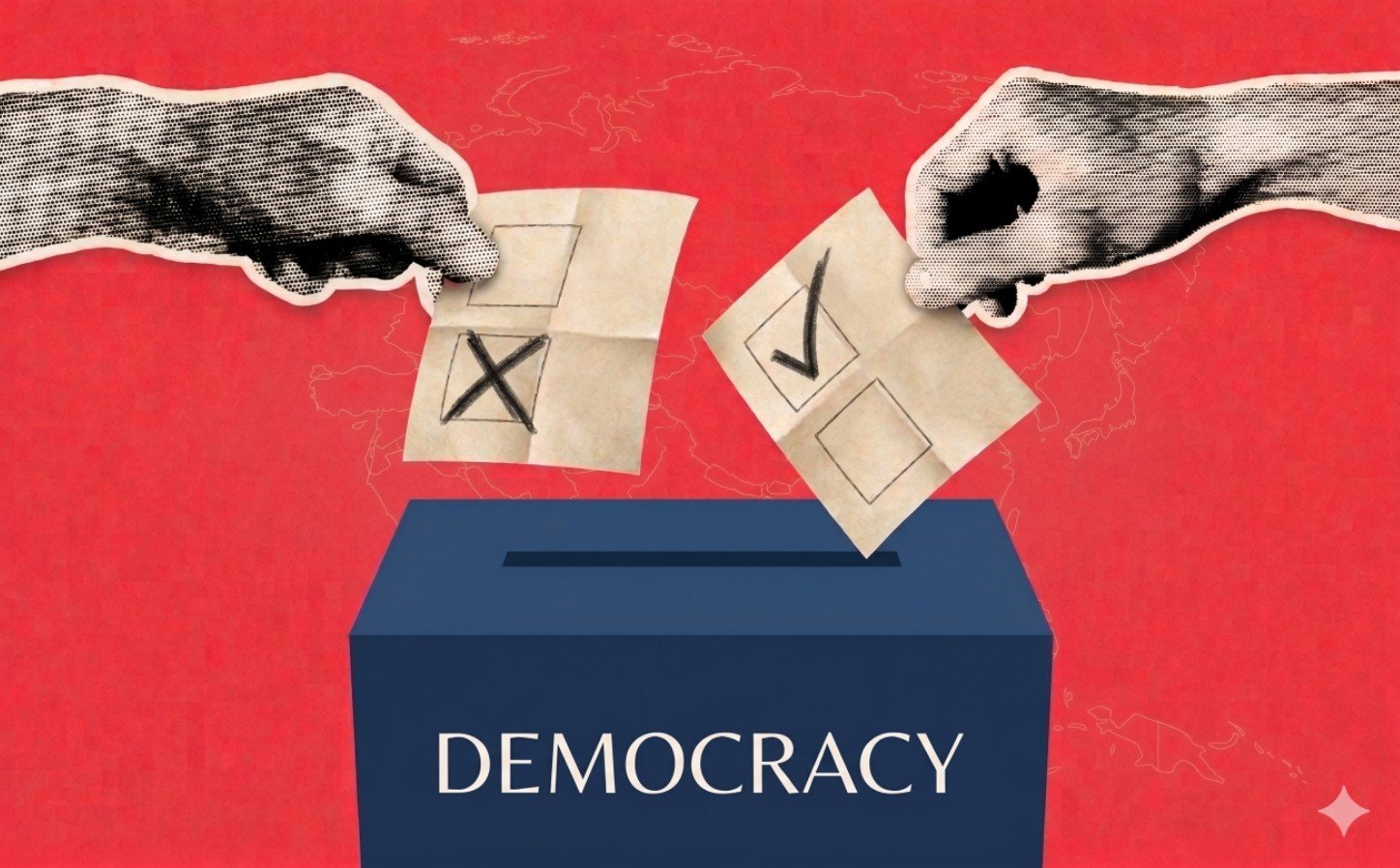
 Analysis: Humphrey Hawksley | Design: Democracy Asia
Only after all that was in place did Taiwan hold its first presidential election in 1996. Voters went to the poll and overnight it became a democracy. We should note that the whole process took half a century.
A fifth element, critical to success, was building up trade with its enemy and, for that to work, both sides need to prioritise the economy over ideology. Taipei has not sent insurgent bombers across the Taiwan Strait as a gesture of independence, nor has Beijing occupied an outlying Taiwanese island as a claim of sovereignty. Instead, China-Taiwan business has created such wealth that everyone would have too much to lose if political hostilities turned to violence. In too many places, such a pragmatic trade-based approach has not been the case.
 Despite political tension, economic interdependence between China and Taiwan has helped prevent open conflict. Credit: Ed Lustan/Inquirer.net
Thankfully, Hong Kong’s uprisings were nearly bloodless and it retains its ability for commerce and money-making. But pro-Western activists remain in jail, and that ‘sun-strewn beach’ proved unreachable. Treaties were signed. Hope was dangled. Promises were made. But when it mattered, raw power decided Hong Kong’s future.
In our newly emerging world order, there is a lesson here for all to see.