Why has India dipped in recent years in international indices measuring the state of a country’s democracy? Kavita Chowdhury set out to investigate.
Why has India dipped in recent years in international indices measuring the state of a country’s democracy? Kavita Chowdhury set out to investigate.
As colourful Republic Day tableaux from regional states rolled down Rajpath or Kartavya Path, in Delhi on 26 January, marking the 77th year of India as a Republic, there was a noticeable difference from previous years. While government ministers and their family members occupied the front rows, the leader of the parliamentary opposition, Rahul Gandhi, was seated way back in the third row.
The positioning of Gandhi, who leads the main opposition Congress Party, reflects the deep trust deficit between the Narendra Modi-led Bharatiya Janata Party (BJP) government in power and the opposition parties. Congress accused the Modi government of deliberately humiliating the Leader of the Opposition, a constitutionally sanctioned post equal in rank to that of a cabinet minister, describing it as a violation of constitutional “decorum, tradition and protocol”.
India takes great pride in calling itself the “mother of democracy”, tracing its democratic lineage back to the post-Vedic era of ancient republics and assemblies. So it was natural that the framers of the constitution in 1950 envisioned a democratic republic with elected representatives. The trajectory of Indian parliamentary democracy since then has not been without its challenges. Resilience helped it bounce back from the infamous ‘Emergency’ in 1975, when civil liberties were suspended and elections cancelled by Prime Minister Indira Gandhi. Subsequently, the rise of regional parties and strong regional leaders coincided with the emergence of coalition governments.

Opposition leader Rahul Gandhi seated away from front rows during Republic Day celebrations at Kartavya Path in New Delhi.
The Congress-led United Progressive Alliance (UPA), a coalition led by Dr Manmohan Singh, was in power for a decade (2004 to 2014) ushering in an era of rights-based laws guaranteeing citizens the rights to education, information, food and employment. In the parliamentary election of 2014, the Modi-led BJP came to power with an overwhelming parliamentary majority decimating the UPA coalition. Unsurprisingly, it led to the emergence of an authoritarian Parliament with a single party, the BJP, dominating the government benches.
The past decade has witnessed the frequent suspension of MPs from the opposition benches and the silencing of opposition voices to the extent that their mikes are muted in Parliament whenever they confront the ruling BJP with uncomfortable questions. The government’s authoritarianism has been exacerbated by the shrinking numbers of opposition members. There was no designated Leader of the Opposition from 2014 to 2024 as the largest opposition party, Congress, did not have the required 55 seats to lay claim to the post.
It is not surprising then that India’s ranking on global democracy indices has been gradually sliding since 2019. The Varieties of Democracy VDem Institute’s 2025 report, that produces the largest global dataset on democracy, classifies India as an “electoral autocracy”.
Without mincing his words, Professor Manoj Kumar Jha, a parliamentarian and national spokesperson of the Rashtriya Janata Dal, a regional political party, speaking to Democracy Asia said: “Numerical majority in the legislature (parliament) should not be construed as a license to go berserk as is the case with the ruling BJP.” Jha cites the instances of how the Modi government pushed through the controversial guarantee for work scheme by overruling strong objections from opposition members. Lambasting the government for replacing the existing Mahatma Gandhi National Rural Employment Guarantee Act with what he described as “a watered-down version”, Jha said the Modi government is “trying to write the employment guarantee act’s obituary”.

The Election Commission of India headquarters in New Delhi, whose impartiality has recently been questioned by opposition parties.
Political observers have noted with alarm the centralisation of all authority by Prime Minister Modi with even cabinet ministers being emasculated. The Prime Minister appears to be exercising authority with little accountability in parliament or beyond. He has never addressed a press conference unlike his predecessor Dr Manmohan Singh. What also stands out is the Prime Minister’s complete disregard for parliamentary accountability, of being answerable for his actions to elected representatives of all parties.
Former judge of the Supreme Court Madan B Lokur, who is known for expressing his views, said the “decline in constitutional morality” is worrisome. Speaking to Democracy Asia, Justice Lokur said, “Parliament is not functioning the way it should be. The government is focussed on pushing its own agenda. The framers of the Constitution wanted both the treasury [government] and the opposition benches to be working together.” He noted: “We often see, in the rules of business in Parliament, issues highlighted by the opposition are not taken up. Moreover, some bills are passed in five minutes without any debate and discussion. The government in power always has the last word.”
Legislative business under the present government has become a mere formality with the government benches using its brute majority to pass bills while opposition demands that bills be referred to parliamentary committees for scrutiny, are ignored. The new guarantee for work bill became law within just five days.
While it is not uncommon for election verdicts to be questioned by rival political parties, what is unprecedented is the erosion of trust in the Election Commission (EC) being witnessed now. The EC is a constitutional authority for the election process for parliament and state assemblies. Its effectiveness hinges on its impartiality. During last November’s Bihar state assembly polls, and the more recent municipal polls in Mumbai, opposition parties accused the EC of bias towards the ruling BJP government. Congress’ Rahul Gandhi labelled it “vote chori” or “vote theft” alleging the EC was carrying out voter deletions and manipulation of voter lists.

The Supreme Court of India in New Delhi — concerns about constitutional morality have also been raised within the judiciary.
Professor Nivedita Menon, a political theorist and former professor at Jawaharlal Nehru University (JNU), told Democracy Asia: “Looking at the past few elections, we see the impossibility of holding free and fair elections now.” She contended that there needs to be a campaign to restructure the EC to restore “legitimacy of elections”. Professor Menon added: “The Election Commission is now a part of the BJP-led government.”
Accountability is the cornerstone of any parliamentary democracy but whenever opposition MPs have been critical of the government, be it Congress leader Rahul Gandhi or Trinamool Congress party’s Mahua Moitra, they have been specifically targeted. In a ‘political vendetta’ the BJP government in 2023 had expelled Moitra from parliament and even evicted her from her official residence. Gandhi too, in 2023 was evicted from his MP residence after being convicted in a court case and thereby disqualified as MP.

Journalists and activists demonstrate in New Delhi over concerns about press freedom and state pressure on independent media. Photo: Delhi Union of Journalists (DUJ)
The Modi government, like other totalitarian regimes, has been assertively clamping down on free speech and freedom of expression targeting journalists, university students, rights activists and taking down cartoons critical of the regime. One of the more discreditable episodes in India’s democracy has been the complete capitulation of the media, pejoratively termed as “godi media” or “lap-dog media”. The contrast could not be more striking. While newspapers withstood the excesses of the Emergency in 1975, the media today have been acting as loyal mouthpieces of the Modi government.
As Professor Nivedita Menon says, “It is impossible to call India a democracy today”. Elaborating further she said: “It is true that prior to 2014 parliamentary democracy in India was not perfect but definitely after 2014, there is an authoritarian government in power. Opposition leaders have no right to dissent and when they do, they are labelled as ‘anti-nationals’”. Professor Menon said there is total misuse of central agencies, like the Enforcement Directorate and the Central Bureau of Investigation. According to Menon, “The big shift post-2014 since Narendra Modi came to power is the complete centralisation of all institutions.”
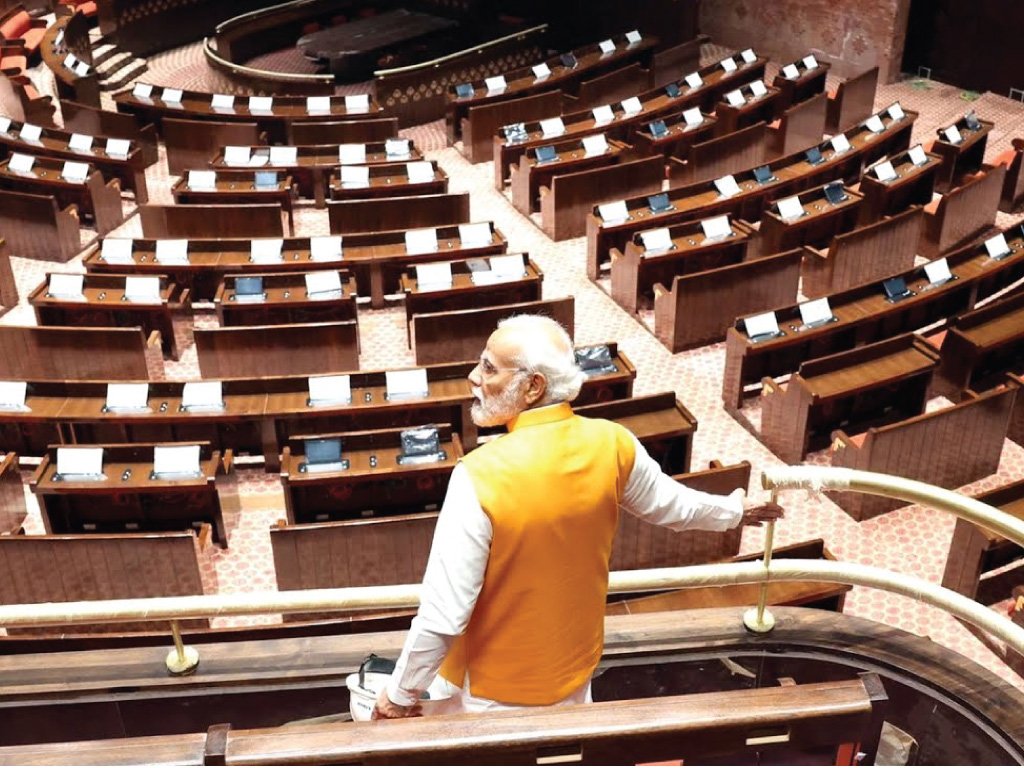
Professor Manoj Kumar Jha sums it up aptly, “It seems ironic that the new parliament building in Delhi, which was inaugurated in 2023, was described as the ‘temple of democracy’ yet its hallowed portals have no space for dissent, dialogue and multiple perspectives, the seeds of a fertile democracy.”