Sri Lanka finds itself once again listening anxiously to developments unfolding thousands of kilometres away in the Middle East. The Iran conflict, and wider instability involving Israel, the United States and the Gulf region, has cast a long economic shadow over the island, as Eranga Pereira reports from Colombo.
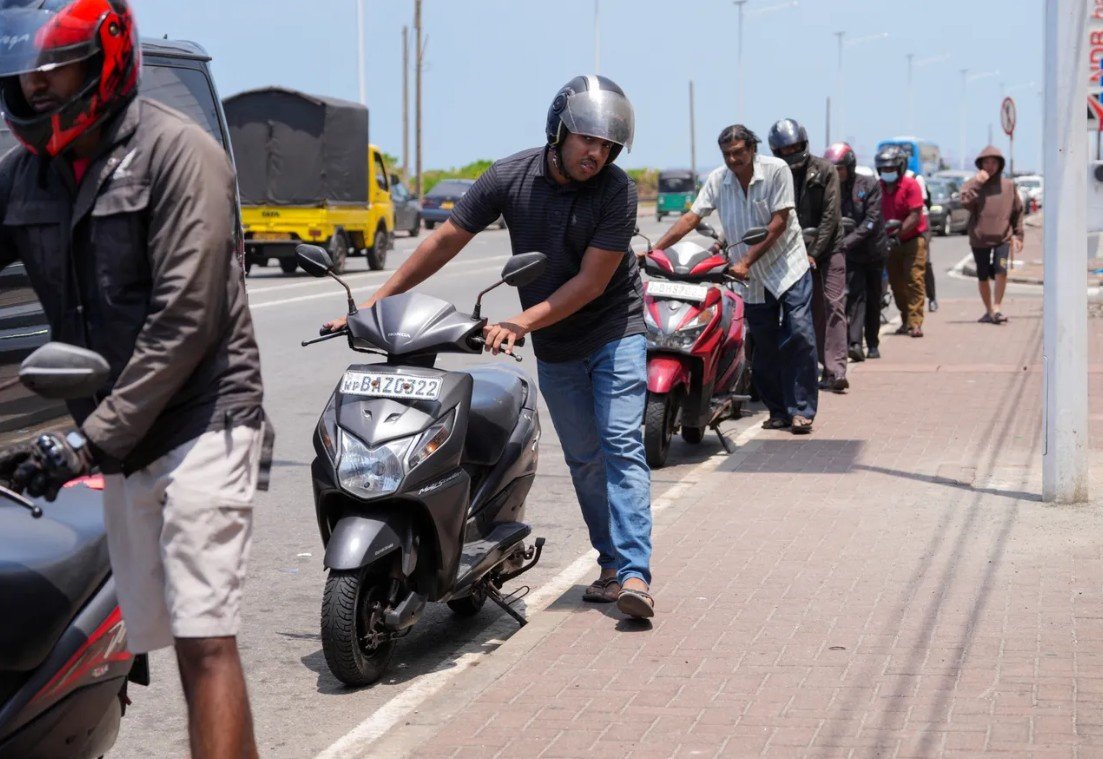
Motorists wait in long queues at a fuel station in Colombo as fears over supply disruptions linked to the Strait of Hormuz crisis revive memories of Sri Lanka’s 2022 economic collapse. Photo: Reuters
Fuel prices have risen, inflationary pressures are returning and familiar public anxieties surrounding shortages and economic insecurity have resurfaced. The unease feels deeply familiar. Four years ago, the country experienced one of the most severe economic collapses in its independent history. The crisis of 2022 was not merely a financial breakdown; it evolved into a profound crisis of governance and democratic legitimacy. Fuel queues became symbols of institutional failure; power cuts disrupted daily life, inflation destabilised households. Public frustration ultimately erupted into the ‘aragalaya’ or ‘people’s struggle’ movement against the government, which led to a fundamental reshaping of Sri Lanka’s political landscape and public expectations of governance.
 Protesters gather at Colombo’s Galle Face Green during the 2022 ‘Aragalaya’ movement, when economic collapse and fuel shortages triggered nationwide unrest. Photo: AntanO/CC BY-SA 4.0
It is this recent memory that makes the current Middle East conflict so politically significant for Sri Lanka. The island’s vulnerability to Gulf instability is neither temporary nor accidental. Sri Lanka remains heavily dependent on imported fuel and maritime trade routes connected to the Middle East. Remittances from an estimated one million Sri Lankan migrant workers in Gulf countries are a major source of foreign exchange. Geopolitical instability in West Asia quickly translates into domestic economic pressure.

Sri Lankan migrant workers abroad, whose labour and remittances play a vital role in supporting households and strengthening the country’s economy amid external shocks. File Photo
The Central Bank of Sri Lanka has warned that the ‘US-Israel-Iran war and geopolitical tensions have created a larger uncertainty, with impacts on global trade and supply chain disruptions’. Though expressed in the restrained language of economic policy, the implications are far-reaching. For smaller and economically vulnerable states such as Sri Lanka, global conflicts increasingly shape domestic political and economic stability in direct and immediate ways.
According to Central Bank data released in April, Sri Lanka’s fuel import expenditure rose by 74.7% year-on-year, reaching US$630 million in March alone due to escalating global oil prices linked to the conflict. Headline inflation increased from 2.2 percent in March to 5.4 per cent in April with higher domestic energy prices identified as a key contributing factor. During the same period, the Sri Lankan rupee depreciated by nearly 3% against the US dollar.

Rising fuel and commodity prices reflect renewed inflationary pressure on households as global energy volatility feeds into Sri Lanka’s fragile recovery.
These figures might appear to be routine indicators of economic volatility. In Sri Lanka, however, they carry emotional and political weight. Economic instability is no longer perceived by citizens as an abstract macroeconomic issue. The events of 2022 transformed economics into lived experience. Rising fuel prices evoke memories of queues stretching for kilometres, uncertainty over basic necessities and a public distrustful of state institutions.
Yet Sri Lanka in May 2026 is also markedly different from that of 2022. The election in 2024 of President Anura Kumara Dissanayake and the National People’s Power government brought public hope of cleaner governance, greater accountability and a more socially responsive state. For many Sri Lankans, particularly younger generations shaped by the protest movement, the new government represented more than electoral transition. It showed the possibility of institutional renewal after years of economic mismanagement and eroding public trust.
 President Anura Kumara Dissanayake in Colombo, as his government navigates renewed economic pressures linked to global instability. Photo: Wikimedia Commons/CC BY-SA 4.0
The Iran conflict has now become one of the first major external tests confronting that promise. Unlike during the paralysis and confusion that characterized the height of the economic collapse, the state’s response has appeared more coordinated and proactive. When panic buying emerged in March, President Dissanayake moved quickly to reassure Parliament that the country possessed diesel stocks for 33 days and petrol stocks for 27 days. To prevent a recurrence of 2022-style shortages, the authorities introduced tighter controls to discourage hoarding.
The government introduced temporary energy conservation measures such as a four-day working week within parts of the public sector to reduce fuel consumption. Emergency fuel procurement arrangements were accelerated, while economic management mechanisms developed after 2022 were reactivated in anticipation of prolonged global volatility.
President Dissanayake declared: ‘We must also structure our economy to withstand this external shock and we possess both the capability and the confidence to do so’. The significance of this statement lies not merely in its economic implications, but in its political tone. In post-crisis Sri Lanka, governance is judged not only by outcomes, but by preparedness, communication and institutional coherence.
Sri Lanka’s diplomatic positioning has similarly reflected strategic caution. Official statements issued through the Ministry of Foreign Affairs called for the ‘immediate de-escalation’ of tensions in the Middle East while reaffirming Sri Lanka’s neutral stance regarding the conflict. Such neutrality reflects both diplomatic tradition and economic necessity. At a time when Sri Lanka remains dependent on Gulf labour markets, debt restructuring processes and external financial support, maintaining balanced international relationships has become integral to economic recovery itself.
Beneath these signs of stabilization lies an undeniable fragility. Sri Lanka’s trade deficit widened to US$2.3 billion during the first quarter of 2026 according to Central Bank figures, driven largely by rising import costs associated with global energy volatility. Central Bank Governor Dr Nandalal Weerasinghe warned that approximately 45 per cent of Sri Lanka’s remittance inflows originate from Gulf economies, making prolonged instability in the region a direct threat to the country’s stability.
The country’s recovery from its own economic crisis remains incomplete despite measurable progress. Sri Lanka recorded approximately 5% economic growth in 2025 under IMF-supported reforms, while official reserves strengthened to nearly US$7 billion by early 2026. Worker remittances reached US$815 million in March, a 17.5 per cent increase compared to the previous year, while tourism earnings continued to recover steadily.
These developments suggest that Sri Lanka is no longer experiencing the institutional freefall of 2022. Inflation has moderated relative to crisis-era levels, state institutions are functioning with greater coordination and economic management has become comparatively disciplined. And yet, this year’s events serve as a reminder of how narrow the margin for stability remains.
 Container vessels and oil tankers at Colombo Port highlight Sri Lanka’s dependence on global maritime trade routes vulnerable to Middle East instability.
Sri Lanka’s experience demonstrates that democratic resilience is inseparable from economic resilience. Public trust in institutions cannot be sustained in conditions of prolonged insecurity and hardship. Democracy is tested not only through elections and constitutional procedures, but through the state’s ability to manage crises transparently, responsibly and without transferring the full burden onto ordinary citizens. The Iran conflict may be geographically distant from Sri Lanka, but its consequences have become intimately domestic, shaping inflation, public sentiment, energy security and perceptions of governance itself.
Four years ago, external shocks exposed the fragility of the Sri Lankan state. In 2026, the country appears more institutionally alert, economically cautious and politically conscious of the consequences of instability. Whether that transformation proves durable, however, remains uncertain. Sri Lanka’s challenge now is not merely to recover from the crisis, but to demonstrate that democratic governance itself can evolve beyond the failures that produced the crisis in the first place.