The arrest of three senior police generals, among them President Prabowo’s chief of staff, in a phone-tapping scandal, and the subsequent deployment of more than 20,000 extra troops to the capital, Jakarta, amid government talk of treason, have further unsettled the country’s stock market. Just what is happening in Indonesia? Stephen Woodhouse has this analysis.
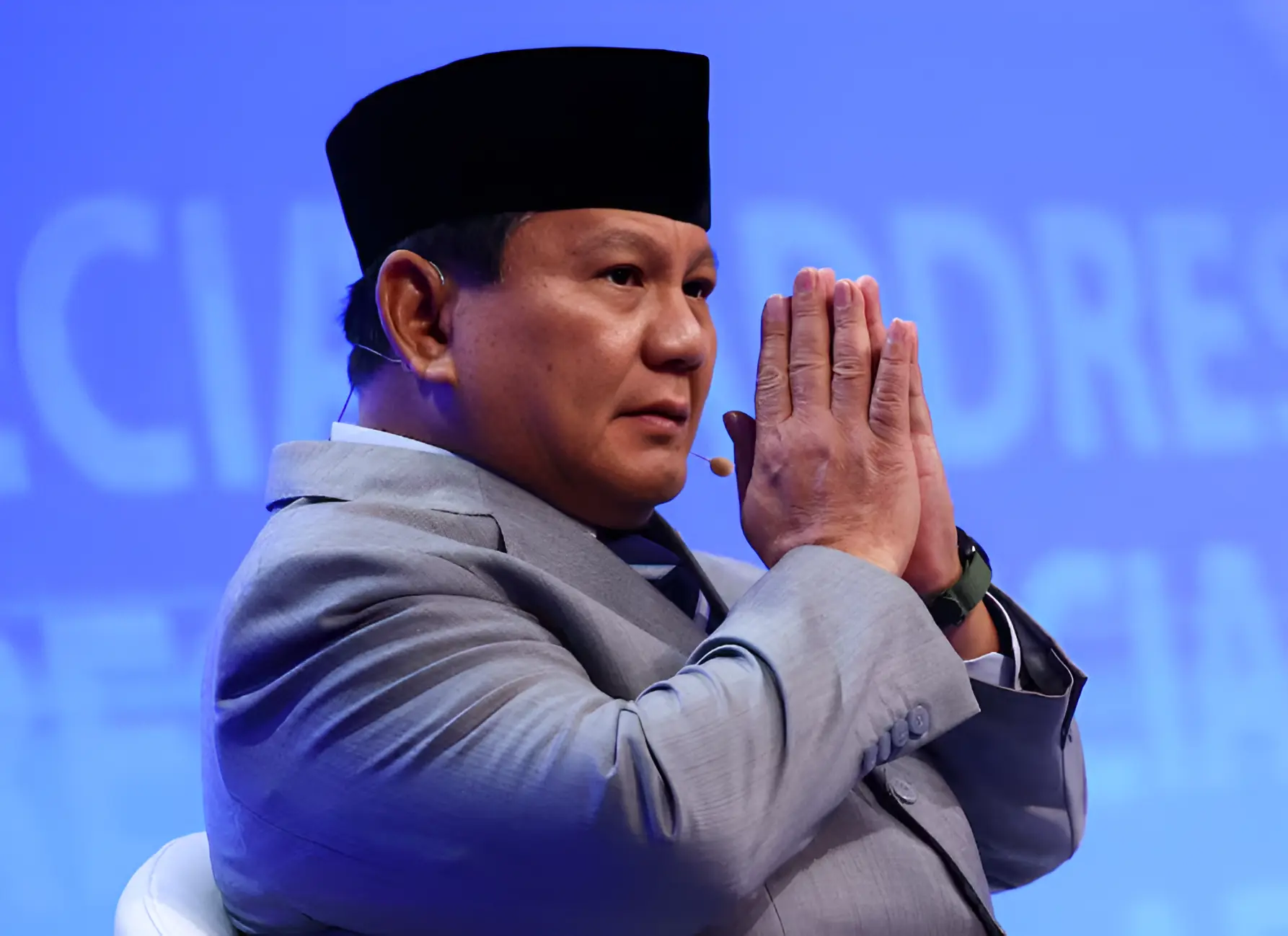
Indonesian President Prabowo Subianto faces mounting political and economic pressure two years after taking office, amid falling market confidence and growing public dissatisfaction. Photo: Edgar Su/Reuters
General Prabowo Subianto had his eyes on the presidency of Indonesia for many years and fought several unsuccessful campaigns before finally succeeding in 2024. Now, two years on, he is under increasing economic and political pressure, with claims that he has become the most unpopular president ever. Ratings by one leading pollster, SMRC, which had Prabowo riding high with an 81 per cent approval rating at the end of his first year, had sunk to 44.5 per cent by the time he completed his second year in office in October.
He won the 2024 presidential poll thanks to strong support from the previous president, Joko Widodo (known as Jokowi), who was known to hanker after a third presidential term from which he was constitutionally barred. A quid pro quo for Jokowi’s support was that Prabowo would continue to give top priority to Jokowi’s flagship project of building a new national capital, to be named Nusantara, in East Kalimantan. Another was that he would give a meaningful role to Jokowi’s son, Gibran, who became Prabowo’s vice president. Prabowo’s failure to advance the Nusantara project has soured relations with his predecessor, and now Gibran has resigned as vice president, ostensibly because he lacked a high school certificate, a prerequisite for the role. Observers interpret this as the former president withdrawing support from his successor.
The accusation that General Listyo Sigit Prabowo (who is not related to the president), national police chief until October, ran an illegal wiretapping operation that targeted the president himself, creates an ever more rocky relationship between the police force and the army, on both of which Prabowo depends. Listyo is a Jokowi loyalist of long standing, while President Prabowo was an army general during the military rule of former president Suharto from 1966 to 1998. Prabowo married Suharto’s daughter, Titiek, in 1983; they divorced in 1998. The national police force has long been an uneasy bedfellow of the military.
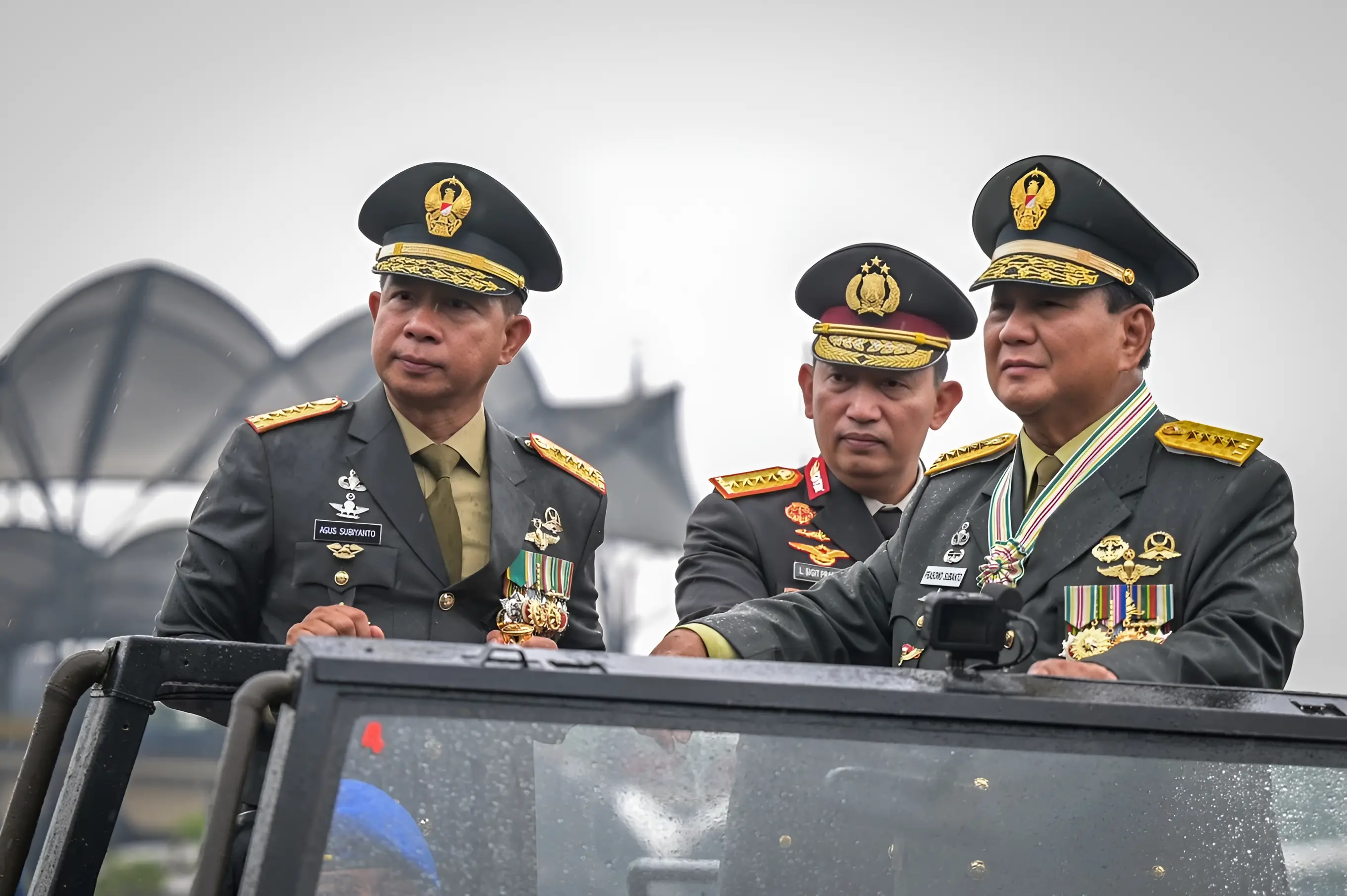 President Prabowo Subianto with military and police leaders, whose increasingly strained relationship has become a source of political uncertainty for his government. Photo: Antara
While political shenanigans carry on largely behind closed doors, the dire state of the country’s economy is no secret. Despite seemingly impressive growth figures, the Jakarta stock market has fallen by 40 per cent this year, with estimated withdrawals exceeding US$5bn. The index provider MSCI is threatening to downgrade Indonesia, which would reduce the status of Southeast Asia’s largest economy from ‘emerging market’ to ‘standalone’. MSCI is reported to have concerns about opaque share ownership, low free float and a lack of prosecutions for alleged market manipulation. Most of the nominal economic growth is concentrated in the raw materials and minerals sector, ownership of which lies largely in government hands and those of wealthy companies. Another major contributor is government expenditure on President Prabowo’s increasingly unpopular and expensive school feeding programme and a village cooperative scheme.
It was a combination of the toxic impact of systemic corruption, collusion and nepotism – known by the Indonesian language acronym KKN – that led to the fall in 1998 of former president Suharto. Under Prabowo, KKN is widely perceived to be ever more rampant. The appointment to key positions of close relatives of the president, such as that of his nephew Thomas ‘Tommy’ Djiwandono as a deputy governor of the supposedly independent central bank, Bank Indonesia, has been viewed negatively by the general public and by international rating agencies, as have appointments to government positions of military officers perceived as being loyal to him, rather than necessarily competent. These have drawn vocal opposition from civil society groups.
 Stock prices displayed on an electronic board at the Indonesia Stock Exchange in Jakarta, 16 October 2026, amid growing concerns over the country's market outlook. Photo: EPA
Among those critical of such appointments is the widely respected former deputy minister of foreign affairs and ambassador to the US, Dino Patti Djalal. He criticised President Prabowo’s government for being reactive to crises that could have been foreseen and mitigated. Comments on Facebook and other social media are almost universally scathing about the president’s performance.
Signs of the stress felt across Indonesia include a decline in the size of a ‘comfortably off’ middle class from 57 million in 2019 to under 48 million in 2024 and an unquantified increase in those earning below Indonesia’s formal minimum wage of US$300 per month. Further signs include a rapid increase in online gambling and online borrowing (pinjol), which puts additional pressures on low-income households. Younger citizens are particularly vulnerable as obtaining regular formal employment is challenging, especially in manufacturing, with garment making hit hard by price competition from China. It is common practice to bribe potential employers in order to obtain employment.
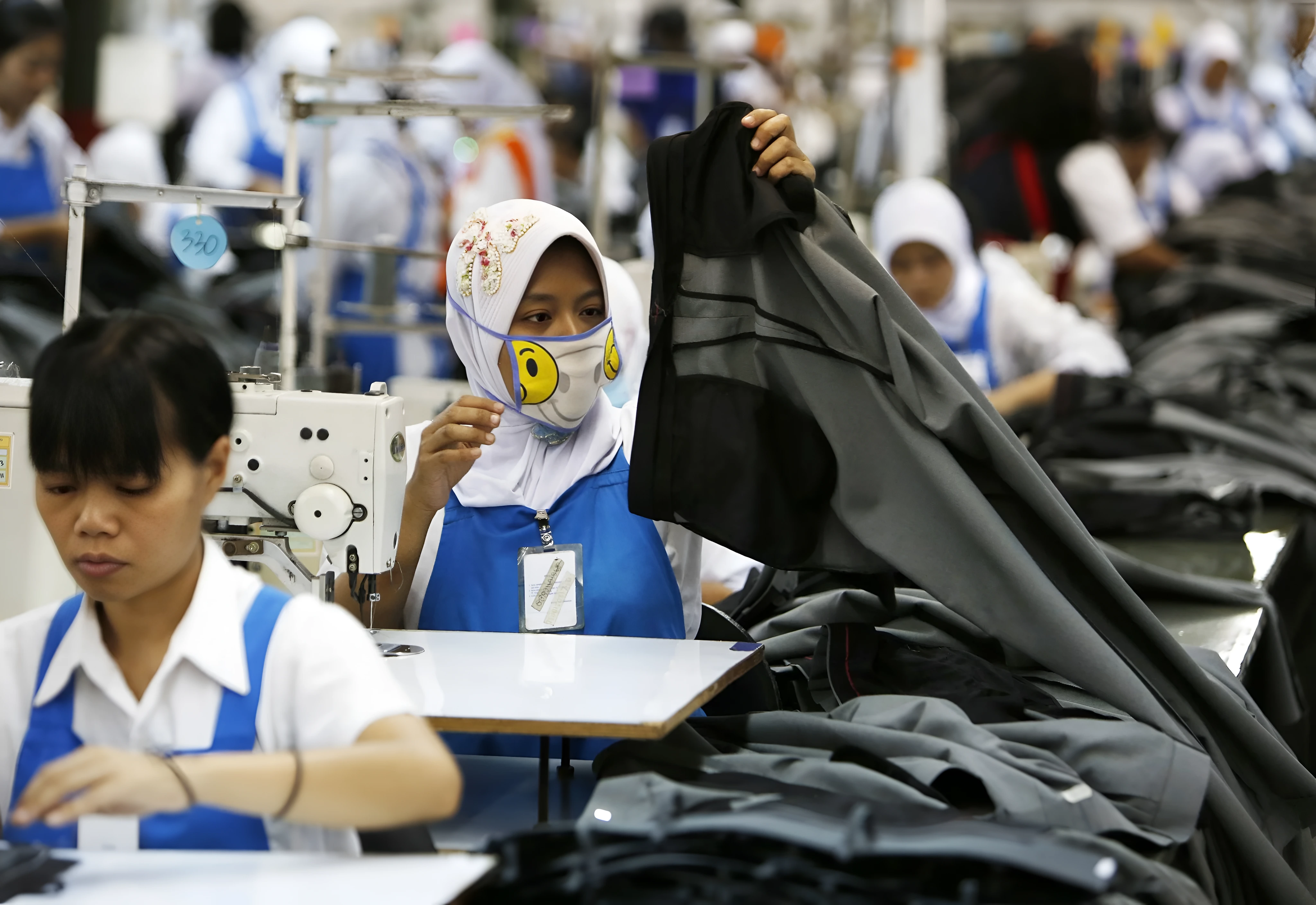 Young Indonesians face difficulties finding secure formal employment, as manufacturing industries such as garment production struggle with competition and economic pressures. Photo: Reuters
Indonesia’s parliament is largely filled by Prabowo loyalists, so discontent is being expressed through extra-parliamentary channels, notably social media, which is full of anger from younger people and the economically disadvantaged, who are concerned at economic inequality and the lack of employment opportunities. They are angry too at the failure to mitigate the human impact of the El Niño drought and haze, and at a feeling that President Prabowo is too supportive of President Trump and insufficiently pro-Palestinian. Street protests are increasing and observers note greater support for protesters by the police than from the army.
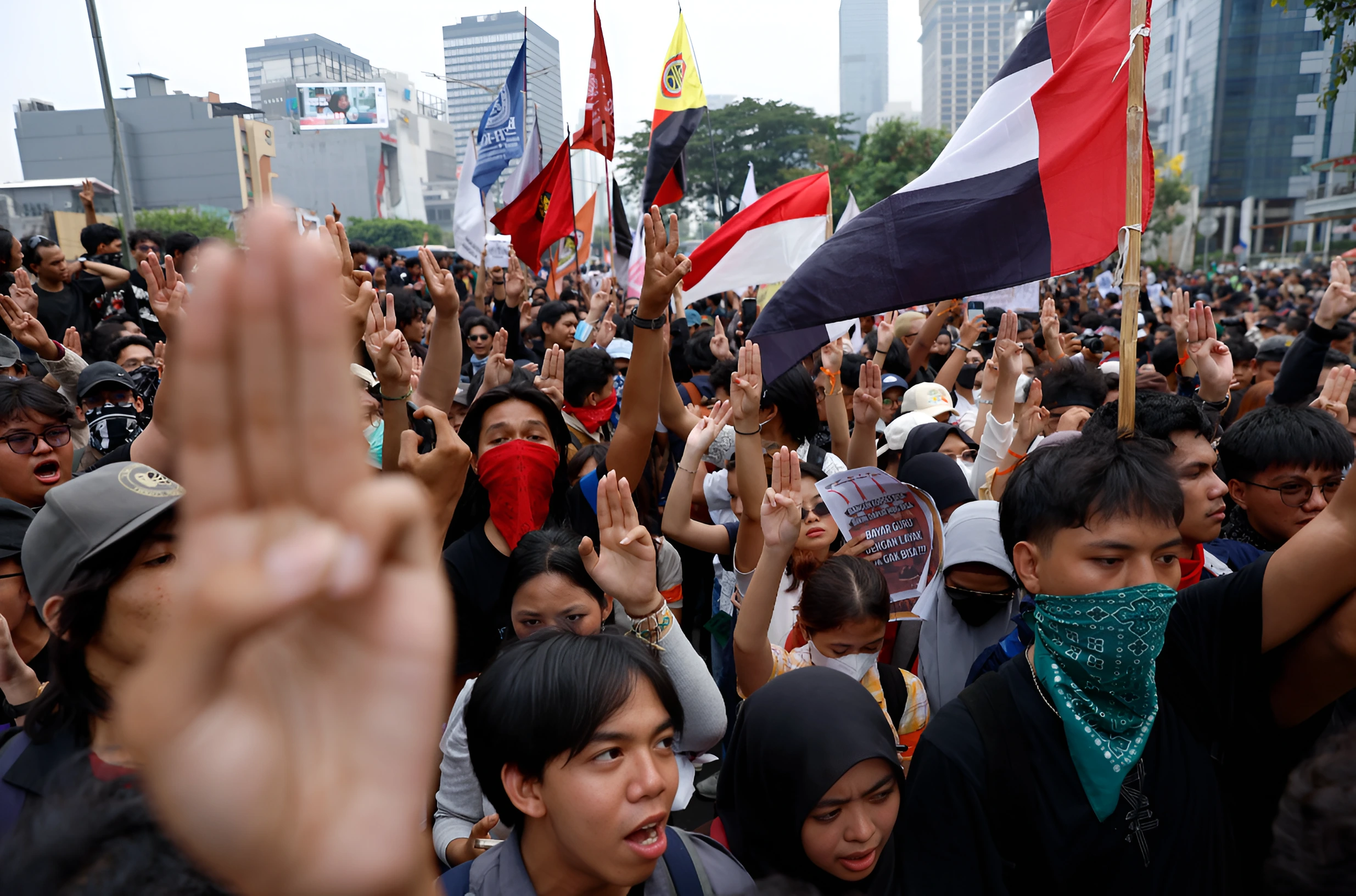 Students protest against the Indonesian government in Jakarta, voicing demands over economic pressures, environmental concerns and government accountability. Photo: EPA
The bulwark of support for President Prabowo by the military and police appears to be fracturing. Parliament will soon be selecting a new vice president from two names put forward by the president. But it is little more than two years before Indonesians are due to choose a new president. With pressure mounting on Prabowo, alternative candidates are coming forward. Opinion polls suggest the governor of West Java province, Dedi Mulyadi, is far more popular than President Prabowo, who, polls suggest, is out of touch, dictatorial and surrounded by an elite that shows almost no concern for the economic plight of the masses. This contrasts with Governor Dedi’s much-publicised social media concern for the poor.