The Quadrilateral Security Dialogue, or Quad, is an informal strategic grouping of Australia, India, Japan and the US aimed at countering China’s growing military power and influence in the Indo-Pacific. Its leaders have not met formally for some time and, as Rahul Bedi reports from Delhi, the organisation is under strain following President Donald Trump’s disparagement of its three other members.
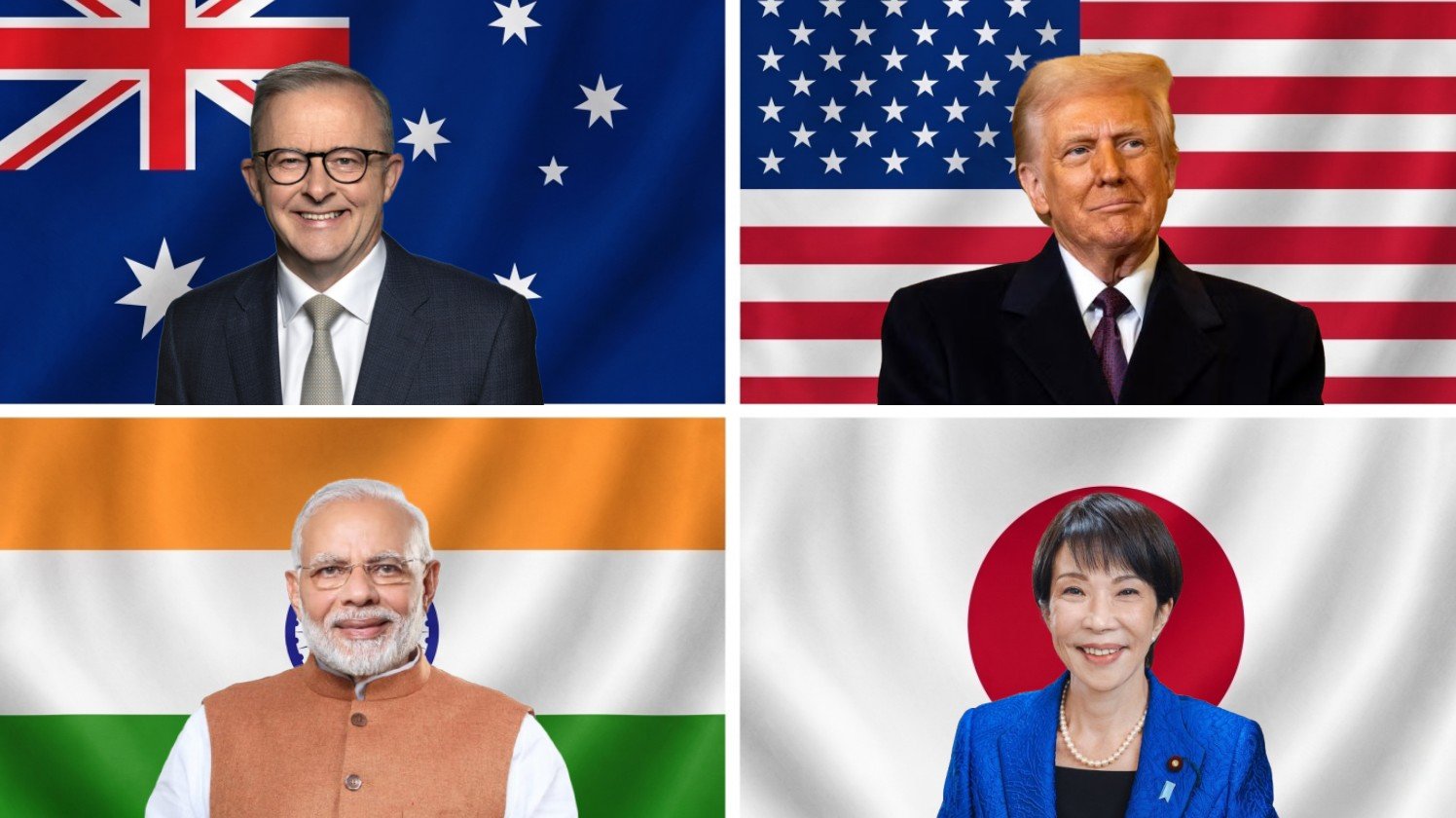
Leaders of the Quad nations — Anthony Albanese, Donald Trump, Narendra Modi and Sanae Takaichi — represent a strategic partnership now facing renewed uncertainty amid shifting US policy signals.
India's foreign secretary, Vikram Misri, made a visit to Washington in April focused on reinforcing India–US strategic, defence and commercial ties. US Secretary of State Marco Rubio is expected to travel to Delhi in May with India exploring the possibility of convening a meeting of Quad foreign ministers during the visit, while internal divisions – sharpened by President Trump’s conduct – continue to cast doubt over the grouping’s cohesion and long-term durability. India wants to use the Quad association to stabilise its bilateral relationship with the US amid enduring geopolitical frictions. The last foreign minister-level Quad engagement, which took place in Washington in July 2025, was aimed at restoring continuity and momentum within the quadrilateral framework. It was expected to be followed by a summit in Delhi last November attended by all four Quad leaders, including President Trump, but the meeting ultimately did not materialise, marking a further setback for the grouping.

India–US diplomatic engagement remains central to sustaining the Quad, as New Delhi seeks to stabilise ties with Washington amid rising geopolitical friction.
Indian security and diplomatic sources indicated that Tokyo has broadly backed efforts to accelerate Quad consultations, reflecting its continued interest in sustaining the grouping amid China’s growing regional assertiveness. This comes despite Trump taunting Japan to ‘step up’ in support of Washington’s objectives in the ongoing Iran conflict, particularly with regard to maritime security, by providing protection to critical energy routes in the Strait of Hormuz. The US president has portrayed Japan in deprecating terms as benefiting from US-led security guarantees, while remaining hesitant in its willingness to assume greater operational responsibility – whether in mine-sweeping operations in the besieged Strait of Hormuz, undertaking naval escort duties, or contributing to wider security roles.
 Donald Trump meets Sanae Takaichi at the White House, where remarks referencing Pearl Harbor underscored growing unease within the Quad.
Tellingly, Trump invoked the memory of Japan’s December 1941 attack on the US navy at Pearl Harbour during an interaction with Prime Minister Sanae Takaichi at the White House in March. When asked by a reporter why Tokyo had not been informed in advance of the US strikes on Iran on 28 February, he said that surprise had been an essential element of the attack, adding that Japan, more than most countries, should understand this. He then remarked pointedly: ‘Who better to understand surprise than Japan—why didn’t you tell me about Pearl Harbor?’, directing his comment at the visibly unsettled Japanese prime minister.
Australia, on the other hand, while concerned at China’s expanding military footprint in the Indo-Pacific, has adopted a more cautious stance. Security officials and those familiar with Quad developments said that Canberra’s reticence reflected ‘heightened sensitivities’ over President Trump publicly singling out Australia for ‘under-contributing’ to US military and naval efforts in the Iran campaign, including maritime operations to secure the Strait of Hormuz.

Strategic waterways such as the Strait of Hormuz have become focal points of tension, exposing divisions among Quad members over military responsibilities.
Similar strains are also evident in the India–US dimension of the Quad equation, with Delhi not immune to Trump’s caustic rhetoric. While this has been more indirect, with the US framing the relationship between Delhi and Washington in transactional and trade-centric terms, it has undermined the strategic convergence that has defined bilateral ties over the past two decades and adversely impacted recent Quad cooperation.
It is in this context that Misri’s US visit assumes significance, less as a routine diplomatic engagement but more as an effort to stabilise a relationship that remains central to the Quad at a moment of growing uncertainty in the evolving global and regional security order. These concerns also echo within large segments of India’s strategic and naval community, which constitutes a critical pillar in operationalising the Quad framework.
‘Through his actions and statements during the ongoing Iran conflict, Trump has significantly eroded the Quad’s cohesion,’ said a two-star Indian Navy veteran associated with the framework during his service years, declining to be named as he was not authorised to speak on sensitive matters. Such behaviour, he added, reflects what many within military and diplomatic circles acknowledge, has revived serious doubts among Quad members over whether the US remains a reliable and steadfast anchor for such long-term multilateral security arrangements.
Originating in humanitarian coordination among the Australian, Indian, Japanese and US navies as first responders in the aftermath of the 2004 Indian Ocean tsunami, the Quad was formally articulated in 2007, lapsed soon after under Chinese pressure, and resurrected in 2017 amid growing concern over Beijing’s expanding military footprint in the region.
 Warships participate in the Malabar naval exercise, a key operational pillar of Quad cooperation in maritime security and interoperability.
Thereafter, it has functioned as a flexible, non-treaty alignment centred on consultations, joint naval exercises, like ‘Malabar’ hosted by the Indian Navy, and cooperation in maritime security, critical and emerging technologies, including coordinated vaccine production during the Covid-19 pandemic. Such flexibility, long considered one of Quad’s key strengths, is now being tested, and its ability to absorb internal shocks – notably unpredictable US policy signals – is also coming under increasing strain.
Alongside this, the same set of factors that have rendered the Quad increasingly tenuous are also beginning to undermine AUKUS, a 2021 trilateral security partnership between Australia, the UK and the US, that emerged as a more structured and consequential long-term defence and technology partnership. Aimed at deepening military and technological integration, AUKUS is centred on enabling Australia’s acquisition of nuclear-powered attack submarines or SSNs, alongside cooperation in advanced domains like cyber networking, artificial intelligence, quantum technologies and undersea and network-centric warfare capabilities. Unlike the Quad’s looser consultative architecture, AUKUS depends on sustained political commitment, a great degree of industrial coordination and high levels of strategic trust among its members.
However, these foundations too have been largely unsettled by Trump’s conduct amid the ongoing Iran conflict, particularly the UK’s reluctance to join US–Israeli-led military action, underscoring emerging strains within the AUKUS framework. These criticisms cut across both the Quad and AUKUS, signalling a troubling shift in US posture in which partners are increasingly treated less as autonomous actors and more as followers, expected to align closely with US presidential military preferences.
 Anthony Albanese, Prime Minister of Australia; Joe Biden, then President of the United States; and Rishi Sunak, then Prime Minister of the United Kingdom, announce the AUKUS submarine partnership, a cornerstone defence pact now facing uncertainty amid shifting US strategic priorities. Photo: White House
Looking ahead, the Quad’s durability – amid broader strains also affecting AUKUS – will depend on three factors: managing disagreements, especially those linked to President Trump and US global actions, Washington’s ability to rebuild trust through a more predictable and consultative approach and the willingness of India, Japan and Australia to take greater initiative and reduce dependence on US leadership.
Without such recalibration, the Quad risks becoming a loosely coordinated arrangement lacking strategic clarity, cohesion, and geopolitical heft in the Indo-Pacific.