It is ten years since the Permanent Court of Arbitration in The Hague delivered what appeared to be a landmark victory for international law. In a sweeping judgment, the court rejected China's claims to almost the entire South China Sea ruling that Beijing’s so-called ‘nine-dash line’ had no legal basis. The Philippines, which brought the case, had won – or so it seemed at the time. Now it seems less clear cut, as Humphrey Hawksley reports.
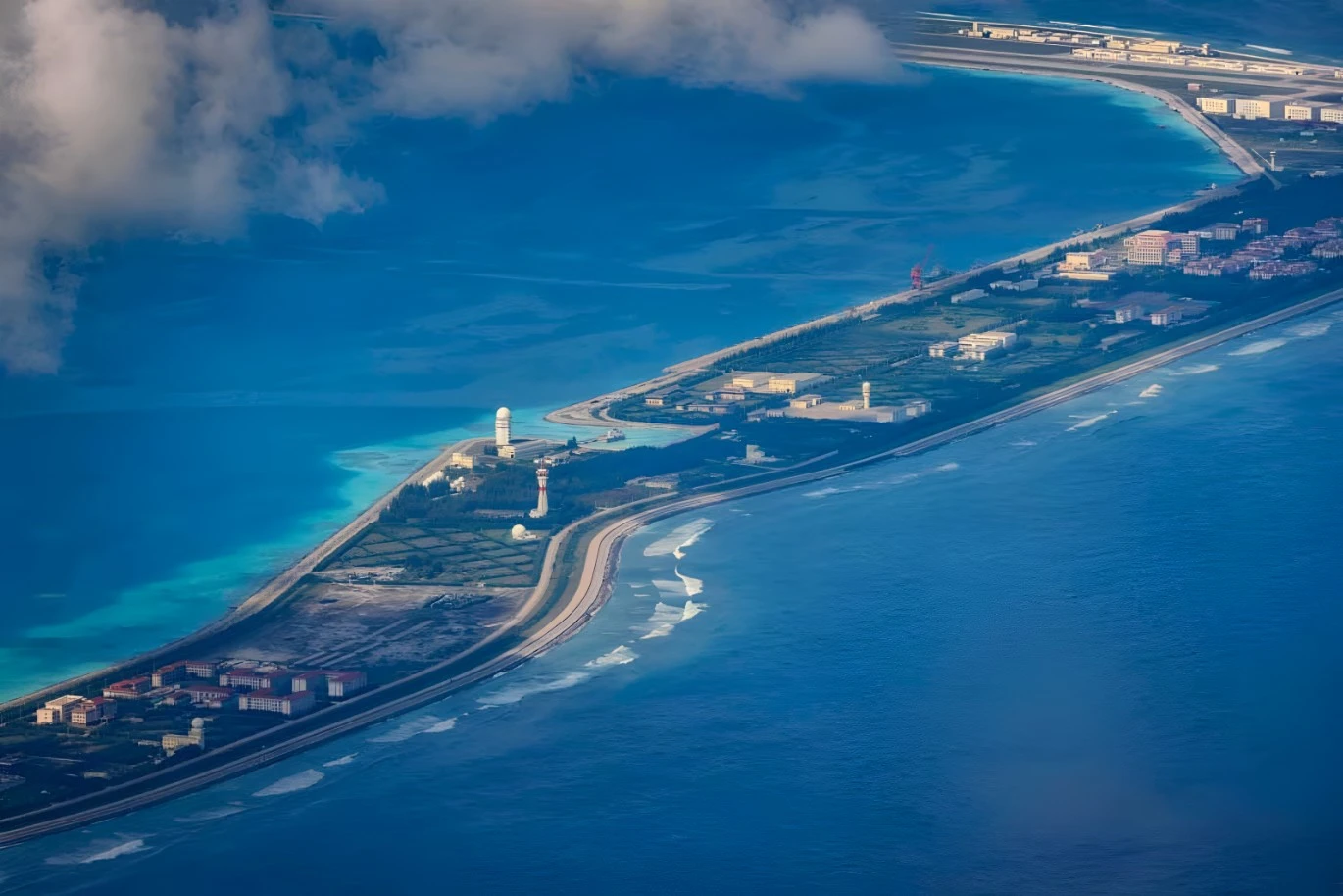
China’s transformation of Mischief Reef into a heavily fortified outpost reflects Beijing’s gradual expansion of its presence in the South China Sea, reshaping the strategic balance without a major war. Photo: Ezra Acayan/Getty Images
After the court’s ruling on 12 July 2016, China, not surprisingly, refused to recognise the court’s decision and continued to build military bases on remote islands and reefs with implications that reach far beyond Asia. In all, Beijing now has more than twenty-five militarised outposts with sophisticated weaponry on both sides of a trade route that is central to the global economy.
The South China Sea has become a strait of sorts. To the east, the bases are concentrated on the Spratly Island chain; to the west on the Paracel Islands. With a blend of military muscle and diplomacy, China now controls a waterway that carries more than ten times the traffic of the fractious Strait of Hormuz and at least as much oil and gas.
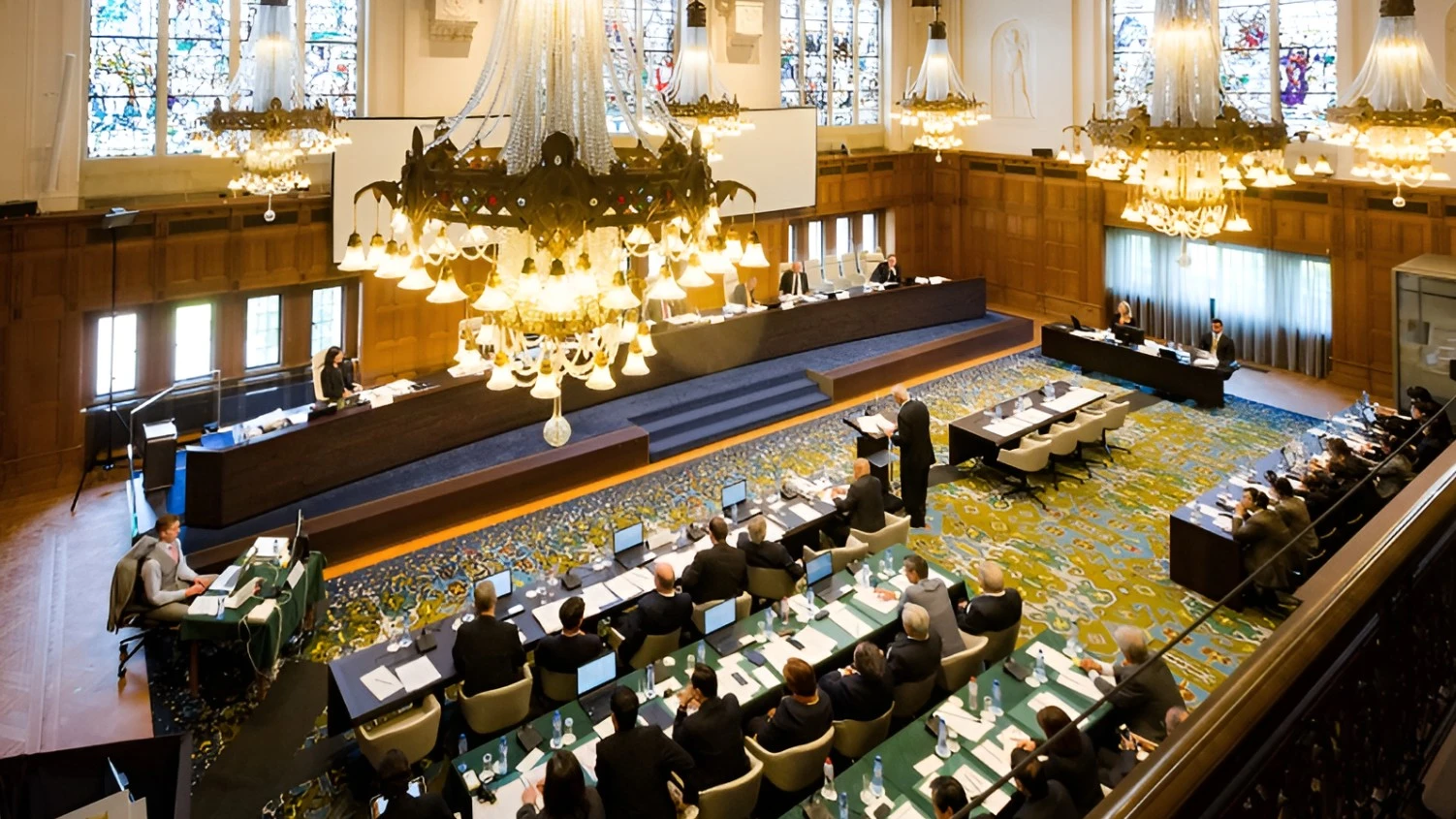 The Permanent Court of Arbitration in The Hague, which ruled in 2016 that China’s expansive claims in the South China Sea had no legal basis. Beijing rejected the ruling and continued to strengthen its position in the disputed waters. Photo: Mediation Centre/File photo
But unlike with Iran and the US, the manner in which China has achieved its aim offers lessons to both the developing world and the West on how to get what you want on the modern international stage. Three years after the 2016 court decision on China, a similar ruling against a leading Western democracy unfolded in a very different way.
The International Court of Justice, the principal judicial body of the United Nations, found that Britain’s control over a swathe of the Indian Ocean was illegal and sovereignty must be handed to Mauritius. Known as the British Indian Ocean Territory, this maritime area includes the American-run base on Diego Garcia, raising questions as to whether military advantage should be forfeited in favour of international law. Like China, Britain initially ignored the ruling. But the global reaction was swift, sharp and ferocious.
Three months later, in the United Nations General Assembly, a hundred-and-sixteen governments demanded that Britain unconditionally withdraw from the Indian Ocean, with the added ‘sting’ that many traditional allies either voted against Britain or abstained. Of a hundred and ninety-three UN members, only six supported Britain.
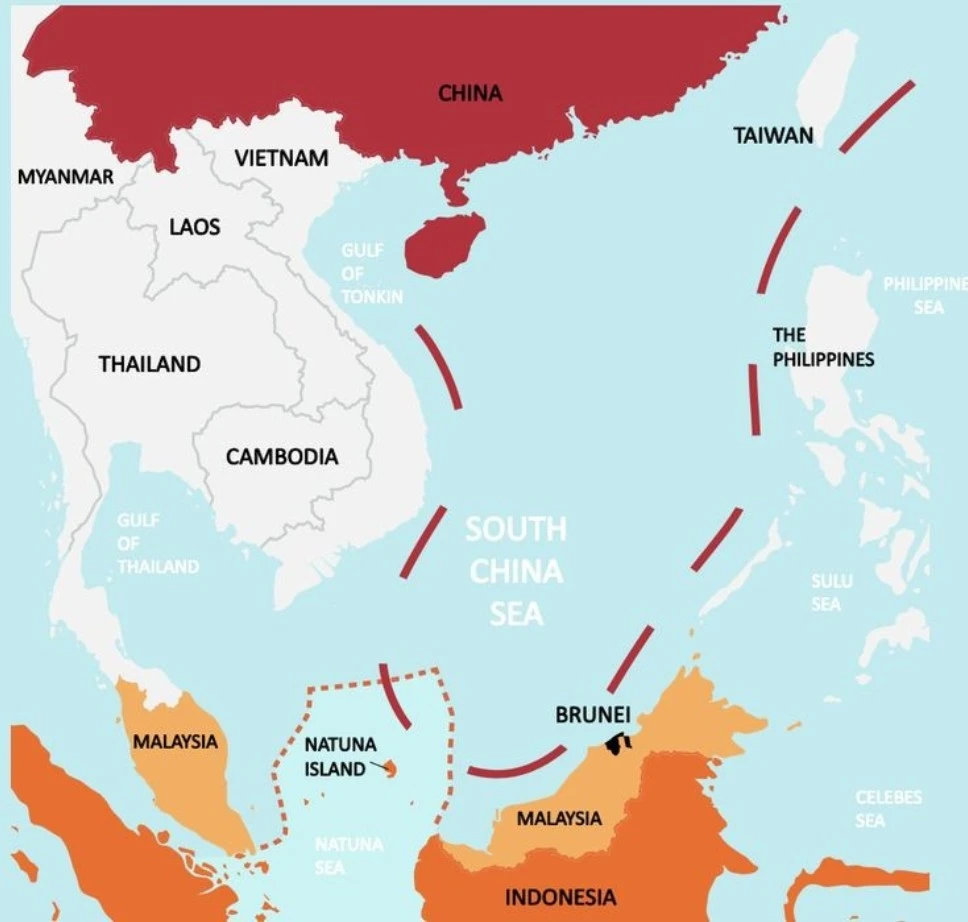 China’s nine-dash line marks its disputed claims across much of the South China Sea. Map Illustration: InsightsIAS
Beijing, on the other hand, received no such reprimand. The Philippines had recently elected Rodrigo Duterte to the presidency who was pro-China and did not push the UN, whereas Mauritius did. If a vote had gone ahead, China would certainly have won. According to the Asia Maritime Transparency Initiative, some sixty governments would back China, with eighty-eight remaining neutral and forty-five, mostly Western democracies, opposing Beijing.
In short, sixty per cent of UN members opposed Britain’s colonial-era Indian Ocean claim, while seventy-seven per cent supported or shielded China over its modern-day South China Sea claim. The implications go far further than any ongoing debate about international law.
In this current climate of rival influence and systems of government, America’s propensity for war is losing ground. China, on the other hand, is adhering closely to the much-cited strategist Sun Tzu that the supreme art of war is to subdue the enemy without fighting.
The Chinese national flag was first planted on the Spratly Island’s Mischief Reef in the mid-Nineties, and its initial structures were ostensibly shelters for fishing boats. There followed a strategy known in defence circles as salami slicing, slow step-by-step implementation, making it near impossible for opponents to draw red lines.
Much of the groundwork was carried out during the Obama administration which believed the costs and risks of using force to stop China outweighed the likely benefits. Three decades after planting that flag, Mischief Reef has a three-thousand-metre runway, hardened aircraft shelters, a deep-water harbour, radar and communications facilities and extensive barracks capable of supporting sustained air and naval operations. China has shifted military geography, extending the reach of its air force, navy and missile forces hundreds of miles from its mainland
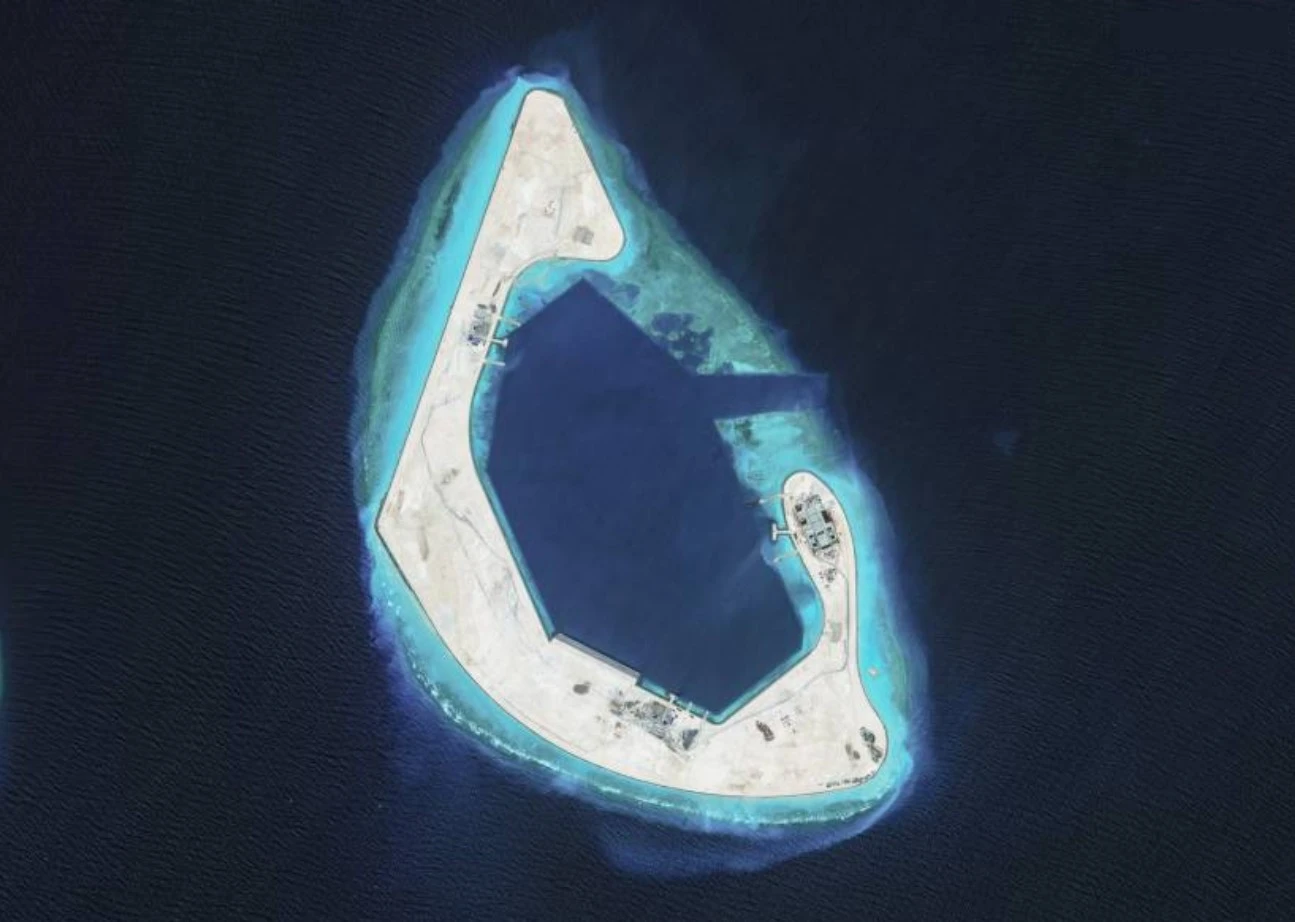 Mischief Reef has been transformed from a small Chinese outpost into a major military installation, illustrating Beijing’s strategy of gradually expanding its control while avoiding a decisive confrontation. Photo: Vantor/Handout/Reuters
Washington has failed to persuade South East Asian governments to present unified opposition against China which insists on dealing with each government separately. Currently, only the Philippines is mounting resistance, around Scarborough Shoal off the coast of Luzon and Second Thomas Shoal roughly four hundred miles to the south in the Spratly Islands. Confrontations with Vietnam have subsided. Indonesia occasionally dispatches patrols to escort Chinese ships away, while Malaysia shadows Chinese activity in disputed waters. None of this has weakened Beijing’s resolve. China’s reach is simply too great with an implicit warning: accept reality or risk your economy.
Viewed from Washington, this South China Sea policy underpins an aggressive expansion that needs to be contained. From Beijing, however, the policy secures supply routes ensuring that, whatever the threat, it has the means to keep open the South China Sea if needs be. China’s thinking has most recently been underpinned by shipping disruption through the Strait of Hormuz prompted by America starting a war with Iran.
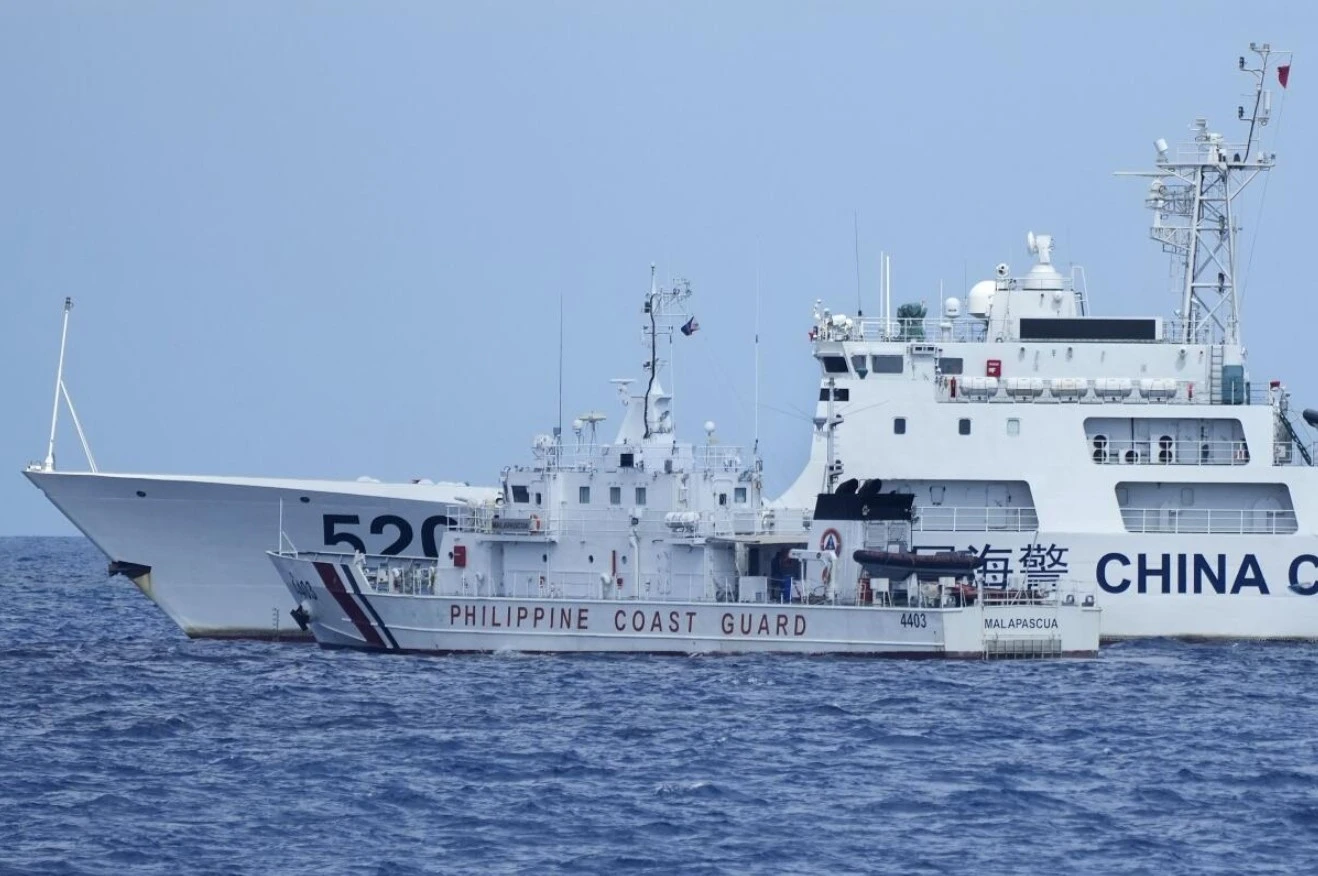 A Chinese vessel cuts across the path of a Philippine Coast Guard boat in disputed waters, illustrating the increasingly assertive maritime encounters between Beijing and Manila in the South China Sea. Photo: Aaron Favila/AP
For decades, the assumption was that such sea lanes would remain protected by American naval supremacy and international law, anchored within the concepts of Western democracy. Today, those assumptions have been shredded.
But, unlike Iran, China has little interest in jeopardising South China Sea trade as a leverage of war. One-third of global maritime trade passes between its island military bases, including oil to power the big economies of China, Japan and South Korea. Container ships carry the products of Asian factories to Europe, North America and, increasingly, to the wealthier markets of the Global South.
Shutting down or disrupting this flow would risk China’s future and all that it plans to achieve, including bringing in the money needed for its military. The island-building, combined with rapid advances in Chinese missile and naval capabilities, is already changing American military thinking for Asia. If conflict did break out, strong voices within the defence community argue that, rather than fight and suffer losses, the US Navy should initially retreat out of range.
From a safe distance, it would choke off China’s energy imports while using submarines, long range bombers and special forces to wear down its ability and resolve. The stakes for both China and the U.S. are so high and the risks so great that such a scenario is unlikely to unfold.
Therefore, the sway Beijing now holds over Asia and its trade routes could be viewed as a modern masterclass in diplomatic, commercial and military influence.
The South China Sea may become a defining lesson of twenty-first-century statecraft, a victory that belongs not to a nation that fought a war, but to one that reshaped a strategic landscape before any shot was fired.