Cricket, a sporting contest followed avidly across South Asia, is now increasingly shaped by political rivalries and state power, as Ashis Ray reports.
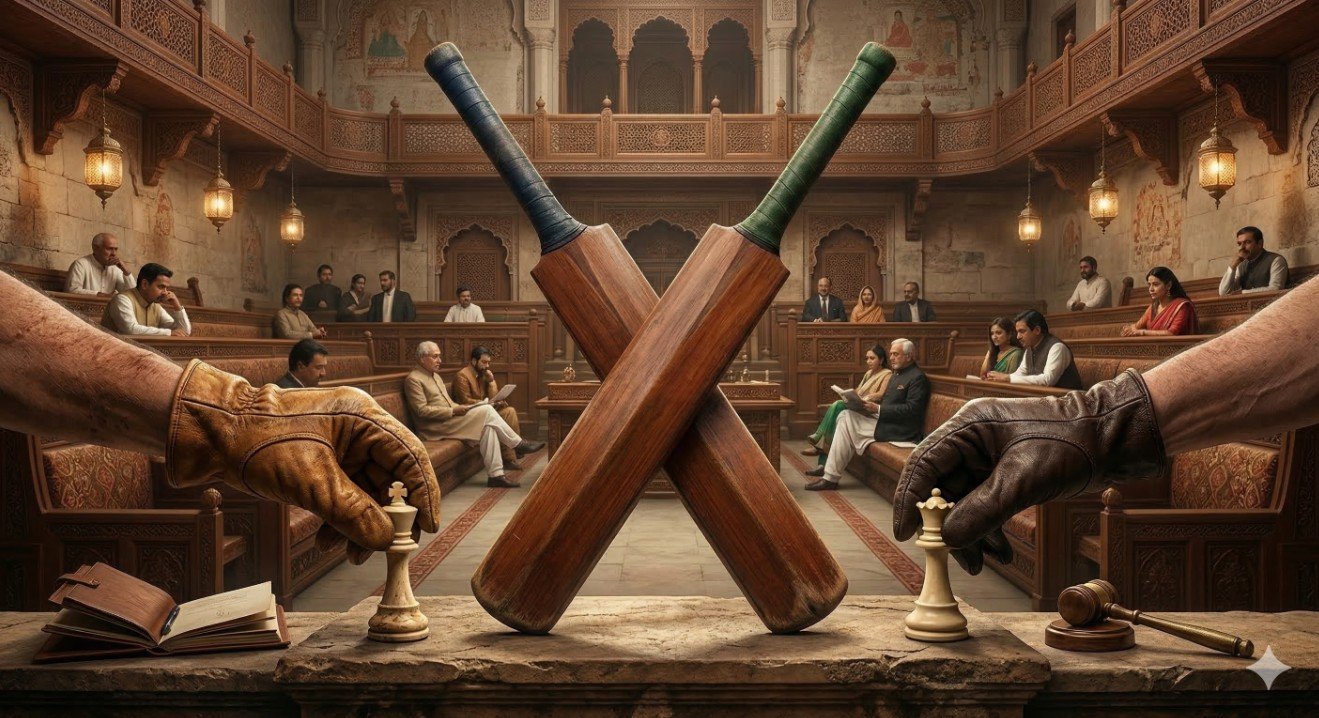
Cricket in South Asia has evolved beyond sport, becoming a stage for political rivalry, nationalism and state influence. Photo: AI generated
After their team retained the Twenty20 World Cup – the first time any side has achieved this – the Indian coach Gautam Gambhir, captain Suryakumar Yadav, and the chairman of the International Cricket Council (ICC) Jay Shah visited a Hindu temple in Ahmedabad for thanksgiving, carrying the trophy presented to the Indians with them. Video of this trip went viral on social media. A former cricketer now opposition MP, Kirti Azad, said this was ‘unsecular’ since there were Sikhs, a Christian and a Muslim in the Indian squad. Yet it underlined the divisiveness that has presently infiltrated Indian and international cricket.
The rumpus obscures the reality that cricket in India has become both commercial and highly political. The Press Trust of India reported last September that the bank balance of the Board of Control for Cricket in India (BCCI) had soared to around £2 billion. This comes mainly from Indian television channels, streaming services, advertisers and sponsors, who are also significant revenue providers for the cricket boards of other countries. A tour by an Indian team is a lifeline for such boards.
Sensing that clout, the ruling Bharatiya Janata Party (BJP), after coming to power in 2014, took control of the BCCI by nominating its president, secretary and treasurer, effectively converting it into a weapon of foreign policy, especially against Pakistan. No bilateral series has taken place between India and Pakistan since Narendra Modi has been prime minister.
 Members of the India national cricket team visit a temple with the T20 World Cup trophy, sparking debate over religion and secularism in Indian cricket.
In India, the allure of cricket has been such that Mr Modi, as chief minister of Gujarat state, had himself elected president of Gujarat Cricket Association, an affiliate of the BCCI, and held that position until he became prime minister in 2014. At that point, he handed charge to his close colleague Amit Shah, now the Indian home minister, who in turn passed the baton to his son Jay Shah. In 2019, Shah Junior was fast tracked into the role of BCCI secretary, in effect its chief executive. In December 2024, he was propelled to the post of chairman of the ICC without having becoming president of the board, generally regarded as a pre-requisite.

Under Narendra Modi and Amit Shah, the BCCI has become deeply intertwined with political power and state influence. Photo: Reuters
By that move the BJP completed its capture of the game's international governing body as well. Before the appointment, Indian political commentator Harish Khare wrote in The Wire ‘the only reason Jay Shah is set to become the next boss of the International Cricket Council is because his father is the junior partner in the old, faltering ruling firm of Shahenshah, an allusion to Modi, and his home minister.

As ICC chairman, Jay Shah embodies India’s growing influence over global cricket administration.
The BCCI was party to the ICC’s decision to select Pakistan as host of the 2025 Champions Trophy tournament. Yet, when it came to participation, India refused to visit Pakistan and were granted special dispensation to play their games in Dubai. The precedence of World Cups in 1996 and 2003 should have resulted in India being scratched from the event but this did not happen because the ICC is also at the mercy of Indian television networks and sponsors who would not countenance India's absence. However, when Bangladesh, who do not possess the same grip over the ICC, asked for their fixtures in the just concluded Twenty20 World Cup to be moved to Sri Lanka, co-hosts of the competition, they were refused.
Because India had retracted from their responsibility in the Champions Trophy, Pakistan were permitted by the ICC to undertake their outings in Sri Lanka rather than in India. An India-Pakistan encounter is lucrative for the ICC because of the significant audience it attracts and thereby earnings from TV, streaming services, advertisers and sponsors. Mysteriously, every draw in an ICC championship ensures an Indo-Pak clash.
In a parallel political appointment, the Pakistan Cricket Board (PCB) is run by the country’s interior minister Mohsin Naqvi, who was selected for that post by the army. When Pakistan threatened not to turn up to play India in the preliminary stage of the T20
World Cup in support of Bangladesh, the ICC warned the PCB it would lose a considerable share of its returns from the 2026 Twenty20 World Cup if Pakistan did not show up for the match. Behind-the-scenes diplomacy ensued and the PCB relented after the ICC agreed not to penalize the Bangladesh Cricket Board for not complying with its commitment to play Bangladesh’s matches in India.

Matches between India national cricket team and Pakistan national cricket team remain politically charged, often reflecting tensions beyond the boundary.
But, as in the 2025 Asia Cup which took place after a four-day armed fracas between India and Pakistan in May 2025, India were happy to lock horns – bearing in mind the fiscal rewards – but their cricketers refused to shake hands with the Pakistani opposition to express their solidarity with Indian soldiers, a clear violation of the ‘spirit of cricket’ as laid down in a preamble to the ‘Laws of Cricket’.
In short, Hindu nationalism, the philosophy of the ruling BJP, has come to pervade not just Indian but international cricket. In effect, the ICC (whose chief executive is an Indian) and the BCCI are ‘joined at the hip’ with Modi and Shah Senior in remote control. ICC's founders – England, Australia and South Africa – are mute spectators, not wanting to jeopardise largesse from the BCCI in the form of India's trips to their shores.
Becoming ICC head should involve detaching oneself from one’s national body and acting impartially towards member boards in the best interests of cricket. Yet on social media, Shah blatantly sided with the Indian military in last year’s Indo-Pak war. Now, instead of maintaining the dignity of the post of ICC chairman, he chose to identify with India’s victory in a sectarian sojourn with Gambhir, a BJP activist and former MP, and Yadav. It was further evidence of the de facto merger between ICC and BCCI under the tutelage of Modi and Shah.