There has been much speculation as to whether the bombing of Iran by Israel and the US and the killing of Supreme Leader Ayatollah Ali Khamenei will mark the end of the Islamic Republic and restoration of democratic government. Richard Oppenheimer witnessed at first hand the start of the revolution that brought the Ayatollahs to power 47 years ago.
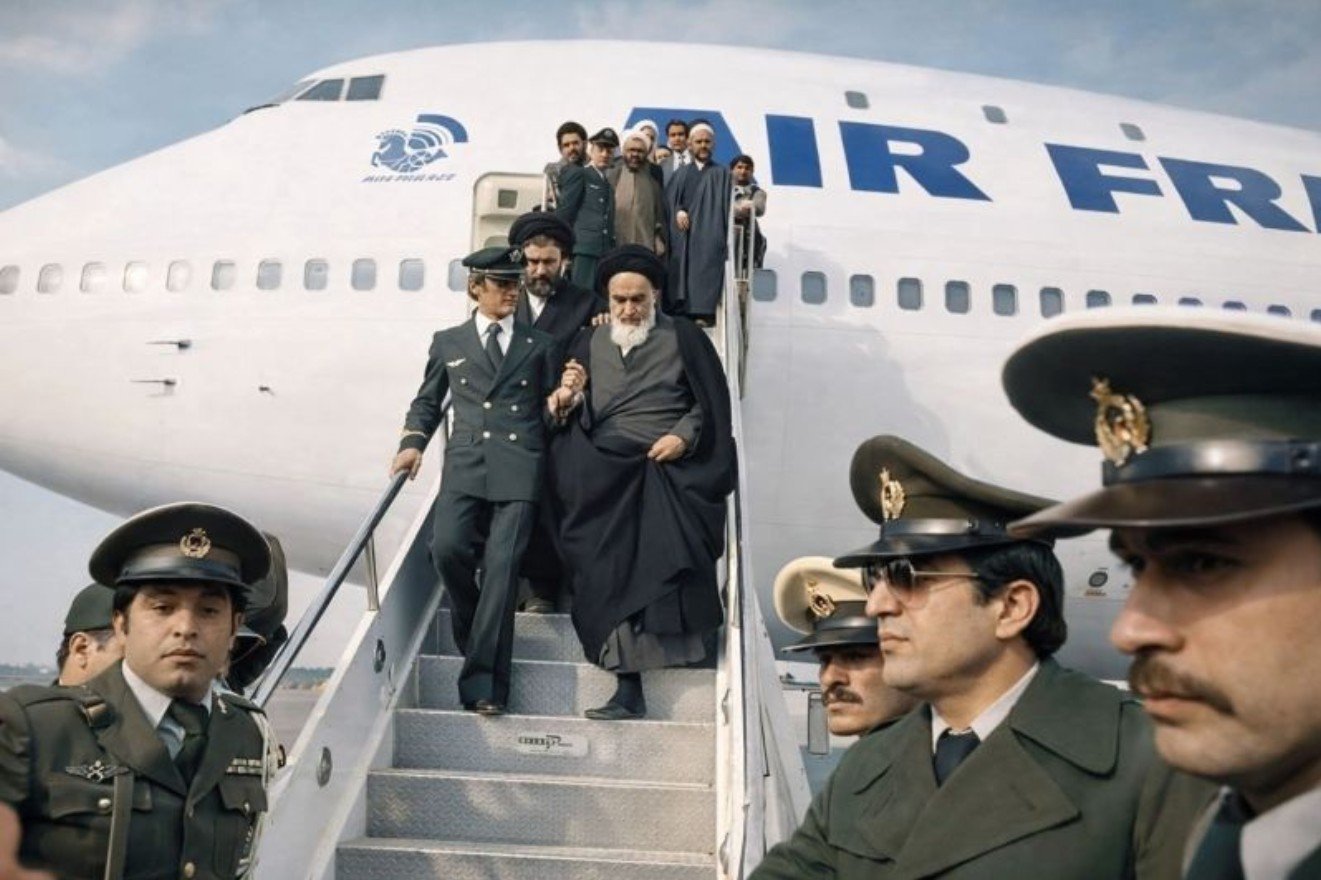
Ayatollah Ruhollah Khomeini returns to Tehran in February 1979, marking a defining moment in the Iranian Revolution. Photo: Bettmann Archive
I had little or no warning when I flew into Tehran in August 1978 of the profound political upheaval that was about to get under way in Iran. I was standing in for the BBC’s resident correspondent and had been assured that things were pretty quiet – nothing to write home about.
I knew that Iran was no stranger to regime change, or indeed to foreign interference in its affairs. In 1953, the democratically elected prime minister, Mohammad Mosaddegh, had been overthrown in a coup d’état instigated by Britain and the United States. The key motive of the coup, which was secretly engineered by the UK’s MI6 and the American CIA, was to protect British oil interests in Iran after Mossaddegh nationalised the country’s oil industry.
The effect of this action was to strengthen the position of the Shah of Iran, Mohammad Reza Pahlavi, and when I had travelled through the country by bus in 1967 on my way to India, the country appeared calm and peaceful. The Shah too must have been feeling pretty confident because in 1971 he chose to throw an exorbitantly expensive celebration to mark 2500 years of the Persian Empire. However, as his rule became increasingly autocratic, the gulf was growing steadily between a newly prosperous westernised urban middle class and the deeply religious, predominantly Shi’a Muslim, population. And the calls for change were starting to be heard.  Prime Minister Mohammad Mosaddegh (left) was overthrown in the 1953 coup backed by Britain and the United States, and later sentenced to prison in December 1953, cementing the rule of the shah and reshaping Iran’s political trajectory. Photo: AP
The main catalyst for change came from the prominent Shi’a cleric Ayatollah Ruhollah Khomeini, who had been living in Iraq for several years, having been exiled for his controversial views and his calls for ‘Jamhuriye Eslami’ or the establishment of an Islamic Republic in Iran. It was his picture that was being carried in the first of several huge marches that I witnessed in August 1978, soon after I arrived in Iran. I remember seeing truckloads of young soldiers, armed and distinctly nervous looking, parked in side-streets along the Old Shemiran Road in North Tehran down which the demonstrators were marching. One of these trucks pulled out and temporarily blocked the marchers and I saw one of the leaders of the demonstration step forward to address the soldiers. ‘You are our brothers, we are not your enemy,’ he shouted, and then women in black chadors brought roses to give to the soldiers, after which the truck pulled back and the march proceeded peacefully.
A few days later, however, after the declaration of martial law, another pro-Khomeini demonstration was met with a very different response. 8 September 1978 – Black Friday, as it came to be called – soldiers opened fire at random on a crowd of unarmed demonstrators in Jaleh Square in central Tehran, killing at least 60 people. In the aftermath I saw many others who were wounded and bleeding.  Shah Mohammad Reza Pahlavi presided over a modernising yet increasingly autocratic Iran before the 1979 Iranian Revolution.
This was a major turning point. Over the next three months the Shah brought in a number of mostly military officials in the hope of stemming the rising tide of opposition to his rule. In early January 1979 he even appointed Dr Shahpur Bakhtiar, a politician from the opposition party the National Front, as prime minister. But then, on 16 January, the Shah himself left Iran unexpectedly – on health grounds it later transpired. The relatively slow-motion regime change was well under way.
Perhaps in response to the Shah’s departure, Ayatollah Khomeini left Iraq and decamped to a little village in France near Paris called Neauphle-le-Chateau to plan his return to Iran. There he held court for a week or so, surrounded by supporters planning his return to Iran. There was much talk of ‘Jamhuriye Eslami’, much less about the detail of the sort of government he envisaged and the role (if any) the various Iranian political parties would be allowed to play.
The departure date was fixed for 1 February 1979 and I had bought my ticket for the chartered Air France flight to Tehran along with 150 other journalists and 50 of the Ayatollah’s entourage. As we all gathered at Charles de Gaulle Airport, we were very aware that there was no firm indication of who was in power in Tehran and what sort of reception we would receive. The Ayatollah was, as usual, a picture of steely, stone-faced resolution.
I remember seeing one of his lieutenants, Abolhassan Banisadr, standing alone at the airport looking deeply unhappy and apprehensive. He was subsequently appointed the first President of the Islamic Republic of Iran, a post he held for 16 months before being impeached in June 1981 and forced to flee into exile in France. He was lucky. Another of Ayatollah Khomeini’s close aides in Paris, Sadegh Ghotbzadeh, who was also on the plane and subsequently served as the Islamic Republic’s foreign minister from November 1979 to August 1980, was executed in 1982 for allegedly plotting the assassination of Ayatollah Khomeini and the overthrow of the Islamic Republic. As the saying goes: ‘The Revolution devours its own children.’  Mass protests in Tehran in 1978 brought together diverse groups demanding change, signalling the collapse of the Shah’s rule.
The flight from Paris was uneventful but we did have two anxious moments on arrival. As our plane was coming in to land the pilot suddenly changed his mind, accelerated up again and circled around for ten minutes before making the landing. Then, when the plane had stopped, armed air force officers ran out from the airport building and surrounded our plane – not, it transpired, to attack us but to protect us from possible attack. Ayatollah Ruhollah Khomeini leaves his villa in Neauphle-le-Château near Paris on January 31, 1979, to board an Air France jet bound for Tehran, marking the beginning of his return from exile that would soon transform Iran’s political system. Photo: AFP
Tehran airport was in turmoil – we had to stamp our own passports because there was no one to do it for us. However, there was a sort of welcoming committee for the Ayatollah, made up primarily of politicians from various opposition parties who were wondering what sort of future lay ahead for them. As far as I can remember, Khomeini ignored them all and we were then swept along in a massive procession made up of hundreds of thousands of ardent supporters of the Ayatollah, bringing him to the Behesht-e-Zarah cemetery to honour the victims of what would soon be the outgoing regime.  Vast crowds gathered as Ayatollah Ruhollah Khomeini visited Behesht-e Zahra Cemetery following his return from exile, where he delivered a speech that symbolised the Iranian Revolution’s triumph over the old regime. Photo: AP
It took another ten days or so for the Shah’s army to declare its neutrality, following the example of junior officers in the air force. Martial law was lifted and the first bricks of the Islamic Republic were laid. 47 years later it still survives, despite a war with Iraq, the American Hostage Crisis, the conflict with Israel and now a devastating aerial bombardment from both Netanyahu’s Israel and Donald Trump’s United States. But Iran – or Persia as it was for most of its history – is no stranger to regime change, or indeed to foreign interference. After all, Alexander the Great, the young king of Macedonia, invaded the Persian Empire 2300 years ago, and Iran’s still there.