On 15 March Kazakhs voted by a substantial majority for constitutional changes which some see as an exit strategy for President Kassym-Jomart Tokayev, who is seeking political closure on the instability that embroiled the country in 2022. Chris Rickleton reports.
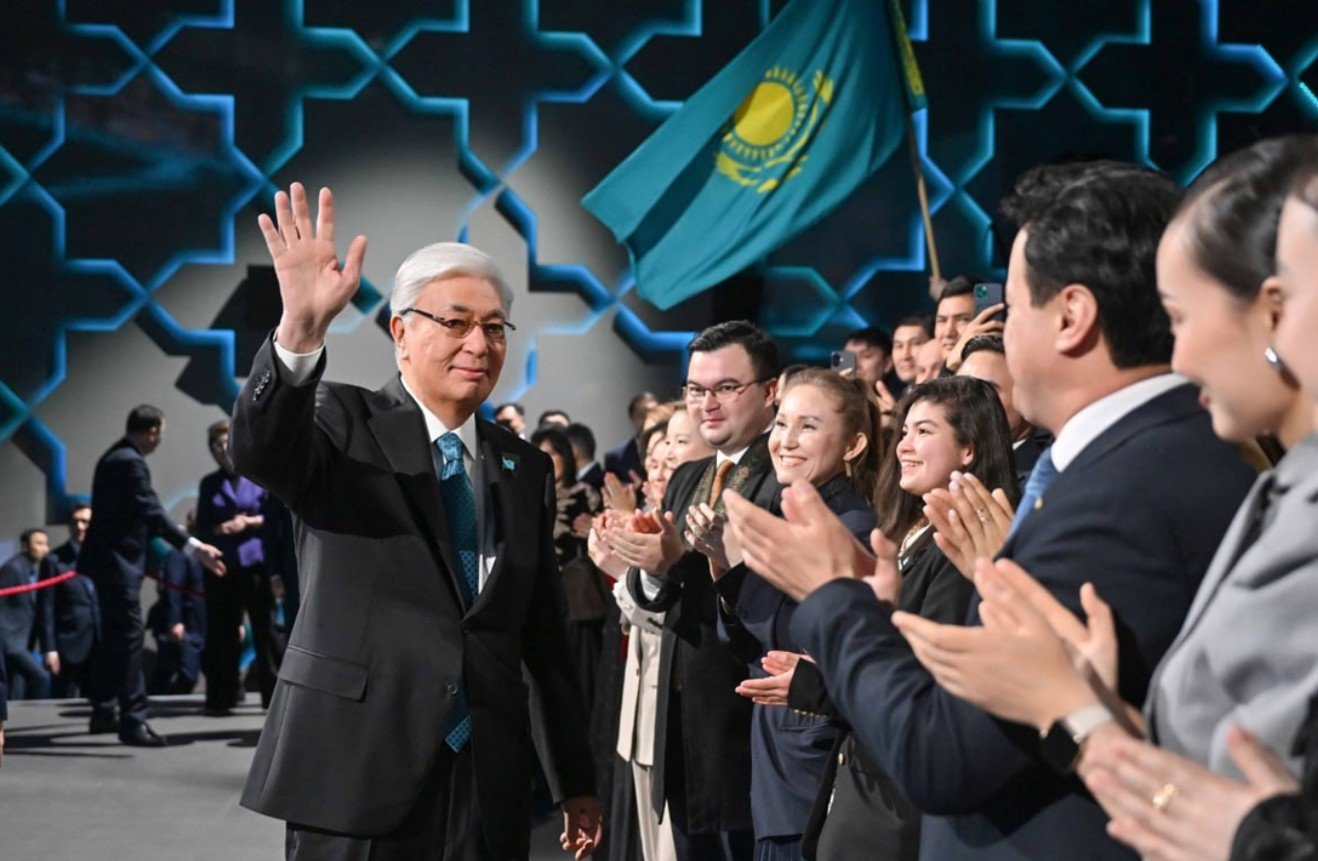
President Kassym-Jomart Tokayev waved to supporters during an event in Astana marking the approval of Kazakhstan’s new constitution in a referendum. Photo: Akorda/Handout
Journalists habitually refer to Kazakhstan, the world’s ninth-largest country by territory, as ‘sandwiched’ between two even larger ones, Russia and China. But Moscow and Beijing will not be the only ones watching 72-year-old career diplomat President Kassym-Jomart Tokayev’s next move.
On 15 March, more than 87% of voters in the Central Asian country backed a new constitution promoted by Mr Tokayev, after a constitutional commission drafted the document in less than three weeks. The referendum result strengthens the hand of Mr Tokayev for the remainder of a term he has suggested will be his last, as he eyes a controlled exit from a turbulent presidency.
 Kazakhs voted overwhelmingly in favour of constitutional changes in a tightly managed national referendum. Photo: gov.kz
In a 30 March opinion for the National Interest publication, Tokayev said that he ‘personally worked on every word of the text’ of the new basic law. The next micromanaged political event will be elections to the new, unicameral parliament, or Kurultai, in August.
Kazakhstan, a landlocked country of 20 million people that runs 3,000 kilometres east to west, declared independence from the Soviet Union in December 1991. Kazakhs, a Turkic Muslim people, account for over 70% of the country’s population. Ethnic Russians are the largest minority with about 15%, down from nearly 40% at the time Soviet power began to crumble.
 Kazakhstan’s strategic position between Russia and China shapes its political balancing and global significance.
Since then, the authoritarian government has leveraged vast mineral wealth to give countries near and far a stake in its stability. Kazakh crude, mostly exported via Russia, accounts for roughly 12% of European Union oil imports, while the list of shareholders in consortia controlling the giant oil fields Tengiz, Kashagan and Karachaganak read like a Who’s Who of the global oil industry. Already the world’s largest uranium producer, Kazakhstan is now seeing competition intensify over its critical minerals, as Chinese and American firms vie to develop some of the region’s largest tungsten deposits. The unstated aim has long been to prevent any one country from gaining undue influence.
Mr Tokayev claims his constitutional reforms are designed to prevent the political system’s long-term domination by any one man. For more than three decades, the political course was set by Nursultan Nazarbayev. Mr Nazarbayev, now 85, became president when Kazakhstan was still under Moscow’s control. By the time Nazarbayev handed the office to Mr Tokayev in 2019, he was constitutionally enshrined as ‘Elbasy’, meaning ‘Leader of the Nation’ in Kazakh. He was also the new ‘lifelong’ chair of the country’s Security Council – where the new head of state was a mere seat-holder – chairman of the ruling party in a country without an opposition. Mr Tokayev, in contrast, was derided by one Europe-based regime opponent as ‘furniture’ that could be set aside.
The balance of power between the two men shifted decisively in January 2022, when unrest that began with peaceful protests over a fuel price spike in the oil-producing but economically depressed west of the country spiralled into chaos, concentrated in the former capital Almaty, leaving at least 238 people dead. Although many took to the streets to protest inequality and corruption, a split in the security elite appeared to prompt more violent mobilisations. During a prolonged internet shutdown, Mr Tokayev announced to the nation that he had been the victim of a coup attempt. Mr Nazarbayev resigned from all his posts soon after the bloodshed, declaring his backing for Mr Tokayev. His relatives were dismissed from powerful and lucrative positions, with one nephew even spending time in jail.
 Deadly unrest in 2022 marked a turning point in Kazakhstan’s political balance, reshaping Tokayev’s authority. Photo: Yerlan Dzhumayev/TASS
A Soviet-trained diplomat, Mr Tokayev served twice as Kazakhstan’s foreign minister, once as its prime minister, and from 2011 to 2013 as under-secretary of the United Nations in Geneva. He speaks fluent English and Mandarin in addition to Russian and Kazakh, although like many Kazakhs raised in the country’s largest city Almaty, his Russian is stronger.
Mr Tokayev continues to acknowledge his predecessor’s achievements. These include the construction of the futuristic capital, Astana. Mr Nazarbayev’s decision to relocate the seat of government 1,000 kilometres north from leafy,
mountain-hemmed Almaty in the 1990s is often interpreted through the lens of geopolitics. Other than Almaty, the ethnic Russian population is mostly located in the north of the country, closer to the 7,644-kilometre border with Russia. As Astana grew, and with a state programme supporting relocation, more ethnic Kazakhs moved from south to north. Yet some Kazakhs fear that there are still parts of the north where the ethnic Russian demographic could be exploited by Moscow in a Ukraine-style scenario that Russian pundits and lawmakers are fond of threatening.
 President Kassym-Jomart Tokayev with former president Nursultan Nazarbayev, whose long dominance the new constitutional reforms seek to move beyond. Photo: Akorda.kz
While the Kazakhstan-Russia relationship is generally close, it has been trickier since the Kremlin launched its full-blown war against Kyiv in 2022. Astana’s neutral stance on the war and its accommodation of Western sanctions have emboldened Vladimir Putin’s proxies in Russia’s media space, who cast Tokayev as an ungrateful ally. Kazakhstan’s historic unrest broke out a month before the invasion started.
A more militaristic Russia has made the relationship with China more important. Chinese President Xi Jinping spoke about his Belt and Road Initiative for the first time abroad during a speech at Nazarbayev University in Astana in 2013. In September 2022, Mr Xi made Kazakhstan his first foreign visit after the pandemic and pledged to ‘categorically oppose any force’ interfering in the country’s affairs.
Mr Tokayev has also established a good rapport with US President Donald Trump, joining Kazakhstan to Mr Trump’s Gaza-focused ‘Board of Peace’ as well as the Abraham Accords linking Israel with its Arab neighbours during Mr Trump’s first term. At a Washington summit featuring Mr Trump, Mr Tokayev and four other Central Asian leaders last year, Mr Tokayev hailed his host as a statesman ‘sent by heaven to return common sense’ to United States policy. Less than a week later, Mr Tokayev was in Moscow meeting Putin, where he described Russia as a neighbour sent by God.
 Astana stands as a symbol of Kazakhstan’s state-building ambitions and centralized political power. Photo: Reuters
Some of Mr Tokayev’s critics argue that his intention is to channel Mr Putin by using the incoming constitution as a pretext to seek a new mandate. That seems unlikely. Mr Tokayev has invested political capital in a change to the basic law introduced nearly four years ago that makes the office subject to non-renewable seven-year term, a restriction that remains in force.
Beginning a third term while championing a constitution that restricts further leaders to one term would smack of the exceptionalism Tokayev claims Kazakhstan is moving away from. At the same time, the constitution strengthens presidential authority over key appointments, provides the office with multiple pretexts to dissolve the Kurultai and allocates the head of state emergency lawmaking powers in such an event. So, a democratic shift therefore looks unlikely.
This leaves another managed leadership handover as the most probable scenario, perhaps closer to when Mr Tokayev’s term ends in 2029.
It would be difficult to manage it worse than last time.