In eastern India, the effects of the Iran war are showing up not in fuel queues or port delays but in the calculations farmers make before sowing. The kharif season begins with the southwest monsoon, which advances across India during June. That is when demand rises for urea, India’s most widely used nitrogen fertiliser. If supplies are tight at this time the consequences appear later in weaker harvests. Rahul Jaywant Bhise writes on how the blockade of the Strait of Hormuz is turning an energy shock into a fertiliser and food-security crisis across Asia.
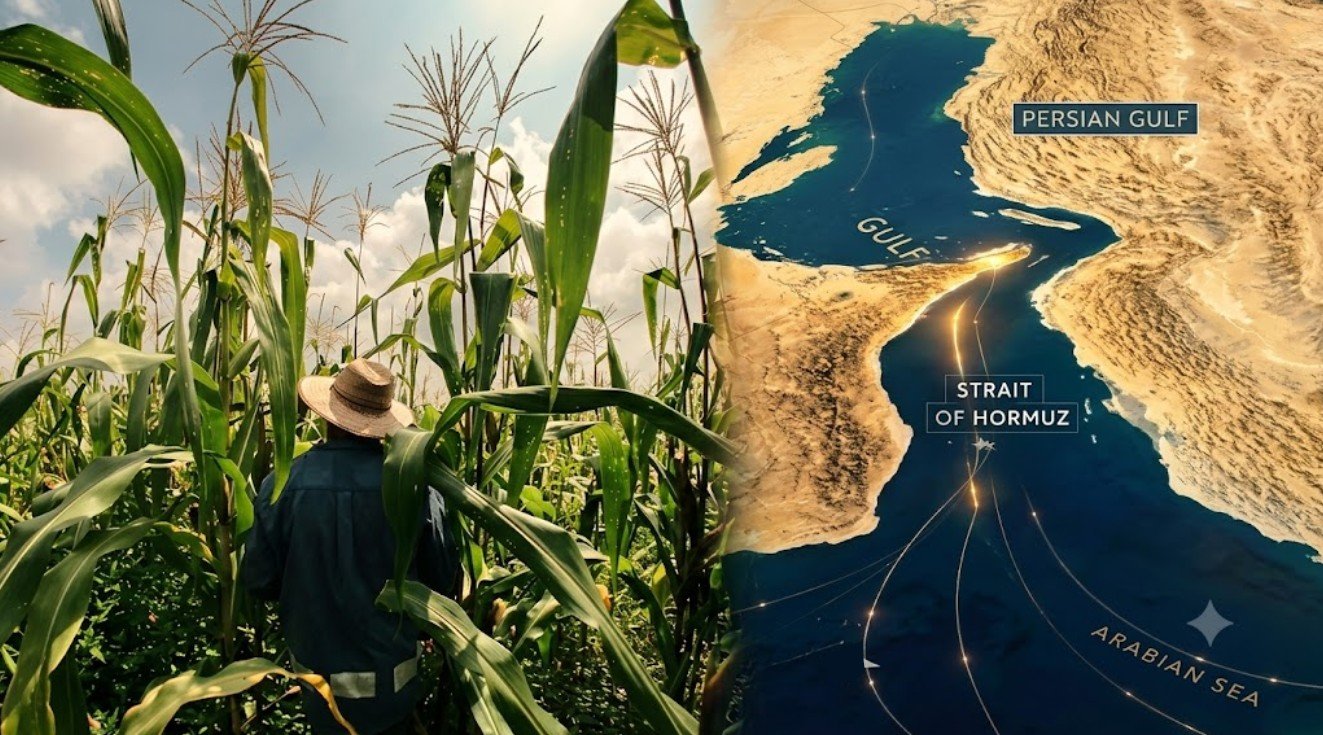
A maritime crisis in the Gulf is evolving into a wider challenge for agriculture and food security across Asia. Image AI generated
The Strait of Hormuz is usually discussed as an energy chokepoint. In the week before the conflict began at the end of February, 38% of global seaborne crude-oil trade and 19% of LNG flowed through the Strait of Hormuz. The more consequential shock may be about chemicals, of which 13% of chemicals flowed through the strait, rather than energy. Modern food systems depend not only on fuel, but on nitrogen.
The chemistry is simple. Nitrogen is one of the essential nutrients crops require, but plants cannot use most of the nitrogen in the air directly. Industrial agriculture solves this through synthetic fertiliser. Ammonia is produced by combining nitrogen from the air with hydrogen, usually derived from natural gas, through the Haber-Bosch process. Urea, the world’s most widely used nitrogen fertiliser, is then made from ammonia and carbon dioxide. These products are manufactured in fertiliser plants, many located close to gas supplies in the Gulf.

Large-scale ammonia and urea plants in the Gulf convert natural gas into fertilisers that sustain agricultural production across Asia. Image AI generated
That is why Hormuz matters for food. The International Fertilizer Association says Iran, Qatar, Saudi Arabia, the UAE and Bahrain accounted in 2024 for 23% of global ammonia trade, 34% of urea trade and 18% of ammoniated phosphate trade. The wider Middle East supplied close to 30% of global exports of major fertilisers. UNCTAD estimates that around one-third of global seaborne fertiliser trade passed through Hormuz in 2024; of that traffic, 67% was urea.
The disruption is already visible. UNCTAD, the UN trade body, says daily ship transits through Hormuz fell by 97% in early March, from an average of 141 vessels a day in February to single digits. AXSMarine and the WTO’s Strait of Hormuz Trade Tracker reported in May that fertiliser-related cargoes were down 87% compared with pre-conflict levels. Costs have risen sharply as well. War-risk insurance on a $100m vessel, normally around $250,000 a voyage, could rise to $500,000 or even $1m.
Fertiliser markets have responded quickly. CRU Group, quoted by the Washington Post, estimated that 30% of global urea supply had been ‘wiped out’ by the disruption, with spot urea prices up 40% since February. CF Industries reported urea prices up 17% year on year and ammonia prices up 25%.
Svein Tore Holsether, chief executive of Yara International, has warned that the disruption risks creating a ‘global auction’ for food and fertiliser in which wealthier countries outbid poorer ones. He told the BBC that around 500,000 tonnes of nitrogen fertiliser were not being produced because of the crisis. The result, he said, could be up to 10 billion meals a week that ‘will not be produced’ because of the lack of fertilisers.
Farmers cannot respond to fertiliser shocks as traders respond to oil shocks. Fertiliser decisions are made at sowing time. If fertiliser is unavailable or too expensive, farmers reduce or delay application. Nitrogen is especially important for cereals such as rice and wheat. Lower application weakens yields and tightens food supply months later.
 Indian farmers prepare rice fields during the kharif sowing season, when timely access to nitrogen fertiliser becomes critical for crop yields. Photo: Gowtham AGM/Unsplash
India illustrates the pressure clearly. It is one of the world’s largest fertiliser consumers and imports a substantial share of its urea requirements. The timing is awkward: kharif sowing begins with the monsoon which is precisely when farmers need nitrogen for rice, pulses and cotton. Any disruption in fertiliser availability during June and July affects agricultural output months later. Higher fertiliser prices also increase pressure on India’s subsidy system, forcing the state either to absorb rising costs or pass them on to farmers.
Pakistan faces a similar vulnerability, but with weaker fiscal buffers. The country remains heavily dependent on imported fuel and fertilisers while continuing to struggle with debt pressures and inflation. Higher fertiliser prices risk feeding directly into food inflation at a time when household purchasing power is already fragile.
Sri Lanka’s exposure is equally acute. UNCTAD lists it among economies highly dependent on fertilisers imported by sea from the Persian Gulf: 36% of its seaborne fertiliser imports originated there in 2024. The country is still recovering from the economic collapse of 2022, and rising fuel and fertiliser costs threaten both agricultural production and the fragile stability restored under IMF-backed reforms.
South East Asia shows how quickly the shock can spread through food markets. Thailand, one of the world’s largest rice exporters, is also highly exposed. Thai farmers are already delaying planting or reducing acreage as fuel and fertiliser costs rise. The Philippines faces double vulnerability as both a fertiliser importer and a major rice importer, exposing consumers to higher farming costs and rising food prices simultaneously. Bangladesh faces similar pressures as fertiliser prices and shipping costs rise across the region.
 Consumers shop in rice markets across South and Southeast Asia as rising fertiliser and transport costs threaten to push food prices higher. Photo: The Daily Star
The politics of fertiliser are sharpening too. China has curbed fertiliser exports since March, according to Reuters, including nitrogen-potassium blends and some phosphate varieties. Bloomberg has also reported tighter Chinese export controls. David Malpass, a former World Bank president, told the BBC that China should stop ‘hoarding food and fertiliser’, saying it had the world’s largest stockpiles. Beijing says domestic food security must come first.
Plastics matter too, though less than fertiliser. The Gulf is a major source of petrochemicals used in packaging, irrigation equipment, storage and food distribution systems. Disruptions to plastics reinforce the same point: modern food systems depend on energy and chemical supply chains, not just farms.
There are few quick substitutes. Pipelines can reroute some oil and gas flows around Hormuz, but not the full scale of seaborne trade. Fertiliser plants take years to build and require gas, infrastructure and capital. Organic manures and biofertilisers help, but cannot quickly replace synthetic nitrogen at the scale needed to sustain current yields.
 Commercial shipping traffic through the Strait of Hormuz has fallen sharply since the conflict escalated, disrupting global energy and fertiliser supply chains. Image AI generated
The distinction between food shortages and famine still matters. A Hormuz blockade does not automatically produce famine. But prolonged disruption does raise the risk of food insecurity by increasing fertiliser costs, lowering yields and straining public finances. Recent reporting on Yara’s warning said the combined fallout could push tens of millions more people into acute hunger if disruptions persist.
For now, the effects remain partly hidden. Fields are still being planted and markets continue to function. But the early signals are clear: ships are not moving, freight and insurance costs have surged, urea and ammonia prices have risen, China is restricting exports and Asian farmers are cutting back. Much of the nitrogen sustaining modern agriculture still passes through one narrow, dangerous strait.