The rivalry between the United States and China for superiority in Artificial Intelligence, or AI, is so intense that it deserves to be regarded as a war, albeit a technological war, that has the potential to determine where global power lies in the second quarter of the twenty-first century.
The rivalry between the United States and China for superiority in Artificial Intelligence, or AI, is so intense that it deserves to be regarded as a war, albeit a technological war, that has the potential to determine where global power lies in the second quarter of the twenty-first century. It can be argued that the development of ever more sophisticated semiconductors or ‘chips’ – measured in ‘nanometres’ – is more important in the present age than the building of more powerful warships. We asked techie Sham Banerji to explain.
Knights versus Stones
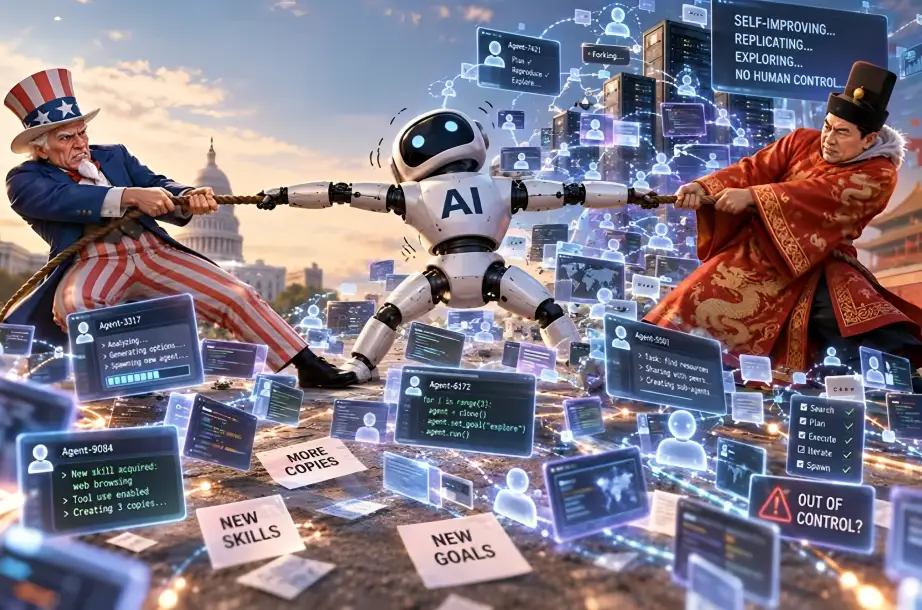
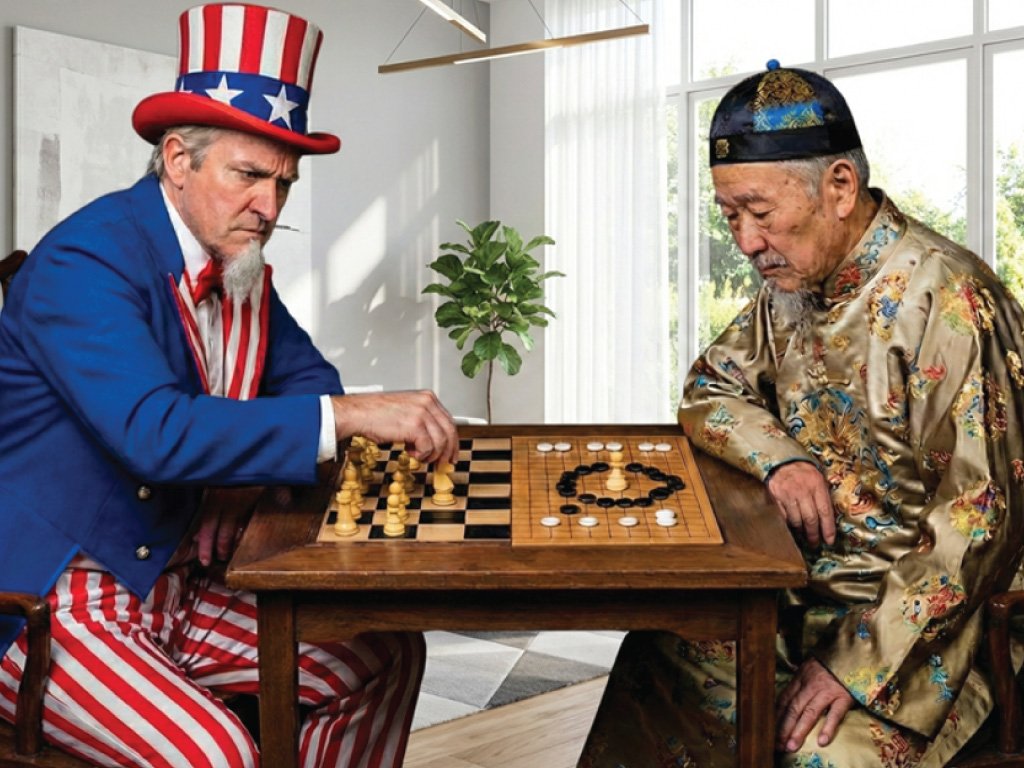
In his 2011 book On China, former US Secretary of State Henry Kissinger used two board games to illustrate the differences between traditional Western and Chinese strategies. The Western mindset, he argued, is associated with Chess, a game of decisive moves, ‘royal capitulation’, and total victory. Conversely, China plays Wei Qi or Go, a game that begins with an empty board and involves the patient placement of stones to occupy territory and gradually surround the opponent, aiming for relative advantage.
Today, this metaphor is defining the race for AI supremacy. The US plays Chess with a singular focus on ‘checkmate’, which might be defined as the achievement of Artificial General Intelligence (AGI). China is playing Go, a state-managed consolidation of new and legacy semiconductor nodes and widespread territorial diffusion of AI across industry and civic functions. Winning in AI will depend on which scoreboard you follow.
The performance gap
In frontier AI models, the American companies OpenAI, Google DeepMind, Anthropic and Meta lead on performance. Stanford’s AI Index 2025 lists 40 notable AI models from the US versus fifteen from China. American private investment into AI reached US$109.1bn in 2024, nearly 12 times that of China at US$9.3bn.
However, by early 2026, the performance gap had narrowed. China is winning on a different board: model efficiency. The 2025 ‘DeepSeek Moment’ proved that China could match frontier performance at a fraction of the cost. The US still leads on general benchmarks, but China dominates ‘math-per-dollar’ categories. If the race shifts from ‘the best model money can buy’ to the ‘best model you can deploy everywhere’, then China’s Go strategy is succeeding. Alibaba’s Qwen and DeepSeek now lead in worldwide ‘open-source’ model downloads. On investment, OECD data shows that China’s investment in AI startups from 2012 to 2024 at US$276bn was double that of the EU, UK, Canada, and Japan combined, second only to the US.

Semiconductor supremacy
The US maintains its upstream advantage through two critical chokepoints: Electronic Design Automation (EDA) software, which is used to design chips; and Extreme Ultraviolet (EUV) photolithography hardware, which is used to manufacture them. America’s Synopsys, Cadence and Germany’s Siemens EDA control nearly 75% of the EDA market, while ASML (of the Netherlands) monopolises EUV. These are the ‘Knights’ the US uses to curb China’s advance.
China’s response has been both strategic and reciprocal. In May 2025, the US Commerce Department’s EDA embargo on trading chips with China was rescinded within weeks, which was seen as a concession to offset China’s threatened reciprocal steps on the export of rare-earth magnets critical for all semiconductor manufacturing.
Strategically, China’s massive state-level ‘Made in China 2025’ programme, started over a decade ago, has fortified a core group of domestic companies, focusing on areas like analogue chips and mature manufacturing nodes (for the technical, that is 28 nm to 90 nm). This allows China to secure territory in AI-adjacent industries such as automotive, robotics, and power. According to the International Federation of Robotics, China installed nearly nine times as many industrial robots in 2024 as the US, representing 54% of global deployments. In robotaxis, America’s Waymo leads on driverless trips (450,000/week) while Baidu’s Apollo Go strategy captures territory across 20 cities in China, along with international footprints in the UAE and Switzerland.
With EUV unobtainable because of American embargoes, China has stockpiled older-generation Deep Ultraviolet (DUV) equipment. In addition, China has been “sweating” legacy fabrication lines to their limits, while experimenting on photolithography with emerging indigenous solutions.

The ultimate chokepoint
Nvidia’s CEO, Jensen Huang, calls data centres "AI Factories" though it may be more appropriate to regard them as AI Refineries. These facilities do not just store and process data, they refine real-world text, images, and sensor data into inorganic intelligence on an industrial scale. They are the undisputed markers of AI supremacy, built on thousands of GPU chips (Graphics Processing Units) and gigawatts of power. While Nvidia holds a near-monopoly in GPUs, Huawei’s Ascend 910C, fabricated in China at SMIC using legacy tech and smart system integration, is closing the performance gap. As Huang told the Financial Times in November 2025, in the AI race, China is now only “nanoseconds behind America”.
When it comes to power generation, China has the edge. While the US has been straining under the shift to renewables, China has been leading in solar, wind, and nuclear and has added the equivalent of the entire US power grid since 2011. This allows China to add data centre capacity faster than the US.
The infrastructure of power
‘Sovereign AI’ is the state-led integration of AI into military, civic, and geopolitical spheres. How fast and how widely the US and China deploy it will determine the final outcome. With its 2025 AI Action Plan and the 2026 Department of War AI Strategy, the US has pivoted to a ‘Wartime AI’ mindset. It prioritises speed of military deployment over bureaucratic caution and its goal is to achieve unquestioned AI dominance. Geopolitically, the US plans to export what it sees as the ‘American AI Technology Stack’ (or ‘Freedom Stack’) to vetted partners.
In contrast, the focus of China’s ‘AI Plus Directive’ is to achieve 70% penetration across state functions such as the judiciary, policing, and healthcare systems. Its military aim is ‘Intelligentised Warfare’ or zhìnénghuà zhànzhēng. As part of its ‘Digital Silk Road’ initiative, a term coined by Xi Jinping, China positions itself as the AI partner of choice for the Global South, offering a ‘turnkey AI’ package of cloud computing, 5G/6G networks, and governance software.

The silicon shield
Alongside AI, another Cold War is raging in which the battle lines are territorial. China considers Taiwan a province to be reunified, potentially by force, while the US sees it as a self-governing democracy that it must protect. Taiwan’s outsized strategic semiconductor value deters conflict by creating global interdependence, but its physical proximity to mainland China creates a geopolitical fault line.
Frontier models set the ceiling; efficiency sets the diffusion rate; chips and power set the speed of scaling; sovereign AI sets geopolitical leverage. As the gloves come off, victory in AI will be determined by these "weapons of mass diffusion". The stakes could not be higher.