It is said that the army in Pakistan wields more power than its democratically elected government, a situation that has prevailed for much of its years as an independent state. Umber Khairi reports.
Pakistan’s democratic process unfolds under the watchful presence of the military, reflecting the enduring imbalance between civilian authority and institutional power. Photo: Sohail Shahzad/EPA
A Turkish politician once remarked that while ‘most countries have an army; in Turkey the army has a country’. Much the same may be said of Pakistan, where the military has become increasingly influential, not by imposing martial law directly but by undermining and controlling the institutions and participants of democracy. In practice, no elected government has been able to function without the military’s approval or survive once it challenges the armed forces.
Pakistan’s most recent general elections were held in February 2024. So, in theory, Prime Minister Shehbaz Sharif now heads a parliamentary government. But the result remains bitterly disputed: independent observers were excluded and, before the poll, state actors tried to prevent Imran Khan’s party from participating by disqualifying and smearing candidates, challenging the party’s registration and banning its cricket-bat symbol. Activists and leaders were detained and harassed.
Khan and his party, the Pakistan Tehreek-e-Insaf (PTI), had themselves come into power at the hands of the military through an earlier disputed election – in 2018. Although Khan entered politics in the late 1990s, he was unable to gain a following until a section of military intelligence, the ISI or Inter-Services Intelligence, took him on as a project around 2011, largely, it was understood, to counter the hold of three-time prime minister Nawaz Sharif and his party and family in the Punjab, Pakistan’s most powerful province.

Pakistan’s military leadership has long played a decisive role in shaping political outcomes. Photo: PPI
Khan was initially useful to the military establishment because he did not identify with the political or parliamentarian class and he routinely insulted politicians, labelling them crooks, thieves and traitors, which fitted well with the military establishment’s ongoing narrative about politicians. He had agitated outside parliament for four months in 2014, bringing Islamabad to a standstill even though he was by then an elected representative. The episode showed how useful he had become to parts of the military establishment in destabilising civilian politics.
Khan was used to destabilise the government at the time – but once he himself was in power, he began to go ‘off-piste’ and became something of a thorn in the side of the military. He became embroiled in a power struggle within the army top brass, aligning himself too closely with one of the generals in the running to succeed the then Chief of Army Staff. A different general got the top post and soon both Khan and his allied general were in prison. Khan has been in prison for over two years, charged in a number of cases. Nearly all Pakistan’s elected prime ministers tend to end up either in jail or in exile.

The 2024 general election unfolded under tight control, with allegations of restrictions on opposition participation.
By cooperating with the army in return for office, Khan followed the path of many Pakistani politicians: a Faustian pact in which power is exchanged for compliance. All the mainstream parties are now, to varying degrees, part of this arrangement. They run national and provincial governments, but real power still lies with the military, especially in economic, defence and foreign policy.

Imran Khan emerged as a powerful political force before falling out with the same establishment that once backed him. Photo: AFP
The military view is simple: the armed forces are the reason Pakistan is still standing and they are the only ones who can keep it running. When the army chief General Pervez Musharraf overthrew prime minister Nawaz Sharif in 1999 – after the latter had sacked him – he cited the main reason as being that the political government had been ‘intriguing to destroy the last institution of stability left in Pakistan.

Beyond defence, the military’s expanding business interests have deepened its stake in Pakistan’s economic life. Photo: The Economic Times
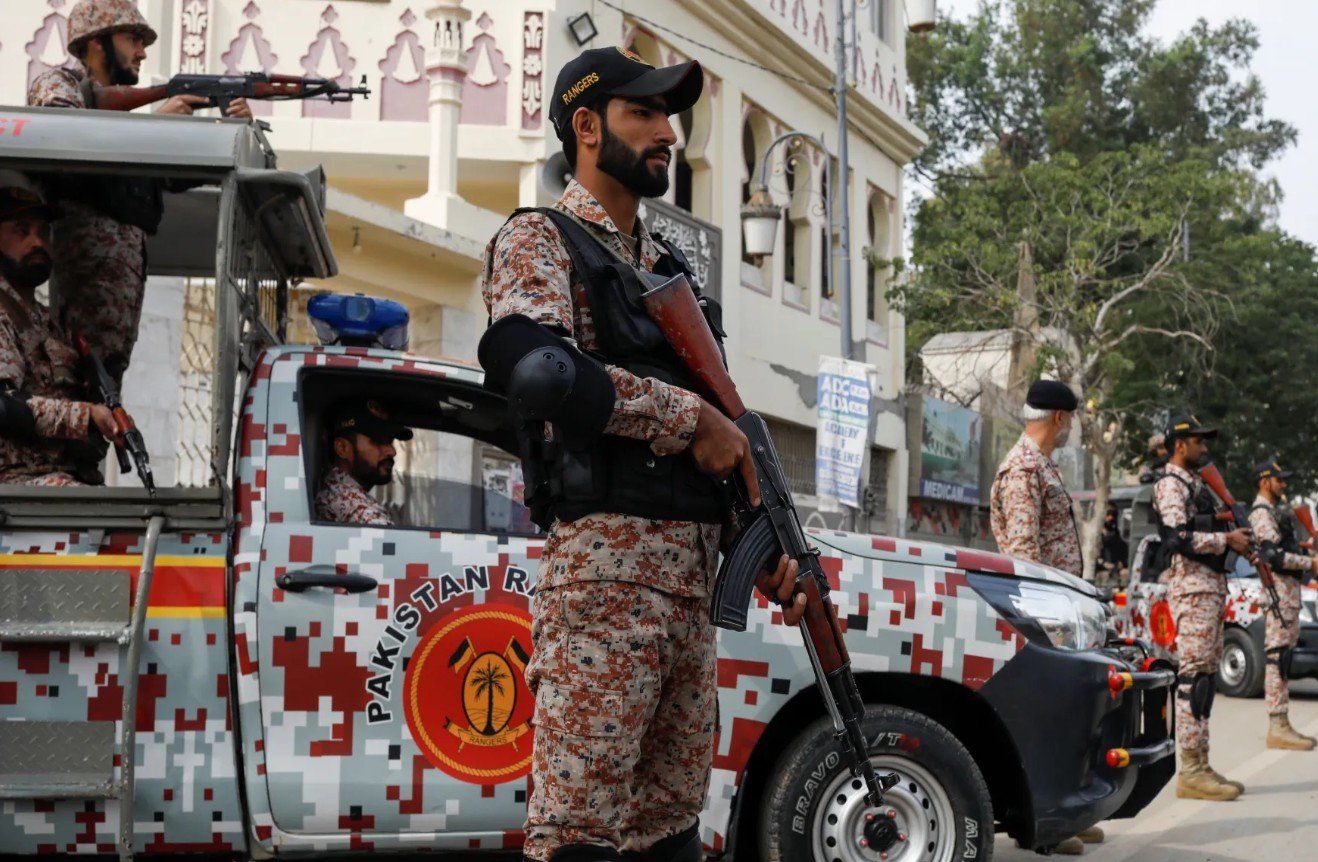
Pakistan’s military views nearly all of its neighbours (except old ally China) with varying degrees of hostility and cites this as a reason why there should never be any cuts in defence expenditure. In terms of the economy, it is not just defence expenditure it is concerned about – the military has its own, ever-increasing interests. These have broadened and mushroomed over the years as the military is now invested in a number of sectors including real estate, dairy and food products, energy and banking. These growing commercial interests, termed ‘MilBus’ by researchers, have raised the stakes for the army in terms of controlling the government.
An uneasy partnership
The partnership is uneasy. The army favours central control, whereas the 18th amendment of 2010 devolved many powers to the provinces. Civilian governments have also tended to favour normalising relations with India and increasing trade, while the military has resisted this. Western governments, especially the United States, often profess support for democracy while preferring to deal with military rulers.
Pakistan has held five general elections this century. At least two elected governments vowed to prosecute former army chief and president Pervez Musharraf for illegally usurping power and violating the constitution. He was charged with treason and sentenced to death, but the Lahore High Court later annulled the verdict. Last year parliament granted the current army chief, General Asim Munir, lifetime immunity from arrest and prosecution.
There are a number of red lines that the military insists not be crossed. One is criticism of the institution and its officers. Another is reporting on or criticising the troubled state of the Balochistan province where there is still a nationalist insurgency.

Shehbaz Sharif speaks in Parliament in Islamabad, where elected leaders govern within a system widely understood to be shaped by the military’s overarching influence. Photo: AP
So, what exactly is the state of democracy in Pakistan?
Pakistan’s democracy is an enterprise in which true power rests with the military establishment, the ‘custodians’ of the country. Yet, at the same time many systems and subsystems of democracy are functioning. Elections are held, citizens turn out to vote, voters make demands of their elected representatives and they expect their representatives to work for them. Even though this happens in a controlled and often repressive environment, the appetite for a democratic dispensation seems to exist. Despite these expectations people realise that the final arbiter will be the military. In this respect Pakistan resembles Myanmar: both maintain a civilian façade under military dominance. This hybrid model may yet evolve into a stronger democracy suited to Pakistan. Equally, by providing civilian cover for military rule, it may further weaken democratic institutions.