Are Asia’s superpowers setting the future global economic agenda? Vince Cable, a Liberal Democrat MP and UK Secretary of State for Business, Innovation and Skills in the coalition government under David Cameron’s premiership, reports.
Are Asia’s superpowers setting the future global economic agenda? Vince Cable, a Liberal Democrat MP and UK Secretary of State for Business, Innovation and Skills in the coalition government under David Cameron’s premiership, reports.
Was recently at a global economic conference in Delhi where the mood was decidedly upbeat. India’s economy is growing at around 7% p.a. Prime Minister Modi spoke to a cheering business audience about successful trade deals with the EU and the USA and his ambitions for a more business-friendly set of policies designed to make India a ‘developed’ economy by mid-century – to roughly where China is today.
Cynics may scoff at India’s economic pretensions just as cynics scoffed at China a generation ago. I don’t scoff and, indeed, thirty years ago I was advising the multinational company I worked for to bet big on both China and India. They followed my advice and haven’t regretted it.
My latest book Eclipsing the West; China, India and the Forging of a New World looks back at the relative performance of these Asian superstates and looks forward to a world economy which they increasingly dominate, along with the USA – and, just possibly, the EU if Europe’s current malaise and division can be overcome.

Prime Minister Narendra Modi outlines India’s ambition to become a developed economy by mid-century.
That new world is already taking shape. China and India, with 36% of the world’s population, account for 27.5% of global GDP, according to the IMF Economic Outlook 2024, only fractionally short of the 28.7% of the ‘advanced’ world; essentially, Europe, North America and Japan. India and China together accounted for 44% of global growth in 2024 and plausible forecasts have them continuing to drive the global economy.
One obvious question in any comparison is why China is so far ahead, close to the living standards of ‘advanced’ economies, whilst India has only recently emerged into the middle-income category. We are, of course, talking crude averages for vast, diverse countries. One third of Indians, mainly in the southern and western states, already live at Chinese living standards, whilst the remaining two thirds in the East and North remain at desperately poor levels.
Part of the answer is that, even in the chaotic Maoist period, China invested strongly in basic literacy and primary and secondary education but, in India, tertiary education had priority and provincial government, which had responsibility for schools, failed to invest. China also carried through land reform, albeit brutally, allowing Deng’s subsequent liberalisation to incentivise an entrepreneurial peasant class. India’s gradualist democratic system, by contrast, left semi-feudal, caste-based rural society intact.
The other key factor favouring China was that Deng Xiaoping’s radical economic reforms were launched in China a decade earlier than Manmohan Singh’s in India and went further and faster. India missed out, almost entirely, on the boom in industrial exports which became the basis of China’s development. China now has around a third of the world’s industrial production; India a dismal 3%. Both countries are best described as ‘state capitalist’ but the Chinese Communist Party also unleashed competitive capitalism whilst India developed an inefficient, protected ‘crony capitalism’.

Deng Xiaoping’s market reforms transformed China into the world’s industrial powerhouse.
Looking forward, however, fortunes are changing. China is dealing with the deflationary after-effects of a vast property market collapse. Consumer demand and private, investor confidence are weak. Large-scale public investment in infrastructure can no longer be funded by bankrupt local government and is, anyway, subject to decreasing returns. Necessary reforms of the internal passport system – hukou – and spending on public services to boost domestic demand are not happening, despite official recognition of the problem. It is possible that even the official 5% growth rate overstates China’s growth. It is likely that the success of China’s new high-tech industries will feed through into the wider economy, but the days of gung-ho Chinese growth are over.

China now accounts for nearly a third of global industrial production. Photo: Xinhua/Han Chuanhao
By contrast, a lot of things are going right for India: broad political consensus on stronger economic reform including tricky areas like agriculture and labour law; the big success of digitisation embracing even the poorest; greatly improved infrastructure; consolidation of India’s domestic ‘single market’; some relocation of supply chains to India from China and Southeast Asia. Big problems remain including a vast surplus of under-employed labour: sometimes, hopefully, described as a ‘demographic dividend’. The yawning gap between the relatively prosperous South – Tamil Nadu, Kerala, Karnataka, Telangana – and the impoverished, populous, Hindi-speaking North – Bihar, Jharkhand and much of the biggest state, Uttar Pradesh – also threatens to create deep political divisions as the South is increasingly milked for tax revenue.

Digitisation — from cities to villages — is reshaping India’s economic infrastructure. Photo: DD News
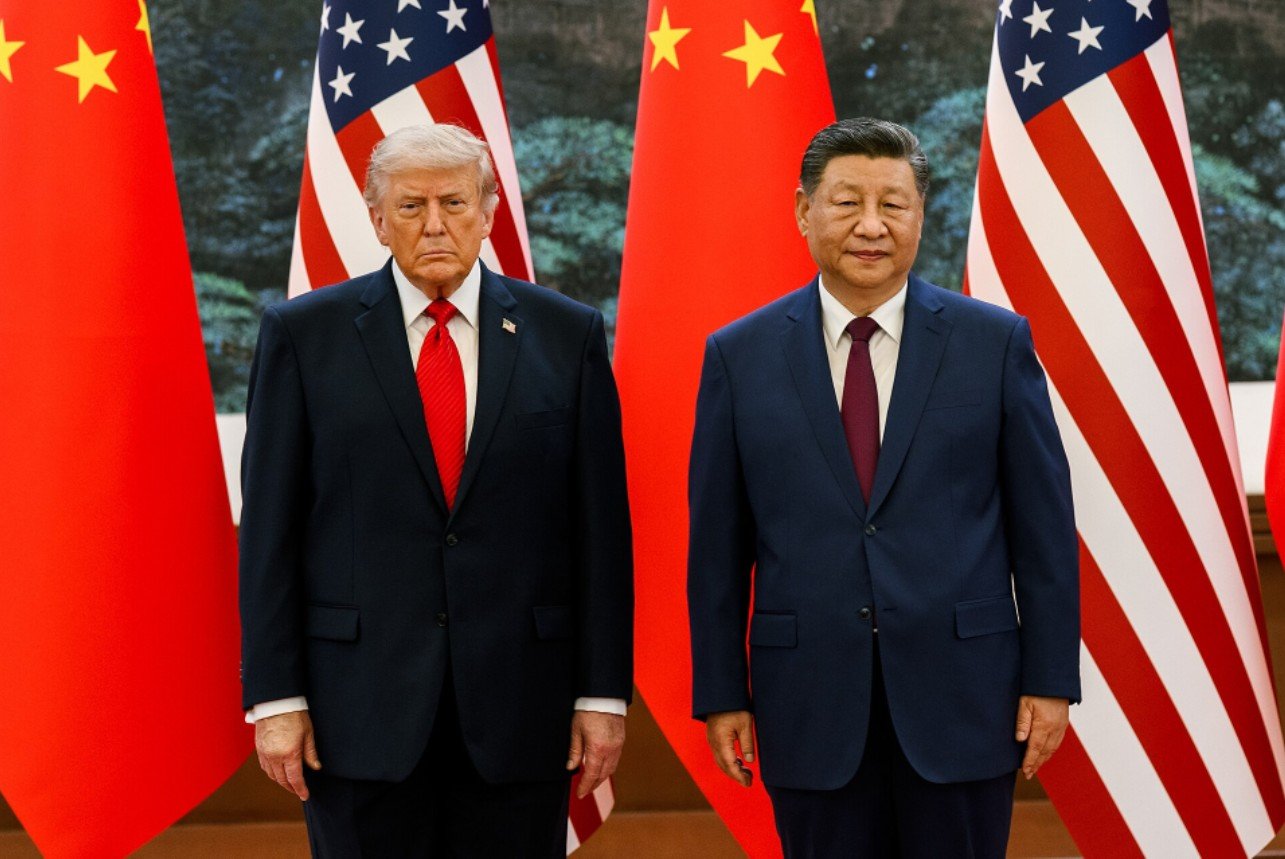
Indeed, politics may be the determining factor in the two countries’ relative success in the long run. China has benefitted from the stability, order and long-term consistency conferred by the Communist Party and its pragmatic approach to business and wider economic policy since the days of Deng. 45 years of prodigious growth and rising living standards is a remarkable achievement, giving the regime a strong underpinning of support. But there is growing worry about the apparent lack of succession planning; Xi’s seeming paranoia about his own position; his obsession with ‘corruption’ which spills over into uncertainty and risk-aversion for business and local officials; and a geo-political confrontation with the USA (albeit that Xi seems to be smarter than Trump).
India’s messy, noisy, fragmented democracy is inherently less disciplined and consistent than China’s autocracy but has the great advantage of adaptability and flexibility. Wrought iron versus cast iron. Having feedback from an electorate helps to mitigate bad mistakes (like Xi’s excessively harsh handling of COVID). The current BJP government under Modi has eroded some democratic safeguards and its anti-Muslim, nationalistic prejudices are divisive. But India’s democracy is still remarkably resilient. And it is a major selling point in building bridges with countries in the region like Japan, South Korea, Australia, the Philippines, which are nervous of China’s growing power.
My book tries to explore some potential long-term scenarios built around these superstates’ prospects and the international environment in which they operate. One is the Global West where there is effectively an economic and military alliance lined up against China. India is the new ‘poster boy’ for the West as its economic strength grows. Trump’s clumsy, erratic behaviour makes such a world implausible for now, but will not outlast him.

Great power rivalry between China and the United States will shape the future global order. Photo: AFP
A second scenario is a multi-polar world of competing states in a fragmenting world order. China, the USA, Russia, the EU, India and perhaps others (Israel? Saudi?) pursue their own agendas with business conducted on a bilateral and regional basis and with few recognised global rules or institutions. This is a grim world for small states and for ‘international public goods’ like the rules around trade, climate, nuclear non-proliferation, nature conservation and humanitarian assistance.
But the second scenario risks degenerating into a third, what I call the Vortex, when experience of catastrophe – lack of cooperation over a global slump or a pandemic or nuclear weapons or run-away climate change – leads to a revival on multilateralism albeit with a reformed system which places the Asian superstates at its centre.